The Cost of Raising Children: Two Experiments in Care and Cash

With American birthrates near a historic low, two jurisdictions are rolling out competing programs to help would-be parents address the high cost of having children.
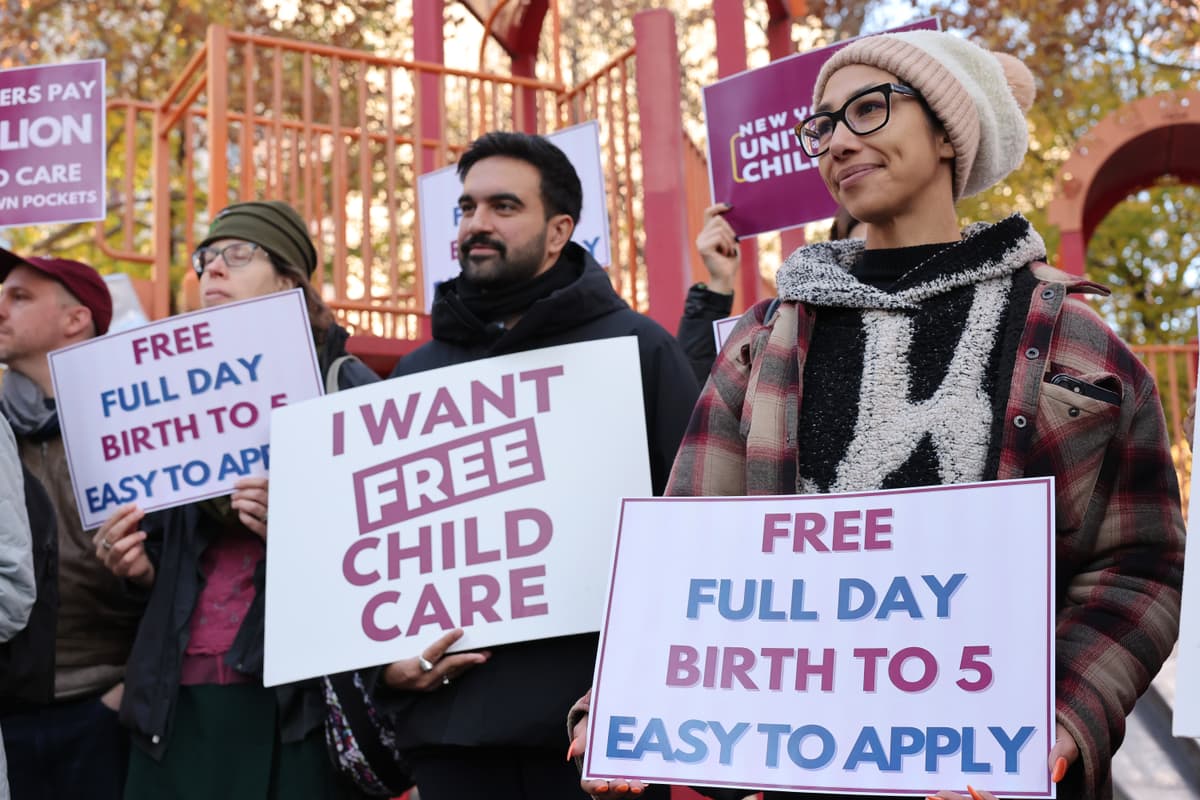

Michael M. Santiago/Getty Images
Demonstrators attend a press conference promoting universal child care at New York City on November 19, 2024. Michael M. Santiago/Getty Images

When New Mexico Governor Michelle Lujan Grisham unveiled a plan to provide every family in the state with free child care, regardless of income, it was presented as a first-of-its-kind experiment: universal early childhood services funded by a constitutional amendment that channels oil and gas revenue into a permanent early childhood trust.

The move has drawn attention well beyond the Southwest, arriving at a moment when American birthrates remain below replacement and many prospective parents cite money — not desire — as the biggest obstacle to having children.

“The cost of raising a child is a significant barrier,” a National Women’s Law Center spokeswoman, Sydney Petersen, tells the New York Sun. She points to recent polling showing that more than a third of adults of childbearing age say affordability is a major reason they aren’t having children. 

“For millions of families, child care, housing, and food costs have continued to outpace inflation, turning family formation into an economic calculation as much as a personal one.”

The Cost of Care and the Family Equation

Child care is among the largest household expenses in the United States. National estimates put the average annual price of center-based infant care above $11,000 — roughly 10 percent of a typical household’s income for one child alone. For single parents and lower-income households, that math becomes decisive: Families cut back on work, rely on informal care, or postpone adding children because the numbers don’t add up.

For people like the CEO of Moms First, Reshma Saujani, the New Mexico model is a welcome development. 

“America’s working families are not alright. And the number one expense breaking their budgets? Child care,” she tells the Sun. “This is why birth rates are falling. It’s not because people don’t want kids, it’s because they’re priced out of parenthood.”

In the United States, the total fertility rate has remained below the “replacement level” of 2.1 children per woman for over a decade. It stood at about 1.6, the lowest recorded level in the nation’s history, in 2023 before bouncing back slightly last year. 

Demographers note that financial strain — from housing costs to student debt to child care — is one of the most frequently cited reasons young adults delay or forgo having children, contributing to the sustained decline.

Those financial strains have a ripple effect on health and development. Evidence summarized by advocates and researchers links stable, affordable care and the income stability that accompanies it to better parental mental health and stronger child outcomes. 

“Families need both adequate income and caregiving supports for their families to thrive,” Ms. Petersen says.

She points to the 2021 expansion of the Child Tax Credit as an example of a cash-style intervention with measurable effects. It temporarily increased payments to families, made the benefit fully available to the lowest-income households, and delivered monthly installments instead of a single annual refund. 

During the year it was in place, child poverty rates fell by nearly half, food insecurity declined, and families reported being better able to cover rent, utilities, and other essentials. When the expansion expired at the end of 2021, child poverty rates quickly rebounded. 

“Most strikingly, it drastically reduced child poverty rates while it was in effect,” Ms. Petersen says.

New Mexico’s approach removes means testing and the paperwork that can deter families from applying. Its architects say universal eligibility reduces stigma and builds broader political support — the logic that made programs like Social Security durable.

“Child care is the linchpin of economic security. Without it, families can’t work, and without working families, our economy doesn’t work,” Ms. Saujani continues. “Until we stop treating child care like a personal problem and start treating it like an economic imperative, families will continue to put off the children they want.”

Limits of Subsidizing Care Alone

Not everyone agrees that subsidizing care is enough to reverse demographic trends or improve children’s well-being. A fellow at the Ethics and Public Policy Center, Patrick Brown, cautions that the evidence tying child care costs to fertility decline is “pretty slim.” 

International examples, he argues, suggest that universal child care can help the most disadvantaged children but may have “negative outcomes for children from middle- and upper-middle class families.”

Critics such as Mr. Brown emphasize that these programs primarily make it easier for parents to work rather than directly improving long-term educational outcomes.

Subsidized care helps lower-income parents stay in the workforce, but for children from middle- and upper-middle-class families, universal access alone doesn’t guarantee better learning or development. Without high-quality educational content, these programs mainly reduce financial barriers rather than directly boost child outcomes.

From Mr. Brown’s viewpoint, the New Mexico model should not be mistaken for a national blueprint. 

“The New Mexico example is virtually non-reproducible because they are using their state funds generated from oil and gas revenue to pay for their expansion,” he says. “Few other states have such a windfall to devote to expanded child care, even if they wanted to.” 

Even in New Mexico, families often face a shortage of available childcare slots, revealing the limits of financing a program without a parallel workforce expansion.

A Services Versus Cash Experiment

In Flint, Michigan, officials are approaching the problem differently. The 79,000-population city recently began offering cash transfers timed to coincide with pregnancy and infancy. Known as the “Rx Kids” model, the program provides unconditional payments of $1,500 a month during pregnancy and $500 per month throughout a baby’s first year. 

Unlike traditional assistance programs, the funds come without restrictions, allowing families to decide whether to spend the money on food, rent, transportation, baby supplies, or debt payments — whatever eases their household strain.

Studies by GiveDirectly, a non-profit providing direct cash transfers to impoverished people in developing countries,  found that this approach delivered measurable improvements.

Mothers receiving payments experienced lower rates of preterm birth and low birthweight, two leading causes of infant mortality. And the need for neonatal intensive care admissions dropped significantly, which researchers linked directly to a reduction in costly complications around birth. 

The organization also documented a decline in postpartum depression symptoms among mothers, suggesting that reduced financial stress improved mental health outcomes during a particularly vulnerable period.

Those improvements carried fiscal implications: The authors estimated that the savings from fewer NICU stays and related interventions could offset a meaningful portion of the program’s upfront costs, strengthening the case that cash transfers in early life can produce both social and economic returns.

Mr. Brown sees this model as far more promising for other states. 

“The Flint experiment is much more interesting, and could show a model of pre-birth, pro-parent support that other states and localities should consider investing in, either with private philanthropy or public dollars,” he suggests. 

Unlike New Mexico, he argues, it doesn’t hinge on volatile fossil fuel revenues or assume every family wants to use center-based care.

Scaling, Politics, and Practical Limits

Scaling either child care subsidies or cash payments nationwide would require sustained funding through new taxes, budget reallocations, or federal partnerships. Analysts say a universal child care system could cost hundreds of billions of dollars annually if extended nationwide, while a nationalized version of Flint’s model would carry multi-billion-dollar price tags. 

In both cases, lawmakers would face trade-offs: Dedicating funds to early childhood support could mean diverting resources from other priorities, such as healthcare, housing, or infrastructure, unless new revenue streams were secured.

Mr. Brown also warns that “universal child care only provides benefits to parents who want to use child care — meaning parents who want to work flexible hours or stay home don’t receive the same level of public support.”

In his view, cash offers a more flexible, targeted way to reduce hardship without trying to graft a universal system onto states that lack the resources to sustain it.

At the federal level, scaling either approach would carry significant budgetary implications. A universal child care guarantee has been estimated to cost anywhere from $42 billion to more than $200 billion annually, depending on the level of subsidy and coverage. 

A national rollout of Flint’s “Rx Kids” cash transfer model would require an estimated $27 billion annually, based on the 2023 United States birthrate of 3.6 million and the $7,500 provided per mother-child pair through the program. 

The Flint program itself has an estimated five-year budget of $55 million, with more than $43 million raised to date. By mid-2025, it had already distributed over $10 million in payments to more than 2,500 families.

The Common Thread

Despite differences in approach, both New Mexico and Flint illustrate how the economics of parenthood shape family decisions. Programs that reduce financial strain — whether through universal care, direct cash, or a combination of the two — have been associated with improvements in health outcomes, lower stress and in some cases, public savings.

New Mexico’s initiative highlights the potential of universal care, while also revealing the limits of relying on resource-dependent funding. Flint’s program demonstrates the flexibility of direct payments and their potential for replication in other settings.

“Until we shift the culture and treat child care like an economic issue that demands government investment, we’ll keep managing the crisis instead of solving it,” says Ms. Saujani.

“New Mexico and Flint have shown us what’s possible when care is funded like the public good it is. The only question is whether the rest of America is ready to follow their lead.”


The New York Sun

© 2025 The New York Sun Company, LLC. All rights reserved.

Use of this site constitutes acceptance of our Terms of Use and Privacy Policy. The material on this site is protected by copyright law and may not be reproduced, distributed, transmitted, cached or otherwise used.

The New York Sun

Sign in or  create a free account

or
By continuing you agree to our Privacy Policy and Terms of Use