
The Dangerous Pitfalls of America’s Alliance With a Former Syrian Terrorist

‘We think we can work with terrorists to fight terrorists, but their difference is like between vanilla and French vanilla,’ an analyst says.
AP/Jacquelyn Martin
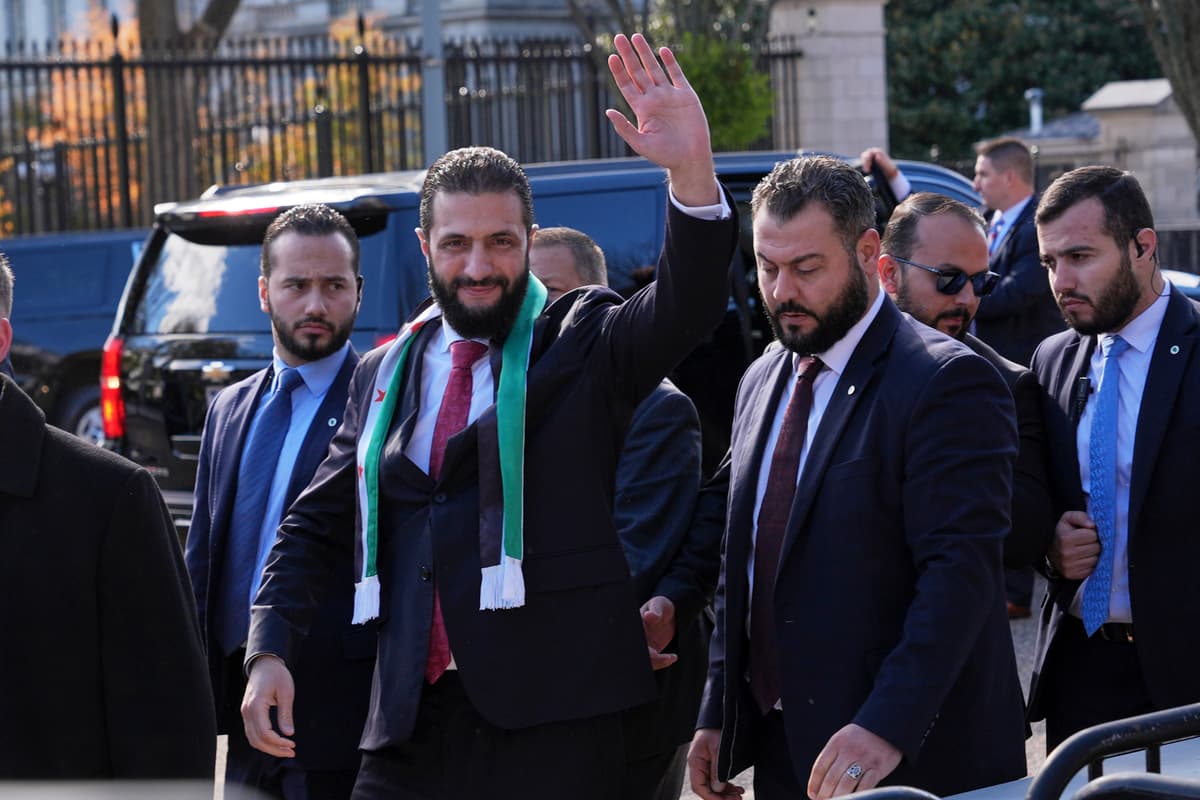
President Ahmed al-Sharaa waves as he greets supporters outside of the White House, November 10, 2025, at Washington. AP/Jacquelyn Martin

America’s attempt to ally with a former Islamist terrorist, Syria’s Interim President Ahmed al-Sharaa, could emerge as a new chapter in a long tradition of getting lost on the road to Damascus.

Questions about the alliance with Mr. Sharaa and his backers come to focus this week in the aftermath of a deadly attack near the Syrian city of Palmyra. An unidentified Syrian shooter killed two Iowa national guardsmen and an American interpreter, injuring three other Americans.

Damascus officials identified the shooter as a member of the Syrian armed forces. President Trump, thigh, said the incident had “nothing to do” with the Syrian government.      

Mr. Trump’s Syria point-man, the American ambassador to Turkey, Tom Barrack, shuttled across the region this week. He consulted Ankara’s foreign minister, Hakan Fidan, on Tuesday. A day earlier he met Prime Minister Benjamin Netanyahu at Jerusalem. It was a “Constructive dialogue working towards regional peace and stability,” the ambassador said. 

In Israel, though, fears grow that neither peace nor stability are possible. Sympathy with Hamas, hostility to Israel, and calls to annihilate Jews dominated last week’s Damascus marches marking the new regime’s first anniversary in power. At Washington, meanwhile, concerns grow over the prevalence of committed Jihadists inside Mr. Sharaa’s inner circles. 

A year ago, Mr. Sharaa overthrew the brutal Tehran-backed regime of Bashar Assad in a 12-day Turkish-backed blitz. At that time, known in his nom de guerre, Abu Mohammad al Joulani, he led an Al-Qaeda offshoot, Hayyat Tahrir al Sham. Now Washington is embracing Mr. Sharaa. In a widely-shared video titled “work hard, play hard,” the new Damascus strongman flaunted his basketball skills alongside the commander of the U.S. Central Command, Admiral Brad Cooper.

Mr. Barrack seems closely allied with Mr. Sharaa’s top backer, Turkey. “Israel can claim it is a democracy, but in this region, what’s worked the best, whether you like it or you do not like it, is a benevolent monarchy,” Mr. Barrack said recently. It was seen to some as an endorsement of President Recep Tayyip Erdogan’s increasingly dictatorial rule. 

Mr. Barrack should represent America “not the interests of another country,” a Turkey watcher at the Foundation for Defense of Democracies, Sinan Ciddi, says. In Turkey, Syria and Lebanon, he added, the Lebanese-born former business associate of President Trump, Mr. Barrack, “is trying to rewrite the rule book for the U.S.” 

Messrs. Erdogan and Barrack strongly endorse the Syrian military force — a ragtag group of undisciplined gangs, some of whom are motivated by bloodlust and hatred of minorities, non-Sunnis, and atheists. It is unclear how much control Damascus has over those groups, and Mr. Sharaa’s associates might have even encouraged this summer’s massacres of minority Druze and Allawaites.

Washington and Damascus accuse the evidently-resurgent Islamic State of murdering the three Americans in Syria. Yet can people who only recently were committed to Al Qaeda’s world view now be trusted to ally with America to combat ISIS and other Islamist enemies of the West?

“We think that we could work with jihadists to fight jihadists?” the editor of the Long War Journal, Bill Roggio, says. The difference between anti-American Mideast groups, he adds, is “just like between vanilla and French vanilla.”

Syria’s Previous Evil

The Guardian newspaper this week reported on the new life of Syria’s former president, Bashar Assad and family at Moscow, where the Butcher of Damascus renewed a career as an ophthalmologist. Outside his Russian elite clientele, though, Mr. Assad is widely seen as a war criminal who is responsible for the deaths of hundreds of thousands of Syrians. 

Yet when he assumed power after the death of his father, Hafez Assad, in 2000, many Washington admirers praised the younger Assad as a London-educated eye doctor with an affinity for computer games. They predicted he could turn Syria into an American ally. That hope quickly fizzled but even as he was butchering rebellious Syrians, Mr. Assad’s wife, Asma, was the subject of an adoring front page profile in Vogue magazine.

Switching Alliances

After the Assad regime, hopes rose again that Syria would sever ties with Russia, the Islamic Republic of Iran, and Hezbollah. Mr. Sharaa, though, met President Vladimir Putin at Moscow in October. And although Damascus publicized its interceptions of Iranian arms deliveries to Hezbollah, habits die hard. The Syrian army only loosely controls the border with Lebanon, and smugglers who had long profited from the weapons trade are reportedly at it again, to Hezbollah’s and Iran’s delight. 

The Kurds, America’s Allies

Unlike Mr. Sharaa’s undisciplined army, a mostly-Kurdish military unit known as the Syrian Democratic Forces was trained by and fought alongside Americans against ISIS for more than a decade. According to an agreement reached in March, though, the SDF is to merge with the national military, which would force the Kurds to cede their arms. 

One of the topics Mr. Barrack discussed at Ankara on Tuesday was reportedly Turkey’s endorsement of the disarming of the SDF. The Kurdish forces have roots in a former Turkish separatists group, the PKK. While designated as a terrorist, that group’s long-incarcerated leader, Abdullah Ocalan, has recently made peace with Mr. Erdogan.

Yet Mr. Ocalan advises the Syrian Kurds against laying down their arms. “Even Ocalan, a convicted terrorist, doesn’t trust Shara to be a competent and non-dictatorial leader enough to ask the SDF to disarm — just let that sink in,” the FDD’s Sinan Ciddi says.

Peace With Neighbors?

Celebrating his rise to power last December, Mr. Sharaa vowed to seek a regional “peaceful coexistence.” The marches at Damascus, though, prominently featured calls of “Khaybar Khaybar ya Yahud,” an allusion to Mohammed’s seventh century annihilation of a Jewish tribe at Khaybar. 

“A year ago, when the Assad regime fell and the Iranian presence was dismantled, there was a moment of optimism,” the founder of northern Israel’s Alma Research Center, Sarit Zehavi, says. “Today, I am much less optimistic. It appears we have simply traded one radical ideology for another. The Shiite radicalism of the Iranian axis has been replaced by the Sunni radicalism of the Muslim Brotherhood and Al-Qaeda.” 


The New York Sun

© 2025 The New York Sun Company, LLC. All rights reserved.

Use of this site constitutes acceptance of our Terms of Use and Privacy Policy. The material on this site is protected by copyright law and may not be reproduced, distributed, transmitted, cached or otherwise used.

The New York Sun

Sign in or  create a free account

or
By continuing you agree to our Privacy Policy and Terms of Use