

‘The Honey Trap’ Is a Tale of Sex and War, Set at Northern Ireland in the Time of Troubles

The new play explores the after-life of the Troubles after the guns have gone quiet at Belfast.
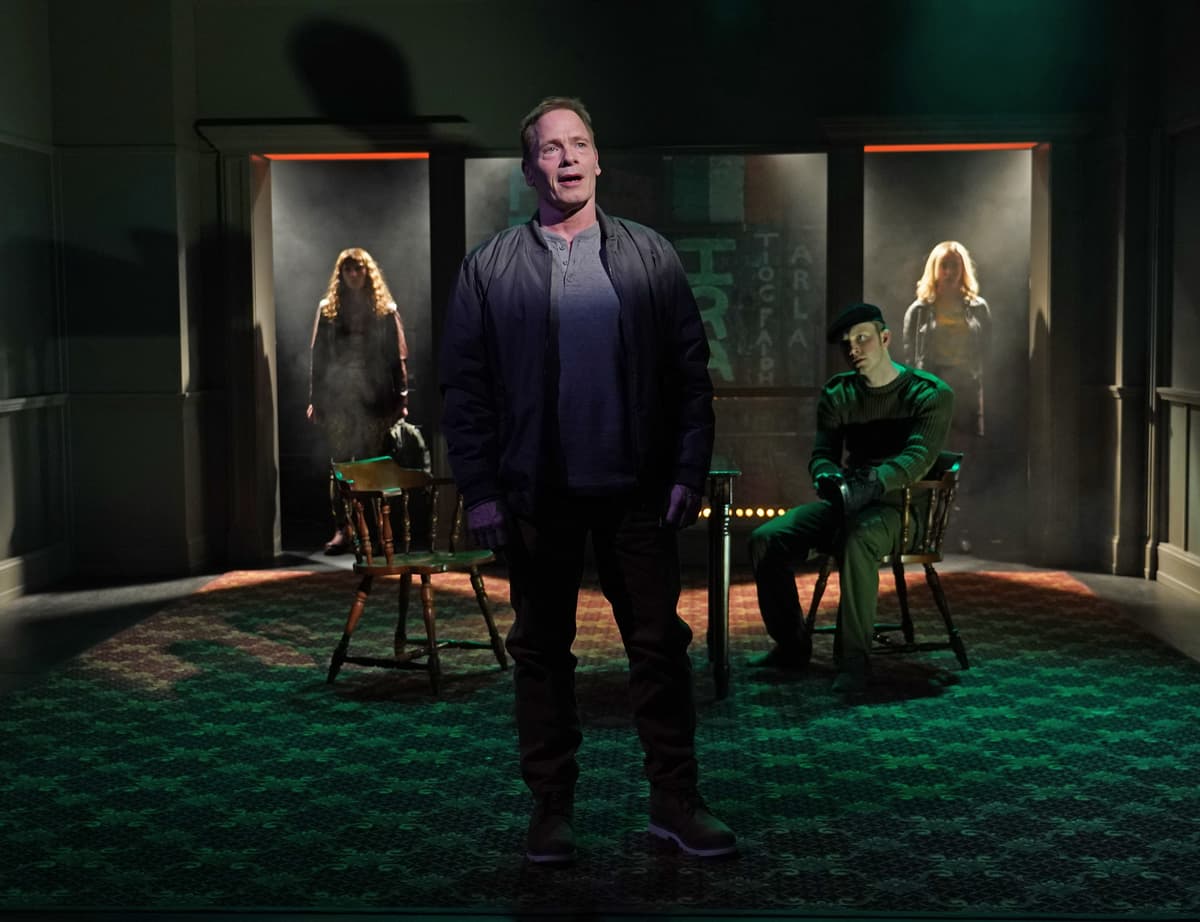
Carol Rosegg via Irish Repertory Theatre
Doireann Mac Mahon, Michael Hayden, Harrison Tipping, and Annabelle Zasowski in Irish Rep's 2025 production of 'The Honey Trap.' Carol Rosegg via Irish Repertory Theatre

“The Honey Trap” at the Irish Repertory Theater, is a ghost story without the comfort of the supernatural. Its hauntings are human. Honey may be sticky, but history is a trap, especially at Belfast, where a 30 year conflict known as “The Troubles” was fought over the fate of Northern Ireland. The clash was between unionists loyal to the Crown — mostly Protestants — and republicans, largely Catholic, who pined for a united Ireland.

Peace came after years of blood in the form of the Good Friday Accords brokered by, among others, President Clinton and Prime Minister Tony Blair, who now has his eyes set on Gaza. “The Honey Trap” toggles between 1979 — a few years earlier 1972 was the conflict’s bloodiest year — and the early 2000s. Its central scene finds two British soldiers, Bobby (Harrison Tipping) and Dave (Daniel Marconi) — “squaddies” —  out at a pub on a Friday night.

Dave, who at 24 years old is a grizzled veteran of West Belfast’s riots, takes Bobby, only 21 and new to the guerrilla conflict, under his wing. Though both are married, they are also young and one edge from the work of suppressing — or guarding, take your pick —  a riven population that seethes at their presence. Two girls, Lisa (Annabelle Zasowski) and Kirsty (Doireann Mac Mahon), a blonde and a brunette, catch their eyes. It proves to be a fatal encounter.

Lisa and Kirsty —those are their noms de guerre — are also soldiers of a different stripe. They are in the Irish Republican Army, a republican paramilitary organization that sought, by means bloody and brutal, to unite the six northern counties that were partitioned to Great Britain in 1921 with the 26 counties of the Republic of Ireland in the south. Bobby is lured to an apartment on Belfast’s fringes, where balaclava-clad men execute him.

Dave’s lucky break — he leaves the bar early, though no virtue of his own — is also a ticket to a lifetime of torment and coruscating regret. The play begins with Dave participating in the “Belfast Project,” also called the “Boston Tapes,” an oral history initiative initially headquartered at Boston College. Confidential testimony was collected from people on both sides of the conflict, with the promise that it would be released only after participants’ death.

Dave is interviewed by Emily (Molly Ranson), an Irish-America graduate student of persistent earnestness. Soon Dave learns that Emily’s dictaphone contains clues to divine the identities, three decades later, of the two girls who ended Bobby’s life and warped his into a tightly bound ball of rage. The second act of “The Honey Trap” tracks Dave’s quest — revved up by revenge — to crack the cold case. It’s back to Belfast, the scene of the crime.

Some of this material will be familiar to fans of Patrick Raden Keefe’s “Say Nothing” or the television series on which the book is based. The play knowingly alludes to that precedent when Dave and Lisa — whose real name is Sonia — encounter each other in the play’s present. “Whatever you say, you say nothing,” Sonia tells Dave of the ethos that prevails in Belfast. That adage comes from a poem by the Northern Irish Nobel laureate, Seamus Heaney — a Catholic.

The “Honey Trap” is written by Leo McGann and directed by Matt Torney, both of whom hail from Belfast. The play feels new, though, for being told from the perspective of a British soldier. Especially given that it’s staged at the Irish Rep, where posters of William Butler Yeats festoon the walls. The set by Charlie Corcoran and Michael Gottlieb’s lighting effectively evoke the nightmare-like flashbacks to a Belfast gashed by guerrilla warfare.

Memory, though it sears both Dave and Sonia well into middle age, proves to be a slippery thing. They both are lying — to themselves and others — about what happened that night in the bar. In a twist simultaneously far-fetched and inevitable, the two veterans find themselves for a second time dancing the dance of sex and violence. “The Honey Trap” is about Ireland, but also about aging, regret, and how loss and lust survive the wars and scar the peace.                         


The New York Sun

© 2025 The New York Sun Company, LLC. All rights reserved.

Use of this site constitutes acceptance of our Terms of Use and Privacy Policy. The material on this site is protected by copyright law and may not be reproduced, distributed, transmitted, cached or otherwise used.

The New York Sun

Sign in or  create a free account

or
By continuing you agree to our Privacy Policy and Terms of Use