The Israel Philharmonic at Carnegie Hall Marks the Return of Hostages With Music from Zion — and Tchaikovsky
The program eschewed politics but was nevertheless buoyed by joy at the return of the Jewish state’s living captives.
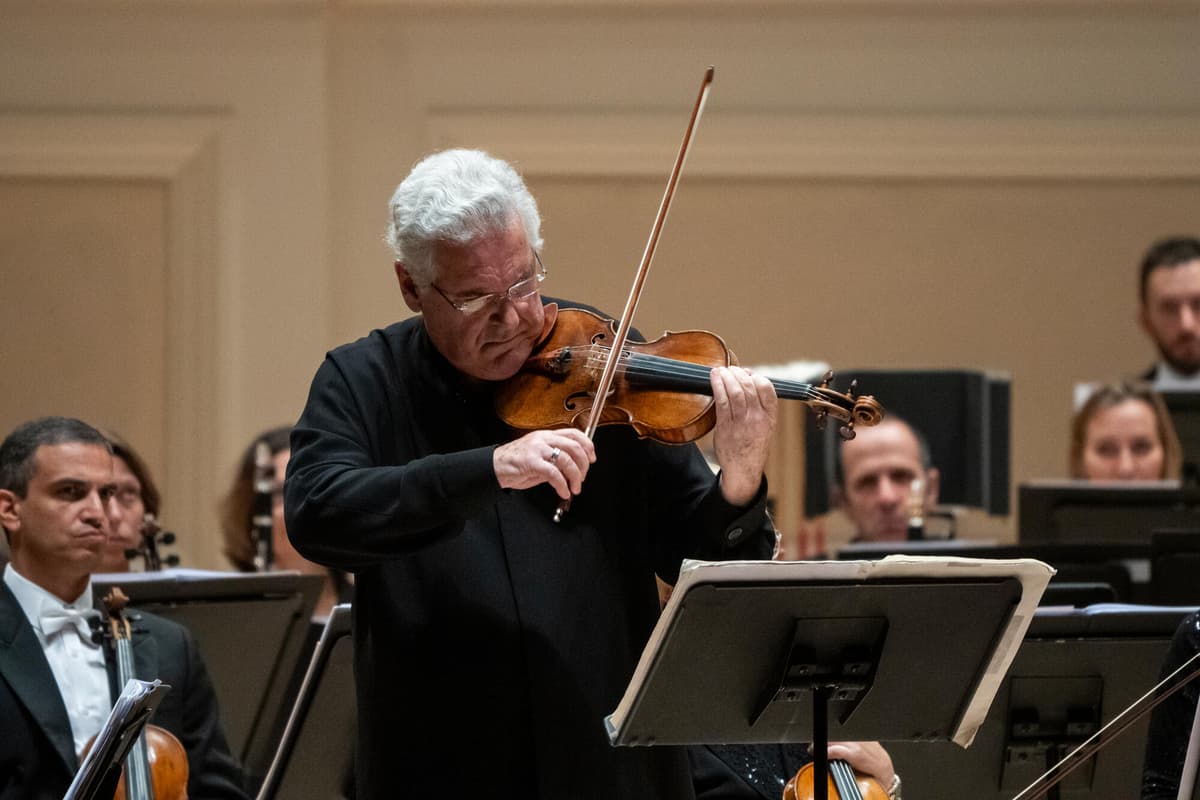

The performances at Carnegie Hall last week by the Israel Philharmonic marked — in string, brass, and percussion — a joyous time in the annals of the Jewish state. The program nowhere touched on politics and “Hatikvah” was not heard but the notes seemed buoyed by the return of 20 living hostages from the clutches of Hamas. If Theodor Herzl were in attendance he might have nodded his great beard in pleasure and murmured “yes — this is what I imagined.”
The Philharmonic was founded in 1936 as a haven for Jewish musicians fleeing Europe. Its first concerts were conducted by Toscanini and featured music by Richard Wagner. Since Kristallnacht, though, the German’s oeuvre has been banned. On the program at Carnegie Hall was Sergei Prokofiev’s “Overture on Hebrew Themes,” a violin concerto by Paul Ben-Haim, and Pyotr Tchaikovsky’s “Symphony No. 4 in F Minor.”
The “Overture” was a collaboration between Prokofiev and a sextet of Jewish musicians, Zimro, whose ambition was to build in Israel a “Temple of Jewish Art.” That did not happen, but the overture, in sonata form, is a delicate distillation of Jewish themes, melding klezmer melodies with passages that seem drawn from the rhythms of prayer. Prokofiev fled the Soviet Union in 1917, eventually alighting at New York City.
Ben-Haim’s violin concerto was played here by the maestro Pinchas Zukerman. Born Paul Frankenberger at Munich, he won the Israel Prize in 1957. The following year Leonard Bernstein conducted the piece reckoned his greatest, “The Sweet Psalmist of Israel,” at Carnegie Hall. Bernstein said of Ben-Haim’s work that it is “universal in its approach as the music of Bartók; full of ideas as the music of Stravinsky” and “undoubtedly Israeli.”
That Israeliness can be detected in the concerto’s second movement, which echoes Ben-Haim’s “Songs Without Words” — the Hebrew word for that is niggun — and “Berceuse Sfaradite.” Both are influenced by Mizrahi music, sounds that echo from the diasporas of Spain and Syria, Iraq and Yemen. The concerto was performed in 1968 to mark the 20th anniversary of Israel’s founding. Bernstein conducted, with Itzhak Perlman starring.
Mr. Zukerman, who has plied his trade at the sonic summit for some five decades, performs with a dignity and precision that feels courteous and sure-handed. He formed an engaging contrast with the Israel Philharmonic’s music director, Lahav Shani, a prodigy who will soon take over as the chief conductor of the Munich Philharmonic. He is coiled and kinetic. A moving moment was when the two performed a lullaby from Mr. Zukerman’s youth.
The showstopper, though, was Tchaikovsky’s “Symphony.” It is titanic and stormy, moody in the way that the planet Saturn’s “great white spots” suggest turbulence on a grand scale. The Russian Romantic described its introductory notes as capturing the “fatal force” that upends our “striving for happiness,” His pursuit of that goal was marred by depression and tragedy, even as he crafted triumphs like “Swan Lake” and “The Nutcracker.”
The Israel Philharmonic’s founder, Bronislaw Huberman, vowed “to unite the desire of a country for an orchestra with the desire of the Jewish musicians for a country.” To be an Israeli artist these days is a revolutionary act in a world marred by boycotts and hostility toward the Jewish state. The ferocity with which cultural spaces have sided with barbarism makes Israel’s commitment to the sounds of civilization all the more splendid.