The Other Stake in the War in Ukraine — and Why Zelensky Fights

The West speaks with double meaning.

Omer Messinger/Getty Images
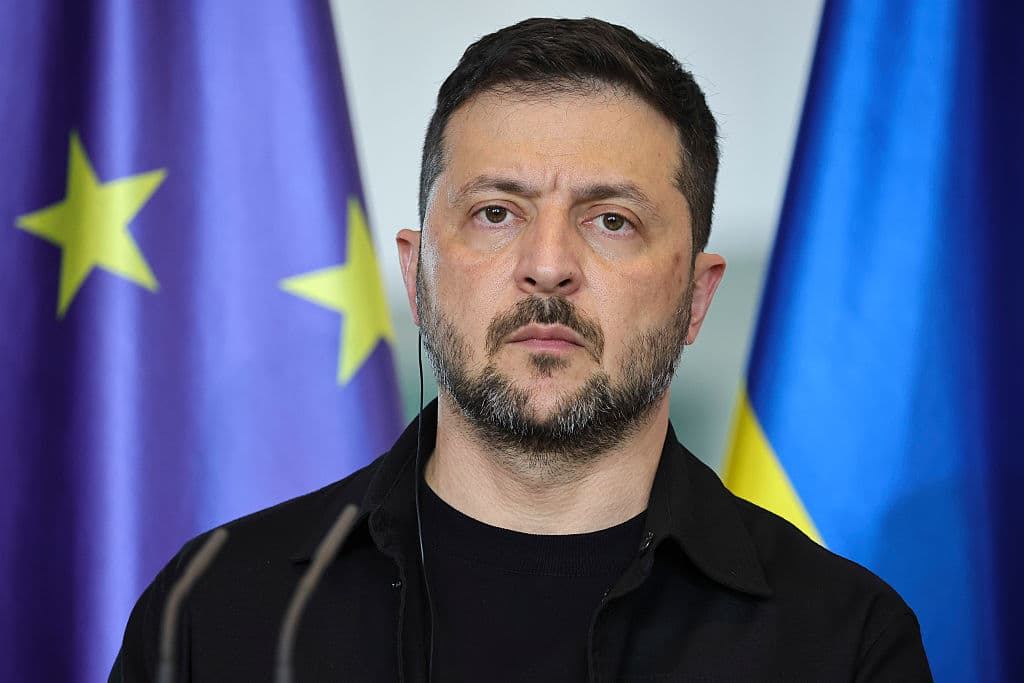
President Zelensky listens as German Chancellor Friedrich Merz speaks during a joint press conference at the Chancellery at Berlin. Omer Messinger/Getty Images

First certainty. Ukraine has not lost the war. Today it may find itself compelled to make a pact or, worse, to capitulate. It may be forced, if the United States abandons it and if Europe lacks the strength to step in, to give up the territories for which it has made so many sacrifices.

Yet I know the ground. I filmed, last March and April, in the areas of Pokrovsk and Sumy, and earlier still at Bakhmut or Chasiv Yar — some of the localities that the Kremlin boasts, morning and night, of having seized in bitter fighting. When it does seize them, they are tiny gains, meaningless. In most cases they are not even taken: One merely dispatches, for the time of a satellite photo, a motorized unit of 10 men whom the Ukrainian army swiftly puts to flight.

There is no Russian breakthrough — that is the truth. There is no retreat, still less a collapse, of President Volodymyr Zelensky’s army. Its commanders are exhausted, of course, but less so than those on the other side. The 20 percent of territory Russia holds today — territory it wants handed to it in a “peace deal” cobbled together by Presidents Trump and Vladimir Putin — was already, for the most part, under its control before the start of the full-scale invasion.

Are we really going to give diplomatically to Mr. Putin what he failed to take militarily? Can one, when the front line has barely shifted in three and a half years of atrocious war, demand that men who have fought with such endurance and heroism now lay down their arms? That would be a first. 

***

Second certainty. The Anchorage summit, in Alaska, was Munich — but worse. At Munich, after all, one did not yet know quite fully of what Hitler was capable. One had an idea. The most clear-sighted among our elders had understood that he was the name of an unprecedented and imminent global disaster. It was 1938, though, and one could still, I suppose, take him at his word when he claimed his appetite for conquest would stop at the Sudetenland or, perhaps, Austria.

In 2025, by contrast, all the cards are on the table. No one can ignore who Mr. Putin is (the head of a terrorist state) or the crimes he has already committed (three and a half years of relentless bombing of Ukrainian cities and their civilians). One must be blind, naïve, or in bad faith to believe for a single instant that vast Russia (the largest country on earth) unleashed this global cataclysm (disastrous also for itself) with no greater ambition than to seize the minuscule Donbas (barely one thousandth or two thousandths of its territory).

Mr. Putin’s war aim — no one is ignorant of it — is Ukraine. His obsession, scarcely hidden, is the destabilization of a Europe whose democratic radiance he sees as an existential threat. And the struggle of his life — he says it, repeats it every year in his speech to the Valdai Club, Russia’s mini-Davos — is to humiliate an America he holds responsible for the collapse, 35 years ago, of his cherished Soviet Union.

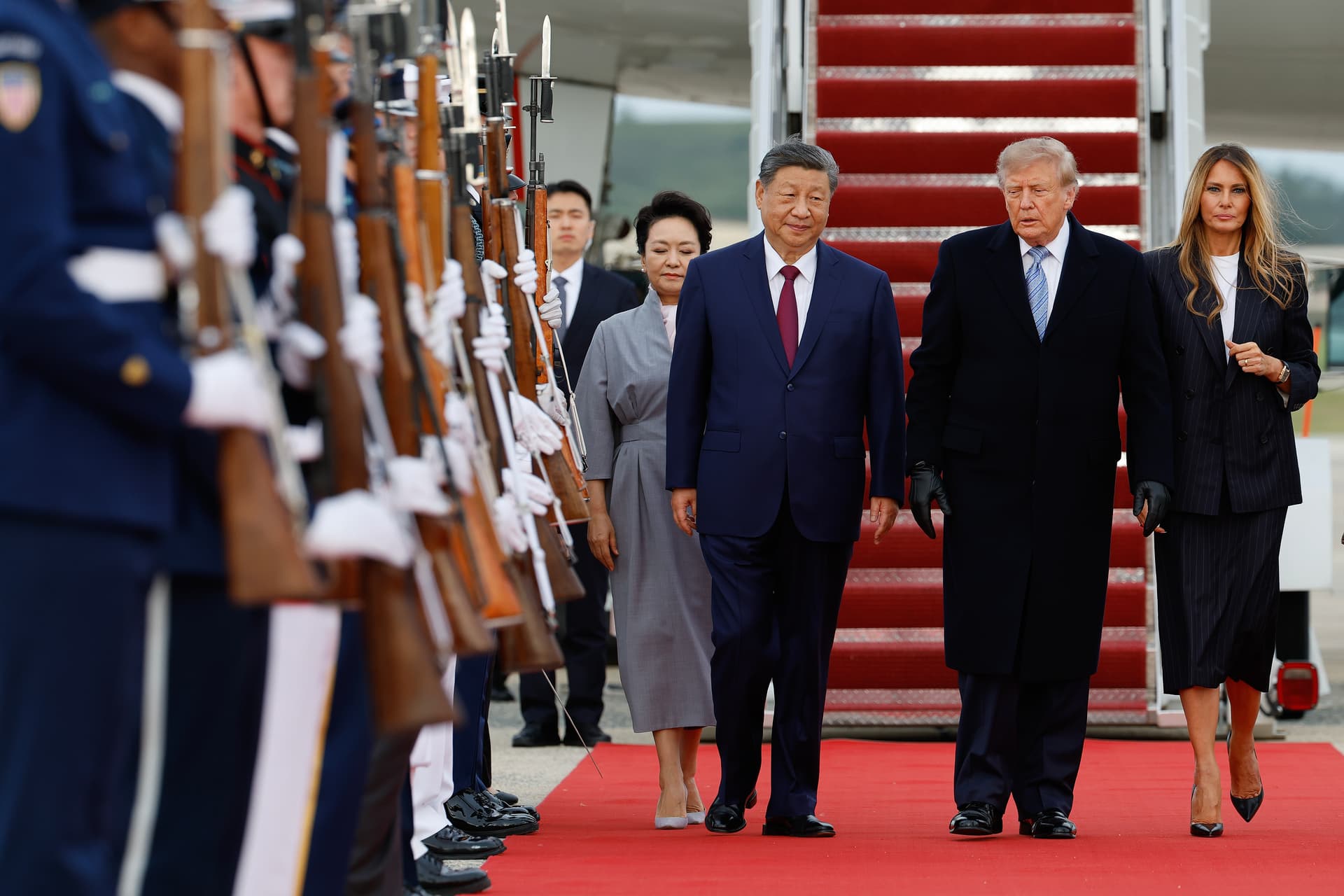
This is the man Mr. Trump welcomed. This is the man whom Reagan’s successor applauded as he stepped off his plane. This is the man for whom American soldiers, on their knees, rolled out the red carpet. Munich, but worse.

***

The uncertainty, however, is Europe — and, beyond Europe, the “coalition of the willing” formed six months ago, whose representatives, President Emmanuel Macron foremost among them, are arriving, as I write, at Washington.

Will they merely be there to support Mr. Zelensky in his renewed confrontation with Mr. Trump — Mr. Zelensky who, the first time, on February 28, 2025, resisted so stoutly, alone, the attempt to break him? Or have they come to declare that the rest of the free world has grasped the importance of the stakes, the historic character of the moment, and the urgent necessity to speak with an autonomous voice, to take up the torch of values that the leader of the world’s first democracy seems ready to let die out, and, for now, to build a sovereign defense?

God knows how much I love America, and how much I have believed, and still believe, in the grandeur of that slow movement of civilization called the West — a movement that began at Rome, and, before that, at Troy and Jerusalem; that passed through the Renaissance and then the Enlightenment; and that blossomed in the invention and, until yesterday, in the triumph of that “Europe 2.0” that was New England.

Yet one must face facts: The West, for some time now, speaks with a double meaning. It is dividing — lamentably, tragically — in two. And its very idea will sink if those who are, at this moment, traveling to America from Europe do not tomorrow succeed in the harder return journey, bringing back, at least for a time, the Western flame to its home. This is the other stake of the war in Ukraine. And this too is why Mr. Zelensky, the great European, fights.


The New York Sun

© 2025 The New York Sun Company, LLC. All rights reserved.

Use of this site constitutes acceptance of our Terms of Use and Privacy Policy. The material on this site is protected by copyright law and may not be reproduced, distributed, transmitted, cached or otherwise used.

The New York Sun

Sign in or  create a free account

or
By continuing you agree to our Privacy Policy and Terms of Use