The Reckoning on Tariffs

A federal appeals court is set to decide whether President Trump has the authority on trade that he has been exercising unilaterally.

Andrew Harnik/Getty Images
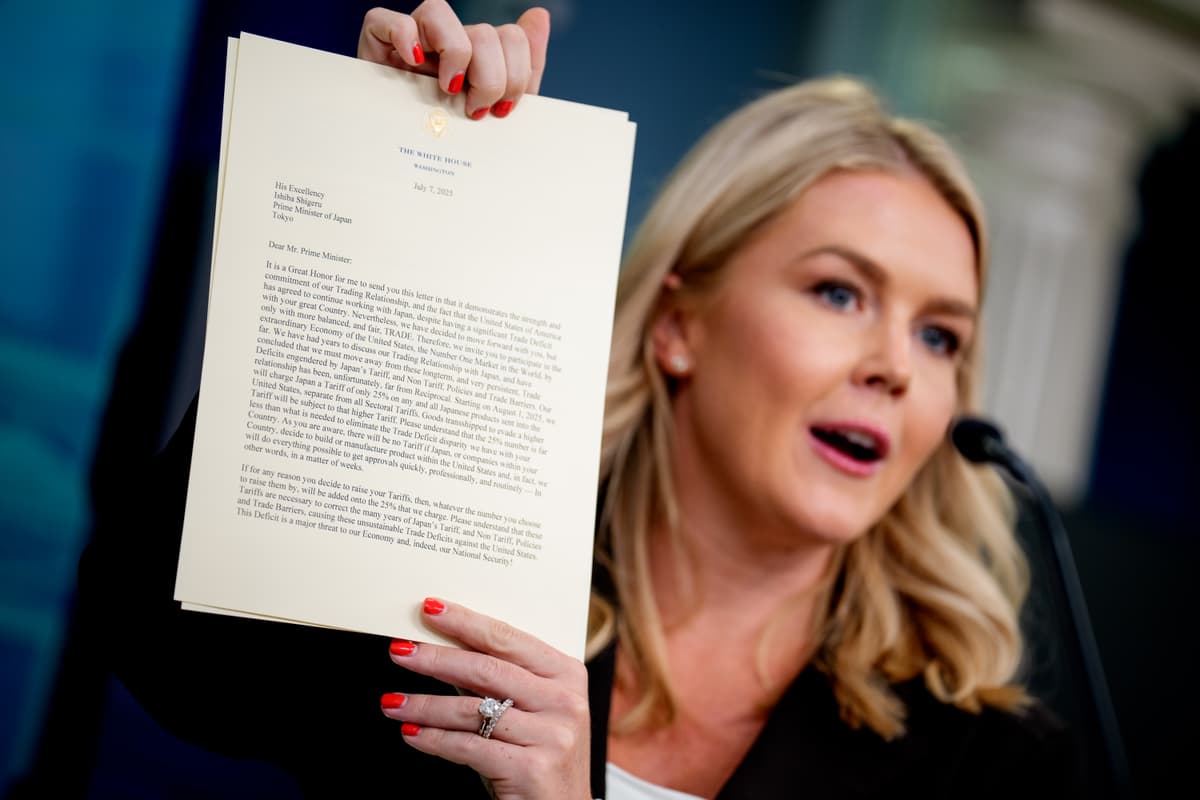
White House press secretary Karoline Leavitt holds up a copy of a letter from President Trump to Japan on July 7. 2025, announcing plans to introduce a 25 percent tariff beginning on August 1. Andrew Harnik/Getty Images

With President Trump ratcheting up tariffs on America’s trading partners, his power to set the import levies faces a day of reckoning in the federal courts. On July 31, the day before some of the tariffs are slated to go into effect, the riders of the Federal Circuit will hear arguments in a case brought by importers and several Democratic-led states who say that Mr. Trump lacks authority under law or the Constitution to be unilaterally imposing the levies.

The case, which touches on questions like the scope of presidential power and the constitutional doctrine of separated powers, could prove to be among the most important yet for Mr. Trump in a term that has already seen its share of courtroom drama. That’s in part because, as Harvard Law’s Jack Goldsmith has explained, the tariff issue is “hard and close.” Even some conservatives express doubts, in what the Times called a “fiery brief,” over his power to set tariffs.

Faced with such rhetoric, the recommendation from these columns was “to keep one’s constitutional cool.” That’s partly because Mr. Trump has a track record of defying the expectations of so-called legal experts, left or right, when it comes to the finer points of constitutional construction. Feature, say, the effort by several states and some of the finest minds in the law to disqualify, under the Fourteenth Amendment, Mr. Trump from the ballot.

The early innings of the tariff case were before a little-known federal tribunal at New York, the Court of International Trade. A three-judge panel, including nominees of Mr. Trump and Presidents Reagan and Obama, ruled that the president lacked “unbounded authority” to set tariffs. That was even though Congress, which holds “power to lay and collect taxes, duties, imposts, and excises,” has delegated away much of this power.

The trade court ruled that “an unlimited delegation of tariff authority would constitute an improper abdication of legislative power to another branch of government.” The ruling, which threatened to upend Mr. Trump’s use of tariffs as a policy tool, was appealed to the Federal Circuit. The circuit riders paused the ruling and will now weigh if the International Emergency Economic Powers Act of 1977 gives Mr. Trump the power he has been using. 

To be sure, as the trade court noted, the Framers gave Congress the tariff power. Yet after the Smoot-Hawley tariff, lawmakers seemed to lose interest in this tool, passing a series of measures to give the president wide discretion to impose tariffs. Mr. Trump is making the most of the opportunity, though in some cases, like his tariffs on Brazil over the prosecution of its former president, Jair Bolsonaro, the tool appears an inapt means to address a reasonable concern.

The importers suing over the tariffs, in V.O.S. Selections v. United States, contend that the 1977 law in question doesn’t even contain the words “tariffs, duties, imposts, or taxes,” and that “no other President” has sought to deploy it to impose tariffs. Mr. Trump avers that the law allows him to “regulate” trade, and that “includes the power to tax goods through tariffs.” However the circuit riders resolve the case, the dispute is likely headed to the Supreme Court.

The high court, though, has already passed on the opportunity to fast-track a related tariff case. That suggests the Nine is skeptical of the arguments by some on the right that Mr. Trump’s enthusiasm for tariffs is symptomatic of a runaway chief executive. The high court’s wait-and-see approach lends credence to the notion that the tariff tumult is ultimately a political question that will need to be sorted out between the president and the Congress.


The New York Sun

© 2025 The New York Sun Company, LLC. All rights reserved.

Use of this site constitutes acceptance of our Terms of Use and Privacy Policy. The material on this site is protected by copyright law and may not be reproduced, distributed, transmitted, cached or otherwise used.

The New York Sun

Sign in or  create a free account

or
By continuing you agree to our Privacy Policy and Terms of Use