
‘The Roosevelts in New York City’ Is an Exhilarating Climb in a Towering Family Tree

A Pulitzer Prize-winning journalist invites readers to walk in the footsteps of the famed New York City family.
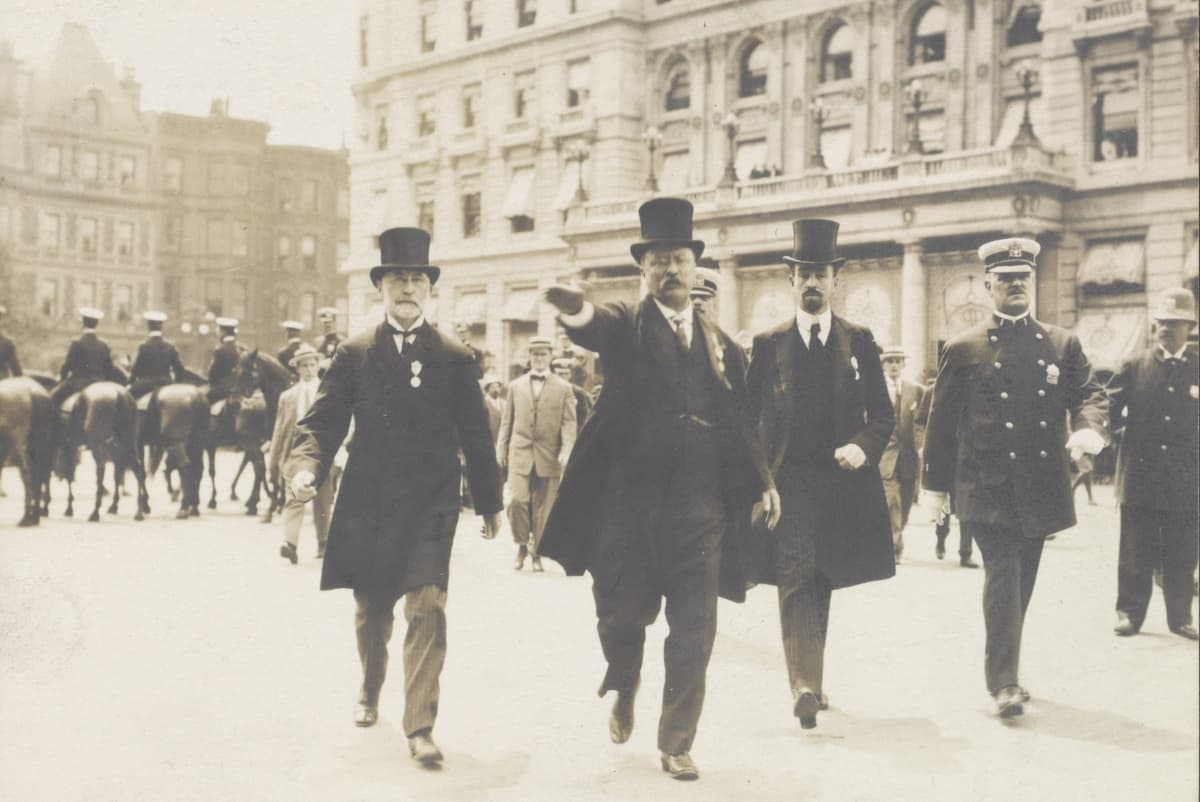
Library of Congress via Wikimedia Commons
President Theodore Roosevelt walking in a homecoming parade at New York City in 1910. Library of Congress via Wikimedia Commons

‘The Roosevelts in New York City’
By Bill Bleyer
The History Press, 240 pages

With “The Roosevelts in New York City,” Bill Bleyer invites readers to walk in the Roosevelt family’s footsteps and draw inspiration from their journeys. He maps the streets where the first Roosevelts plowed their fields and points out addresses where descendants lived, loved, and worked. Some spots are marked. Others hide in plain sight.

A Dutch farmer, Nicholas Maartenszen van Rosenvelt, planted the roots of an American dynasty in what was then New Amsterdam. A backwater village at the time, it would one day be what the jazz legend Edward “Duke” Ellington called “the capital of everything.”

President Theodore Roosevelt called the humble van Rosenvelt “our very common ancestor.” When he “came over in the 1600s,” Mr. Bleyer told me in our History Author Show interview, the entire city was “below Wall Street,” behind an actual wall. “The family moves uptown and has a big impact, starting with the second generation.”

The Roosevelts, Mr. Bleyer said, were “all involved in city government or other levels of government and committees.” Theodore, a Republican assemblyman and police commissioner, ran for mayor in 1886. With the city in the grip of Congressman William “Boss” Tweed’s Democratic Tammany Hall machine, he finished third.

bleyer
The cover of Bill Bleyer’s new book, ‘The Roosevelts in New York City.’ Courtesy author

TR, the only president born and raised in Manhattan, is the book’s star. Mr. Bleyer catalogues the reconstruction of his birthplace at East 21st Street, which the president didn’t want to become a shrine and demolished. “After he died, Mr. Bleyer said, “a woman’s group is formed and they’re talking about different ways to honor” him.

Theodore’s widow, Edith Roosevelt, suggested rebuilding the birthplace. “She obviously knew how her husband felt,” Mr. Bleyer said, but disagreed. The author laments the faceless brownstone rebuilt next-door. The original was a twin of the birthplace and home to TR’s uncle, Congressman Robert Roosevelt.

“It’s hard to believe,” Mr. Bleyer said, “that there’s another Roosevelt as interesting as TR, but there is,” and so, he devotes a chapter to Robert. “He was a conservationist, crusading newspaper editor, and reformer who helped get rid of Boss Tweed. But he was also a philanderer.”

Thanks to Mr. Bleyer’s relationship with the Roosevelt family, he was able to deliver fresh details of Robert’s life. He had been a poor fit in the family for decades, as was TR’s alcoholic brother, Elliot, Eleanor Roosevelt’s father. His struggles resulted in many historians “feeling sorry” for the first lady, a trope Mr. Bleyer avoids.

“The Roosevelts in New York City” is unique among books about the family in that President Franklin Roosevelt is what Mr. Bleyer calls “really kind of a bystander” and “out of the New York picture.” It’s not until the New Deal that he makes a mark.

TR
Theodore Roosevelt and his brother, Elliot, in 1865 watching from a second-story window Lincoln’s funeral procession. National Archives

The house on East 76th Street where TR’s niece, Eleanor, married Franklin, her fifth cousin, was preserved. Hunter College’s Roosevelt House is the double townhouse that Sara purchased for the newlyweds so she could live next-door and, Mr. Bleyer said, “keep Franklin tied to her apron strings,” much to Eleanor’s dismay.

Manhattan’s Sara Delano Park, Mr. Bleyer noted, is on land “owned by Isaac Roosevelt, who was the first rich, really politically important” family member. Eleanor, treated as a “Cinderella” by the family in her youth, has the most spots on New York City’s current map.

There’s a statue of Eleanor at Riverside Park and a monument at the United Nations, where she served as a delegate. The school where she taught, churches she attended, and Greenwich Village apartment where she lived — now part of NYU — all abide.

Readers can follow “The Roosevelts in New York City” from Maiden Lane up to Riverside and see how the family evolved with the city. It’s an exhilarating climb in a towering family tree, one that grew from the seed that Nicholas van Rosenvelt planted when he couldn’t have imagined that Gotham would ever again be the capital of anything at all.


The New York Sun

© 2025 The New York Sun Company, LLC. All rights reserved.

Use of this site constitutes acceptance of our Terms of Use and Privacy Policy. The material on this site is protected by copyright law and may not be reproduced, distributed, transmitted, cached or otherwise used.

The New York Sun

Sign in or  create a free account

or
By continuing you agree to our Privacy Policy and Terms of Use