The Surprisingly Sophisticated Edge of ‘Cocktail’: How the Long-Discounted 1988 Film That Cemented Tom Cruise’s Stardom Is Finally Getting Its Due
A 35mm print of ‘Cocktail’ was recently screened the Museum of the Moving Image. Its screenwriter, who also wrote the gritty New York novel on which it is based, says ‘it’s better than I remember.’
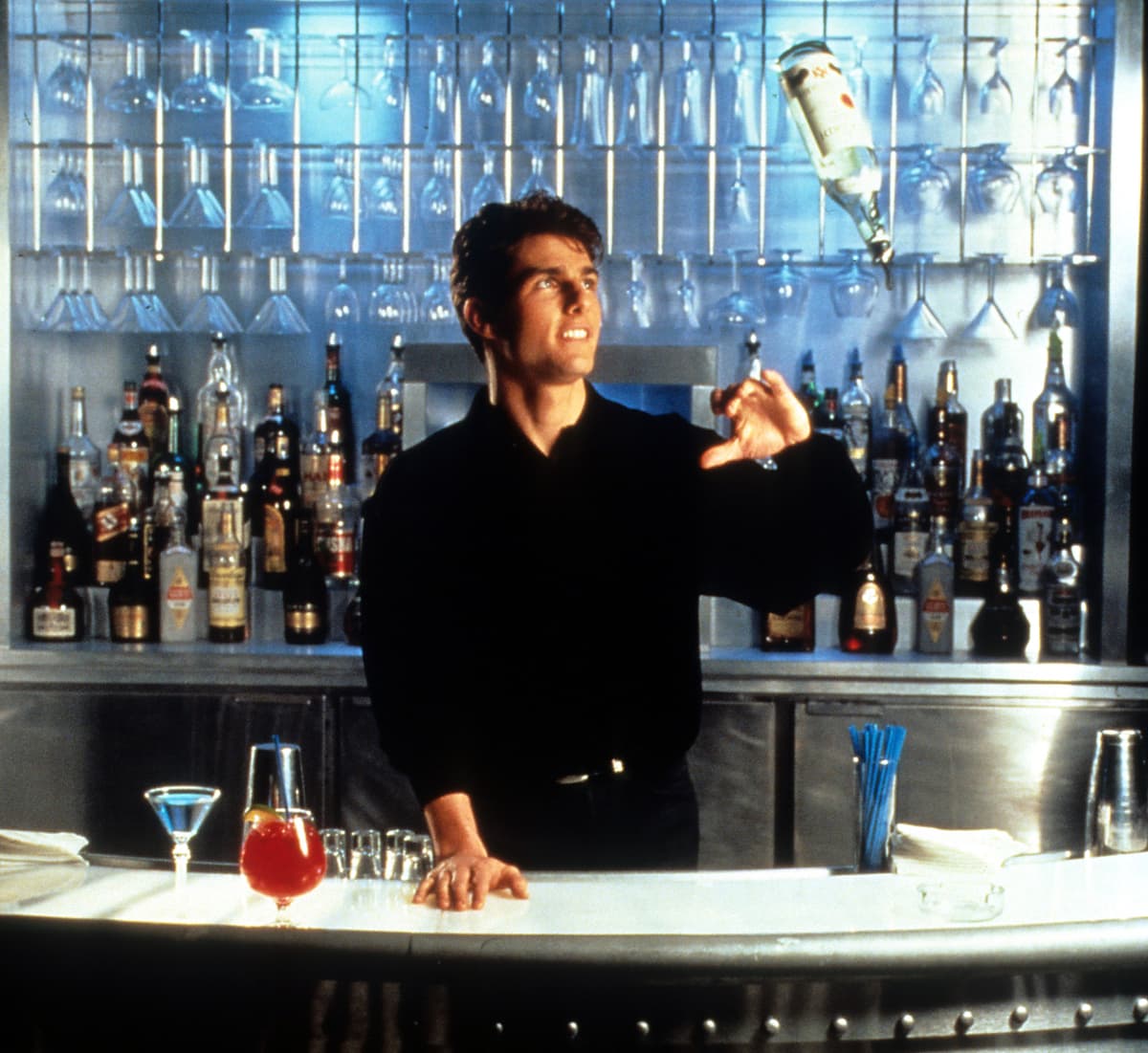

Promoting “Mission Impossible: Final Reckoning” two months ago, Tom Cruise did something unusual. The biggest – some say last – movie star publicly referenced his 1988 romantic comedy drama film “Cocktail.” While waiting to enter the cinema for a London screening of his eighth “Mission Impossible” blockbuster, Mr. Cruise exuberantly flipped his microphone, displaying the flair bartending skills he learned during pre-production for “Cocktail.” “I’m trained,” he said in the promotional clip. “You know, it’s ‘Cocktail.’”
For a time, it seemed Mr. Cruise didn’t especially want to know “Cocktail.” “You sit there and go, ‘What the hell happened?’” he told Rolling Stone in 1990 of watching the film with his first wife, Mimi Rogers. “When we saw it on the screen we go, ‘What the f—k is that?’” But moviegoers viewed things differently. “Cocktail” was a box office smash, reinforcing Mr. Cruise’s star appeal in the face of hostile reviews, in a similar vein to how “Sleeping with the Enemy” would be perceived for Julia Roberts a few years later.

But is “Cocktail,” which chronicles the professional and personal exploits of a young barman, Brian Flanagan, in New York and Jamaica, now belatedly being given its due? The Museum of the Moving Image, the media exhibition space and cinema located in Queens, screened a 35mm print of the film last month as part of its Tom Cruise season which runs until mid-August (interestingly, a separate Cruise film season which ran at London’s repertory cinema BFI Southbank in May, did not screen “Cocktail”).
“’Cocktail’ is the kind of low-key, mid-range studio entertainment more keyed into the complexities of human ambition than numbing spectacle,” MOMI perceptively declared in its online description of the film. Among those revisiting “Cocktail” was the film’s screenwriter Heywood Gould who also wrote the 1984 novel the film was based on.

It was the first time Mr. Gould had seen “Cocktail” on the big screen, since before its release. “‘Cocktail’ is better than I remembered it being at the time,” he said afterwards.” If ever a university course is taught on the differences between films and the books they are adapted from, “Cocktail” should take pride of place. While Mr. Gould’s novel is a cynical, dark late 20th century Big Apple twist on Balzac’s “Père Goriot,” the film softens Flanagan’s character considerably and expands the role of his mentor Doug Coughlan (Bryan Brown). A jaunty soundtrack, featuring the Beach Boy’s “Kokomo” and Bobby McFerrin’s “Don’t Worry Be Happy,” enhances the cinematic breeze.
Yet while the film is prettier, and less gritty than its source material, by today’s standards “Cocktail” possesses a more sophisticated edge than most of today’s Hollywood fare. How many of today’s blockbusters contain dialogue that rivals Coughlin telling Flanagan, “There are two kinds of people in this world: the workers and the hustlers. The hustlers never work and the workers never hustle!”

Ironically given that it’s dismissed in some quarters as Tom Cruise at his most formulaic, the star has never subsequently appeared in anything quite like “Cocktail” in his career (although it’s striking how many of Mr. Cruise’s other films feature bar scenes). Boosted by assured direction from New Zealand filmmaker Roger Donaldson, Mr. Cruise and Mr. Brown serve as ideal foils for each other. Mr. Cruise is especially good at displaying discomfort when his character finds himself in unfamiliar surroundings, such as when in the company of rich people or getting to grips with being a barman, and the movie also features striking performances by Elisabeth Shue and Gina Gershon as Flanagan’s love interests.
An aspirational film about a young idealistic man on the make, “Cocktail” is also a cautionary tale in which its protagonists frequently cheat and scheme. Reading the reviews for “Cocktail,” it’s striking that contemporary critics attacked it for reasons that have little to do with the film’s escapist merits or otherwise. (“Cruise gets tanked a couple of times and staggers around a little and throws a few punches,” wrote Roger Ebert. “But given the premise that he and Brown drink all of the time, shouldn’t they be drunk, or hung over, at least most of the time?”) David Denby, then of New York magazine, bizarrely objected to the raucous bartending scenes in the film contradicting his own theories relating to the motivations of drinkers: “Unless I’m missing something, most young heteros who go to East Side bars want to drink and meet one another, not groove on the bartender.”

Mr. Gould was no stranger to Hollywood when he wrote the script, having written “The Boys from Brazil” and “Fort Apache, The Bronx.” He recalled the film was initially bought by Universal and then placed into turnaround before being made by Disney’s Touchstone Pictures, with whom Mr. Tom Cruise then had a three-picture deal. He is philosophical now about the dozens of drafts he wrote watering down “Cocktail:” “The difference between the film and the book is with the book I was trying to write the Great American Novel. With the film I was just trying to get it made.”
Mr. Gould revealed his own first choice for Flanagan was now-late actor David Carradine. Those in the frame for Mr. Coughlin included Al Pacino, Donald Sutherland and Burt Reynolds. Mr. Brown, who would play Coughlin, last year said about an early script of “Cocktail,” “It was one of the very best screenplays I had ever read.”

Reputations of films change with the times. Recently “Darling,” John Schlesinger’s Frederic Raphael-scripted caustic satire of 1960s London, which won Julie Christie a Best Actress Oscar and which like “Cocktail” has a “be-careful-what-you-wish-for” message, was critically-acclaimed upon its re-release in the UK after being dismissed for decades as dated.“Cocktail” was released this month 37 years ago and the cinematic legacy of the summer of 1988 is lasting, with the likes of “Die Hard” (despite its current reputation as a Christmas movie), “Coming to America” and “Midnight Run” often cited today. One of “Cocktail’s” most enduring legacies is Coughlin’s laws, the eloquently misanthropic series of principles the character swears by (many of which he himself self-destructively breaks). Coughlin’s laws include, “Bury the dead, they stink up the joint.” While by no means a classic, “Cocktail” deserves to live on alongside those aforementioned 1988 cinematic staples, for reasons that go way beyond Tom Cruise’s 30-second premiere exploits.