
Those Not Familiar With María Félix May Want To Become So at the Museum of Modern Art
MoMA, in mounting a retrospective of the Mexican actress and singer’s pictures, ‘María Félix: La Doña,’ is touting her as ‘one of Mexico’s—and world cinema’s—most captivating figures.’
“He was very much in love with me,” a Mexican actress and singer, María Félix (1914-2022), said about her countryman, the painter Diego Rivera. You can’t blame him. Félix was known by the public-at-large as La Doña after a star-making performance in “Doña Bárbara” (1943), a school-of-hard-knocks melodrama directed by Miguel M. Delgado and Fernando de Fuentes. Statuesque and raven-haired, Félix had a “beauty … so powerful and so intense that it hurts.”
Such was the opinion of a French poet, painter, and filmmaker, Jean Cocteau, who met Félix on the set of Luis Saslavsky’s “The Black Crown” (1951), a picture on which he worked as scriptwriter. More than a few members of the culterati of the time agreed with Cocteau, among them the Surrealist painters Leonora Carrington and Leonor Fini, the latter of whom’s “Las Dos Mariás (Double Portrait De María Felix)” (1955) is typical in its portent and atypical in its restraint. Did Félix encourage a level of measure from the often extravagant Fini for this commission?
Measure was congenitally foreign to Rivera. Félix encountered the enfant terrible of Social Realism while filming “Río Escondido” (1947), a movie in which his murals at Mexico City’s Palacio Nacional figure prominently. Rivera followed up by painting the overripe “Portrait of María Félix” (1948), but it was his subsequent canvas, “La Doña María Félix“ (1949), that proved too much for the actress. She refused to lend the canvas for public display and garnered Rivera’s ire in doing so. Eventually Félix hired a bricklayer to “paint over my nude portrait with white to cover it a bit.”
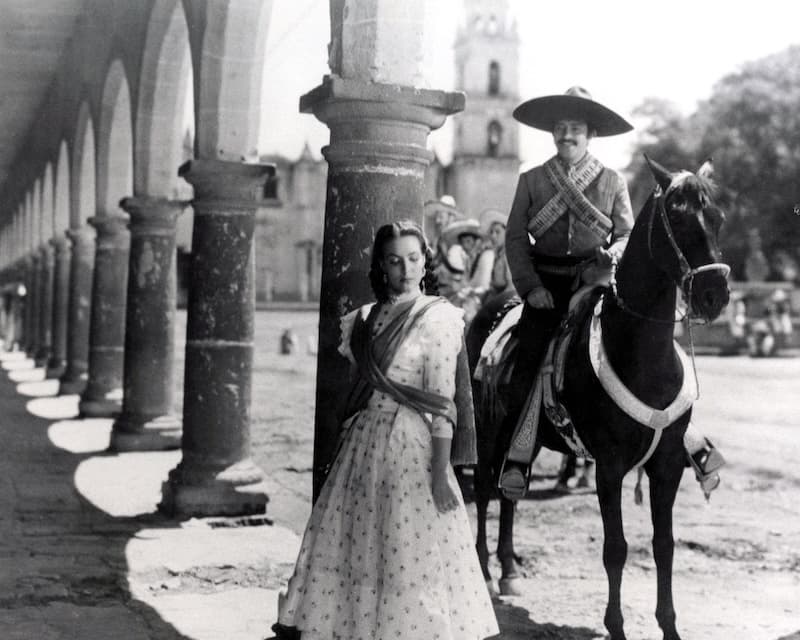
Never heard of Félix? The Museum of Modern Art has seen fit to mount a retrospective of Félix’s pictures, “María Félix: La Doña,” and is touting her as “one of Mexico’s—and world cinema’s—most captivating figures.” “Doña Bárbara” is on the docket, as well as Emilio Hernandez’s “Enamorada” (1946), a variant of Shakespeare’s “The Taming of the Shrew.” Souvenirs of Félix’s European tour will also be on hand, including Jean Renoir’s “French Can Can” (1955), wherein a scantily clad Félix exhibits an eye-popping display of belly-dancing.

Via Colección y Archivo Fundación Televisa
María de los Ángeles Félix Güereña was one of 16 children born to a military family based at Alamos, Sonora. Her allure was recognized early on — she was crowned “Beauty Queen” at the University of Guadalajara — and she worked as a secretary for a plastic surgeon happy to utilize Félix’s looks as a selling point for his skills. She met her future husband, the singer and actor Jorge Negrete, on her first film, “El Penon De Las Animas” (1942), but it was the third movie, “Doña Bárbara,” that made her an icon. Félix’s mannish raiment in this tale of rape, witchcraft, and ranch management only magnified her sex appeal.
The actress, MoMA tells us, “redefined femininity on screen through her portrayals of difficult, domineering women who defiantly operated outside the social conventions of her time.” Likely the best starting point on which to get a handle on Félix’s “defiance” is “Enamorada,” a sweeping, if tonally uneven, epic about how music, in conjunction with that old standby, love, has charms to soothe the savage breast. The savage, in this case, is José Juan Reyes (Pedro Armendáriz), a guerilla general whose rebels have overtaken Cholula, a respectable township whose grandeur has withstood the vicissitudes of time and circumstance.
Reyes starts rounding up citizens, aiming to steal from the rich and give to the poor, after which the rich will be summarily executed. His plans are thwarted upon realizing that the village priest, Padre Rafael Sierra (Fernando Fernández), is a long lost compadre and that the daughter of the city’s richest citizen is the headstrong, free-thinking, and — but you saw this coming — beautiful Beatriz Peñafiel (Félix). Up until Senorita Peñafiel shows up a good 30 minutes into the picture, a lot of time is spent with the bandit and the priest as they engage in philosophical dialogues about the best ways to go about serving the public weal.
Ho-hum, right? So bring on the romance. Credit for making these early passages bearable goes to Fernández’s uncanny sense of composition, choreography, and emphasis, along with the skills of Gabriel Figueroa, whose cinematography relishes everything under its command, the wrinkles of age no less than the resplendence of a church interior. “Enamorada” gains in visual splendor the more it unfolds. It’s something of a classic.
As for La Doña: she’s a star for whom acting is less a matter of dramatic nuance than cinematic presence. As Beatriz, Félix flares her eyes, strikes a pose, and repeatedly slaps the menfolk upside their deserving faces. Imagine a piss-and-vinegar Dorothy Lamour or a less winsome Paulette Goddard. (Goddard would play Beatriz in Fernandez’s American version of “The Torch” (1950).)
By the end of “Enamorada,” Félix establishes her mettle in a man’s world even as Beatriz capitulates to it. That’s a tidy fillip neatly set out in what should prove to be an illuminating run of movies.