
Top GOP Senators Move To Strip ‘Rogue’ Jack Smith of His Law License for ‘Disgraceful’ Prosecutions of Trump
The Republican lawmakers want the special counsel to face disbarment.
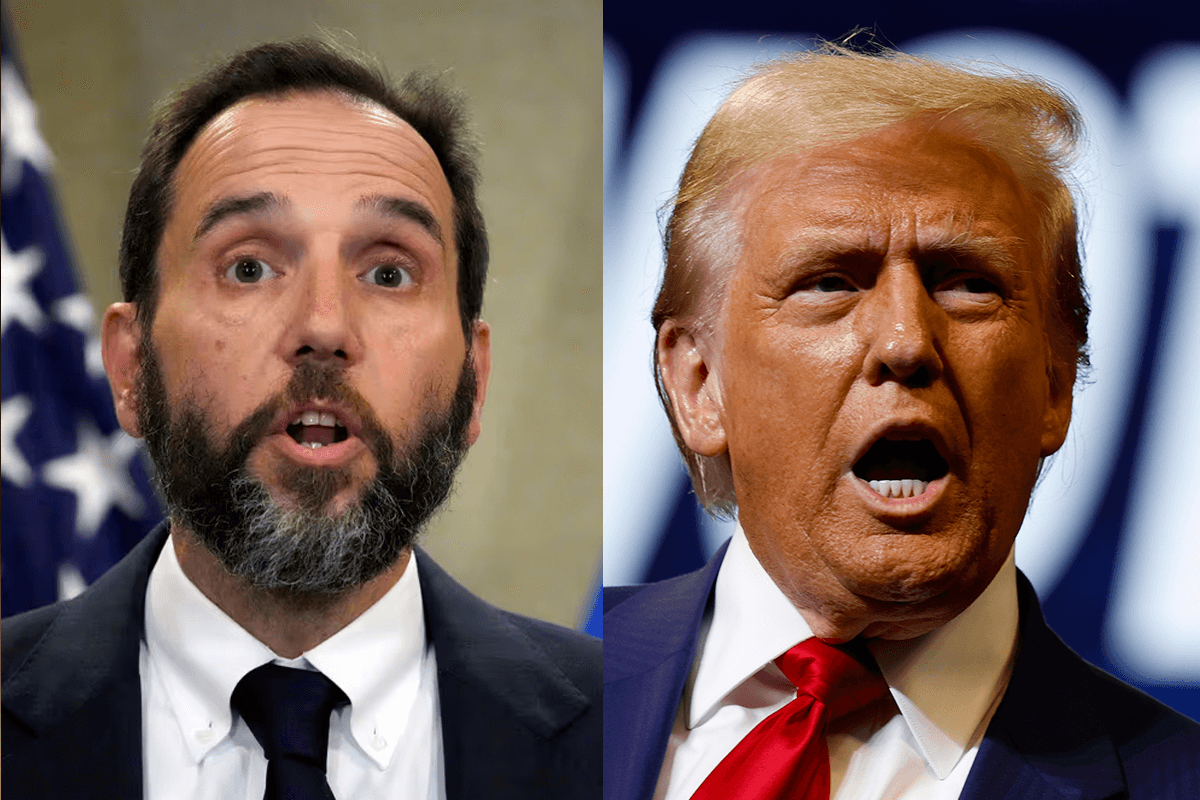
A new threat is emerging for Special Counsel Jack Smith — the possibility that he could be stripped of his ability to practice law the way a number of Republican lawyers were during the Biden administration.
That punishment was floated in a weekend letter to Attorney General Pam Bondi by four Republican senators — Marsha Blackburn, Lindsey Graham, Tommy Tuberville, and Dan Sullivan — and one congressman, Mike Kelly. The lawmakers are outraged by disclosures that Mr. Smith accessed their telephone data as part of his “Arctic Frost” criminal investigation into President Trump’s challenge to the 2020 elections results.
The senators write that “this invasion of our privacy was nothing more than a fishing expedition geared toward targeting President Trump.” Mr. Smith eventually criminally charged the 47th president twice over — for election interference in the 2020 vote case and also for improperly hoarding top classified documents at Mar-a-Lago. Both of those cases were dismissed when Mr. Trump won re-election.
The escalation in scrutiny comes days after Mr. Trump, in the Oval Office and in the presence of Attorney General Pam Bondi, ventured that “deranged” Jack Smith “in my opinion, is a criminal.” Mr. Trump was aware of Mr. Smith’s recent comments, made in an onstage London conversation with a fierce critic of the president, Andrew Weissman, a MSNBC analyst. Mr. Smith fervently denied any politicized prosecutions. Mr. Weissman previously served as Special Counsel Robert Mueller’s top deputy.
A few days prior, Mr. Trump reacted to the disclosures relating to “Arctic Frost” by declaring that “Deranged Jack Smith got caught with his hand in the cookie jar. A real sleazebag.”
Now the Republican lawmakers write that “Jack Smith was a rogue Special Counsel … who would do anything to stop President Trump—including taking concerted steps to spy on duly elected members of Congress. … By infringing on our constitutional rights and obligations as elected federal officials, Jack Smith and his team of prosecutors trampled on this separation of powers principle that underlies our system of government.”
All members of Mr. Smith’s team who remained at the Department of Justice following Mr. Trump’s second inauguration have been fired, including paralegals and other support staff. His personal attorney, Peter Koski, has also been sanctioned via an executive order that revoked his security clearance.
The lawmakers’ letter asks Ms. Bondi to refer Mr. Smith to the Department of Justice’s Office of Professional Responsibility, which handles discipline. The solons accuse him of “prosecutorial misconduct” in pursuing a subpoena, “without any sufficient rationale or cause,” to obtain the lawmakers’ phone records. He pursued this course, they allege, “for one simple reason: we are Republicans who support President Trump.”
The letter’s eight authors also carbon copied the disciplinary bodies of the New York and Tennessee bar associations. Those are the two states where Mr. Smith is a licensed attorney — he was a federal prosecutor at Nashville for a few years.
Mr. Smith has also practiced extensively abroad, serving as a war crimes prosecutor at the Hague when he was picked by Attorney General Merrick Garland to investigate Mr. Trump. The letter urges the Empire and Volunteer States to “consider all options in holding Smith accountable for this misconduct—including disbarment.”
The lawmakers contend that the “conduct that Jack Smith and his team engaged in harkens back to a dark chapter in American history that we have not seen since the days of J. Edgar Hoover, and the completely corrupt investigation and prosecution by the FBI and DOJ of the late Senator Ted Stevens of Alaska.” Stevens, who served in the Senate for more than four decades, was in 2008 convicted of corruption and lost re-election.
Gross prosecutorial misconduct was later uncovered, and the conviction was vacated. Soon after his exoneration, in 2010, Stevens died in a crash of an Alaska bush plane. The lawmakers who are now turning up the pressure on Mr. Smith warn against a return to what they call these “disgraceful” eras of overzealous prosecutions.
Both Tennessee and New York have adopted rules for professional conduct that prohibit lawyers in those states from adopting “means that have no substantial purpose other than to embarrass, delay, or burden a third person or knowingly use methods of obtaining evidence that violate the legal rights of such a person.”
In recent years lawyers affiliated with Mr. Trump have suffered disbarment. These include John Eastman, Kenneth Chesebro, and Mayor Rudolph Giuliani. Another adviser to the 47th president, Jeffrey Clark, is also facing the suspension of his ability to practice law.
Mr. Smith is also facing scrutiny from Congressman Jim Jordan, who has summoned the prosecutor to testify before Congress about his “partisan and politically motivated prosecutions of President Donald J. Trump and his co-defendants.” The Ohioan wrote to Mr. Smith that “as the Special Counsel, you are ultimately responsible for the prosecutorial misconduct and constitutional abuses of your office.”
Mr. Smith has struck a defiant note as he emerges from months of silence following his resignation days before Mr. Trump retook the White House. During the interview with Mr. Weissmann, Mr. Smith blasted as “ludicrous” the suggestion that his prosecutions were politically motivated. During an earlier appearance at George Mason University he called himself “saddened and angry” by developments at the DOJ under Mr. Trump.
Mr. Smith is also facing an investigation into whether his prosecutions of Mr. Trump — which he pursued at an aggressive cadence — violated the Hatch Act. That is a law that prohibits federal employees from engaging in political activities meant to sway the outcome of elections. Violations of the Hatch Act can be punished by a $1,000 fine and a firing from federal service, but violators are not subject to criminal penalties.