Transgender Identity Among American College Students Is Dropping Dramatically, New Research Suggests

‘It appears that trans and queer are going out of fashion among young people, especially in elite settings,’ the researcher says.
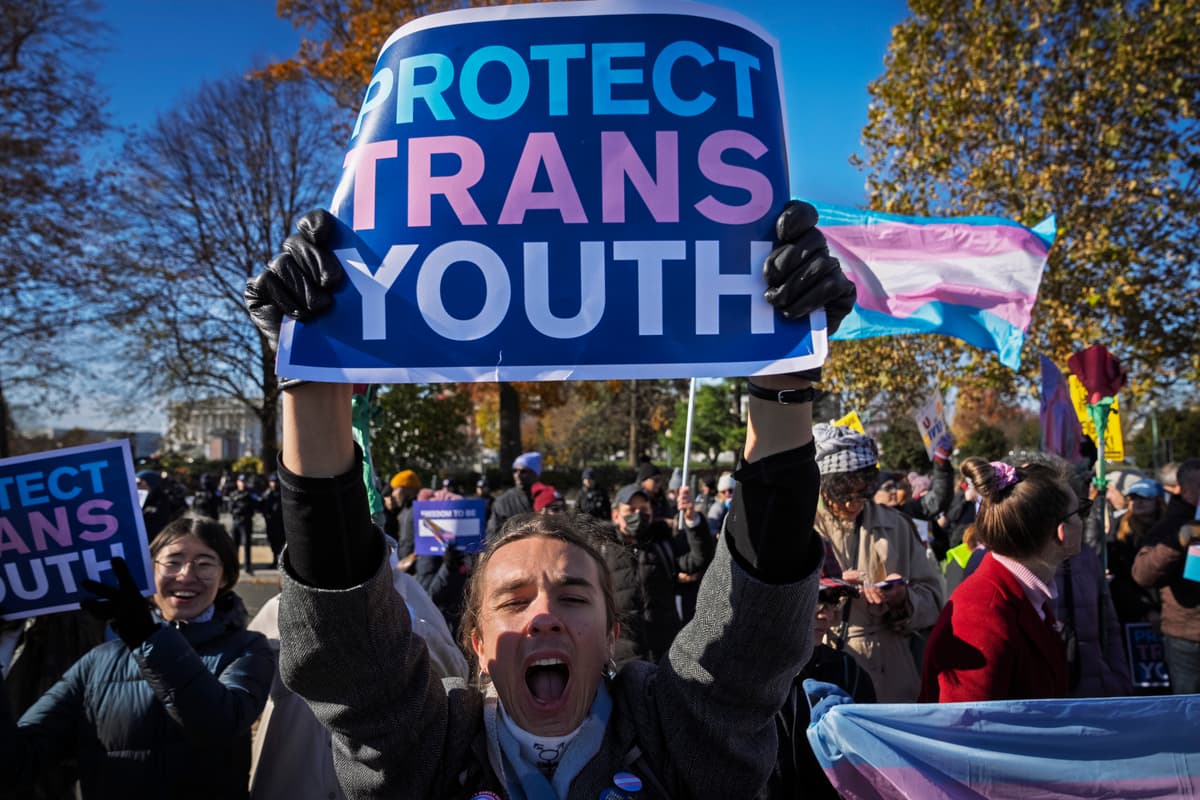

AP/Jacquelyn Martin
A young person cheers as supporters of transgender rights rally by the Supreme Court, December 4, 2024. AP/Jacquelyn Martin

A comprehensive new study suggests that there has been a sharp decline in transgender and non-binary identification among students at American universities, with Ivy League schools showing particularly dramatic drops following a peak in 2022-23.

A professor of politics at the University of Buckingham in Canada and director of the Centre for Heterodox Social Science, Eric Kaufmann, analyzed data from multiple high-quality youth surveys, including more than 50,000 students annually, and found that non-binary identification at elite institutions has fallen by nearly half in just two years.

“Trans, queer and bisexual identities are in rapid decline among young educated Americans,” Mr. Kaufmann wrote in his report, adding, “It appears that trans and queer are going out of fashion among young people, especially in elite settings.”

At Ivy League universities, the share of students identifying as other than male or female jumped to a peak of 7 percent in 2023 from 3 percent in 2021 before plummeting back to 3 percent by 2025.

The prestigious Andover Phillips Academy showed an even more dramatic shift, with non-binary identification dropping to 3 percent in 2025 from more than 9 percent in 2023. Similarly, a Brown University student survey showed a decline to 2.6 percent in 2025 from about 5 percent in 2022-23.

Recent surveys by the Foundation for Individual Rights and Expression, which sample students primarily at leading research universities, documented the decline across a much larger sample of 55,000-69,000 students per year. Non-binary identification fell to 3.6 percent from 6.8 percent between 2023 and 2025.

“This does not appear to be the result of a shift to the right, the return of religion or a rejection of woke culture war attitudes,” writes Mr. Kaufmann, author of “The Third Awokening: A 12-Point Plan for Rolling Back Progressive Extremism.” “Despite high correlations between sexual/gender identity and political attitudes within individuals, the over-time trend in gender and sexuality seems relatively independent of political, cultural and religious beliefs.”

In response to a post about the study on X, billionaire Elon Musk weighed in on the subject. “The awful illusion has finally been shattered, with increasing repercussions for the modern-day Mengeles who mutilated children,” he wrote in a post on his social media platform. 

“The obvious truth is that you can change your appearance and dress with varying degrees of success, and I don’t oppose consenting, peaceful adults who do so, but you can never truly turn a man into a woman or a woman into a man. That is biologically impossible,” Mr. Musk wrote.

The dramatic “rise and fall” pattern appears concentrated among elite educational institutions. Less prestigious colleges showed stability in transgender identification rates throughout the same period, suggesting the phenomenon may be more pronounced in elite academic environments.

The Higher Education Research Institute surveys, which sample students from lower-ranked colleges than FIRE, showed non-binary identification remaining steady at about 2 percent through 2019-24 — significantly lower than the elite samples.

The research also identified improving mental health among young people as one factor contributing to the decline in transgender identification. Post-pandemic mental health improvements appear to account for part of the shift, though researchers note this explains only a portion of the dramatic change.

“While the trans share falls across all mental health categories, it declines less among those who are depressed,” the study found. Among mentally healthy students, the decline was more pronounced, suggesting that compositional changes in student mental health partially drove the overall trend.

Contrary to expectations, the decline in transgender identification occurred alongside stable political and cultural attitudes among students. The research found that “political ideology, culture war attitudes and levels of religious identification remained stable throughout the 2020-25 period.”

This finding challenges assumptions that the decline might be attributed to broader cultural or political shifts, suggesting instead that other factors are driving the change.

The data show that younger students are driving the decline in transgender identification. “When trans, bisexual and queer were at their peak, they were more popular in later graduating classes,” the study noted. “But by 2025, the freshman 2028 cohort was less likely than older students in 2025 to identify as BTQ+.”

This pattern suggests that transgender identities may be “declining in popularity with each new cohort” among the youngest college students.

The study says the findings represent “a momentous and unanticipated post-progressive cultural shift in American society which is distinctly out of phase with the expectations of cultural left observers in educational institutions and legacy media outlets.”

The research raises questions about whether this decline will continue and what broader implications it may have for American society. As Mr Kaufmann notes, “Only time will tell if the substantial decline of BTQ+ identification will continue among young Americans.”


The New York Sun

© 2025 The New York Sun Company, LLC. All rights reserved.

Use of this site constitutes acceptance of our Terms of Use and Privacy Policy. The material on this site is protected by copyright law and may not be reproduced, distributed, transmitted, cached or otherwise used.

The New York Sun

Sign in or  create a free account

or
By continuing you agree to our Privacy Policy and Terms of Use