Trump Accuses E. Jean Carroll of Cribbing From ‘Law & Order’ for Her ‘Hoax’ Accusations as He Appeals Judgment to Supreme Court
The 47th president alleges that the sex and advice columnist’s allegations appear drawn from scripted television.
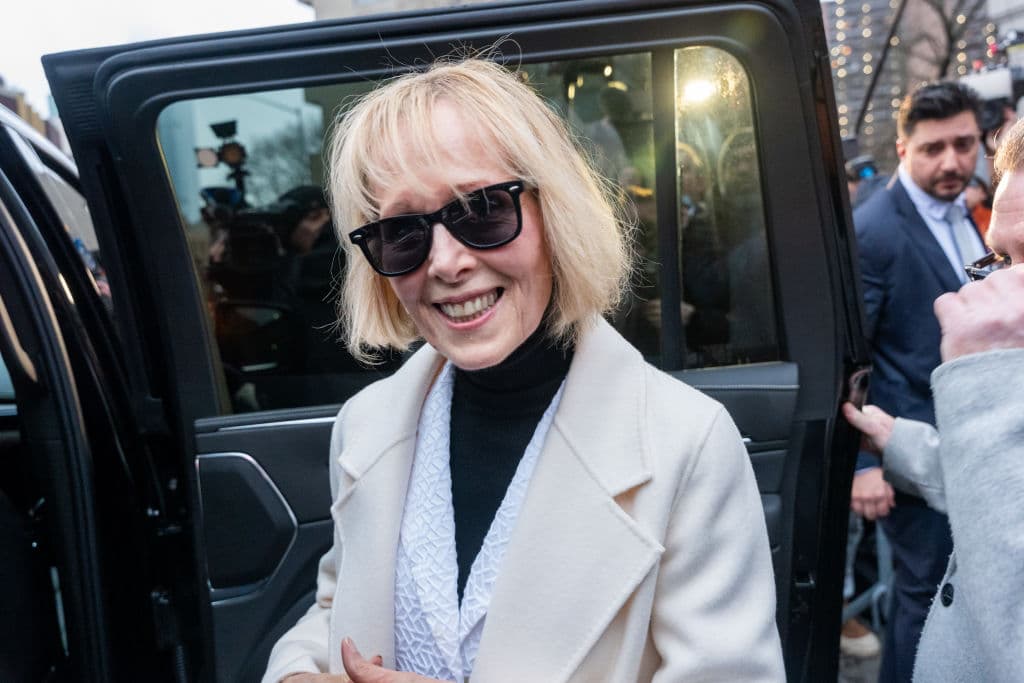

President Trump’s request that the Supreme Court hear his appeal of a $5 million judgment he owes to the sex and advice columnist E. Jean Carroll could set up a high stakes showdown between the president and the author who claims he sexually abused and defamed her.
Mr. Trump has enjoyed something of an appellate hot streak. On everything from disqualification on the basis of the 14th Amendment to presidential immunity to his massive civil fraud verdict in New York initial defeats have been, at least partially, reversed. Last week the Second United States Appeals Court ordered another hearing on whether his hush money case belongs in federal court.
In his E. Jean Carroll filing the president tells the highest court in the land in that “Carroll’s allegations are a story that precisely matches the plotline from an episode of one of admittedly her favorite TV shows, ‘Law & Order.’” A spokesman for Mr. Trump, in a statement accompanying the filing called for an end to the “Democrat-funded travesty of the Carroll Hoaxes.”
Mr. Trump’s petition to the high court, via a writ of certiorari, comes some 11 months after the Second Circuit declined to overturn the verdict imposed by a civil Manhattan jury. The trial judge was Lewis Kaplan, whom Mr. Trump has called a “radical Trump hater” and “a bully.”
Judge Kaplan did not allow Mr. Trump to deny Ms. Carroll’s sexual abuse accusations — which he said were considered fact — during the separate defamation trial, which led to an $83 million judgement. Mr. Trump now tells the Nine that Judge Kaplan made a “series of indefensible evidentiary rulings.”
The case stems from an alleged encounter between Mr. Trump and Ms. Carroll in a dressing room on the lingerie floor of Bergdorf Goodman, the upscale Manhattan department store, sometime in the mid-1990’s. Ms. Carroll, now 81, in a 2019 New York magazine article, contended that he raped her, an allegation he flatly denies and called a “complete con job.”
Those denials led to her first suit for defamation and sexual abuse, which Mr. Carroll won to the tune of $5 million, though the jury found that Mr. Trump did not rape her. During a second trial Mr. Trump was found liable for a further $83 million for further defamation.Mr. Trump has separately appealed that verdict, though that request for review was denied by a panel of the Second Circuit.
The appeals court ruled that Mr. Trump’s conduct “supports a significant punitive damages award — it involved malice and deceit, caused severe emotional injury, and continued over at least a five-year period … the degree of reprehensibility of Mr. Trump’s conduct was remarkably high, perhaps unprecedented.” He has appealed that determination to the full Second Circuit.
The appeal to the Supreme Court concerns the first verdict. The president argues that Ms. Carroll “waited more than 20 years to falsely accuse Donald Trump, who she politically opposes, until after he became the 45th President, when she could maximize political injury to him and profit for herself.” Ms. Carrol’s latest book, “Not My Type,” a play on how Mr. Trump, as president, described her after she’d made her accusations, was a New York Times bestseller. She has not yet received a dime from Mr. Trump.
Mr. Trump’s argument for appeal centers on his contention that Judge Kaplan admitted “highly inflammatory propensity evidence against President Trump.” Propensity evidence, which cuts to a defendant’s character or past bad behavior, is generally inadmissible in court because it is seen as prejudicial. Juries are meant to convict or acquit only on the facts at hand.
The appeal argues that Judge Kaplan “erroneously allowed testimony about multiple decades-old, unverified, and unrelated allegations to be presented to the jury.” These errors, Mr. Trump insists, include allowing Ms. Carroll’s lawyer, Roberta Kaplan, to play for jurors the notorious “Access Hollywood” tape on which Mr. Trump bragged about touching women without consent. Judge Kaplan also allowed two other women to testify about alleged sexual misconduct by Mr. Trump, ,which he has denied.
Ms. Carroll’s legal team explicitly leaned on these women’ s accounts during closing arguments, telling the jury that “You heard Jessica Leeds and you heard Natasha Stoynoff tell you how he used this exact same MO or playbook with them.” Mr. Trump tells the Supreme Court that both women suffer from “credibility problems.”
The sole dissenter on the appellate panel that rejected Mr. Trump’s appeal, Judge Steven Menashi, a Trump appointee, wrote that Judge Kaplan’s “ judgment cannot be justified under the rules of evidence that apply as a matter of course in all other cases.”
After the panel of the Second Circuit rejected Mr. Trump’s appeal, the full court, en banc, refused by a vote of 4-2 to hear the case. The vote came down along party lines: the four judges who voted for the majority were all appointed by President Biden while the two judges who dissented were appointed by Mr. Trump.Judge Myrna Perez, an appointee of President Biden who wrote the majority’s opinion, reasoned that the case did not command the “exceptional importance” that would justify granting Mr. Trump’s appeal.
Judge Kaplan also dismissed a counterclaim by Mr. Trump, who alleged that Ms. Carroll’s allegation on CNN that he raped her was defamatory. The judge ruled that Ms. Carroll’s representation was “substantially true” even though the jury had found Mr. Trump “not liable” for rape. Judge Kaplan reasoned that “the only issue on which the jury did not find in Ms Carroll’s favour was whether she proved that Mr Trump ‘raped’ her within the narrow, technical meaning of that term in the New York penal law.”
The Supreme Court, alone among federal courts, possesses the power of discretionary review, meaning that it can decide not to review Mr. Trump’s appeal. It declined to intervene when Mr. Trump, in the days before he took office for a second time, requested that the justices block his sentencing in his hush money case. Judge Juan Merchan sentenced him to an “unconditional discharge,” meaning no further punishment was meted out.

