Trump Administration Asks Supreme Court To Rule on Its Bid To Limit Birthright Citizenship

A lower court’s decision blocking the president’s executive order ‘invalidated a policy of prime importance to the president and his administration,’ the solicitor general says.

Mariam Zuhaib/AP
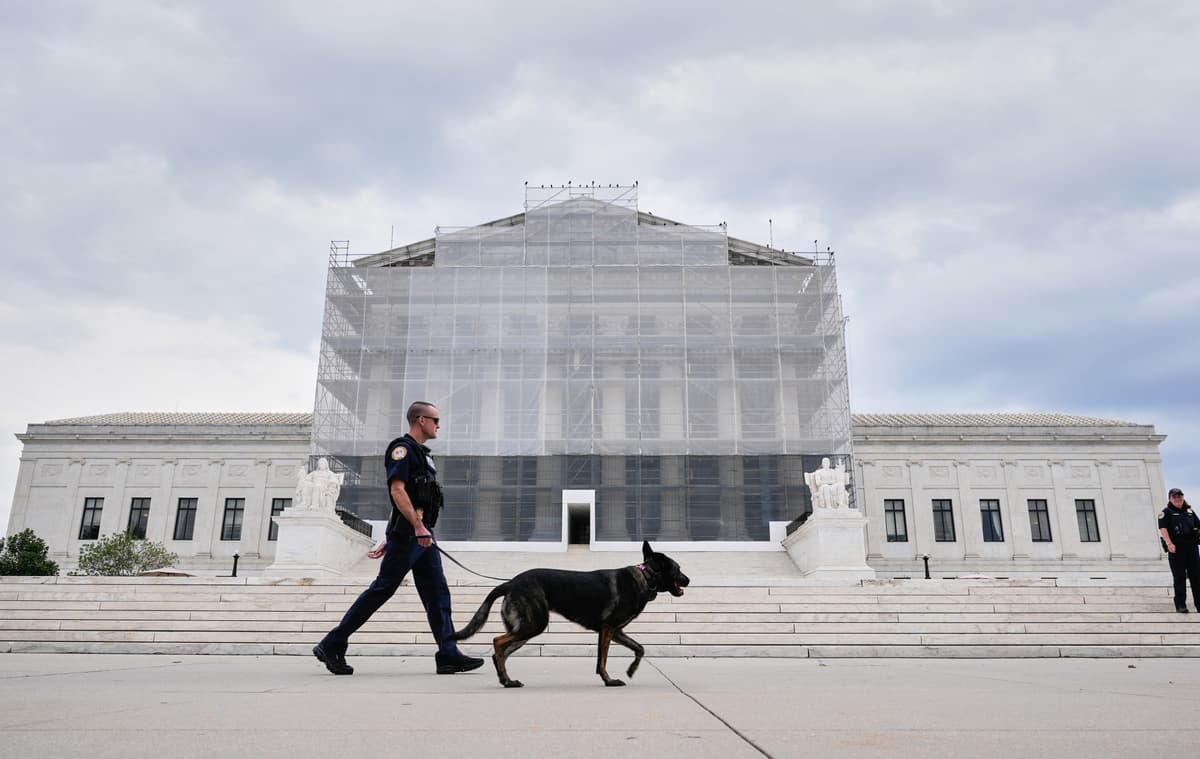
A U.S. Capitol Police officer with a K9 detector dog patrols outside the Supreme Court at Washington, D.C., on September 24, 2025. Mariam Zuhaib/AP

The Trump administration has petitioned the Supreme Court to rule on its executive order that seeks to deny American citizenship to children born in America if the parents are illegal aliens or visitors on short-term visas.

On Friday, Solicitor General D. John Sauer submitted petitions to the high court, requesting a hearing on the legality of the birthright citizenship executive order early next year, potentially leading to a ruling by June. Multiple lower courts have blocked the policy, ruling it unconstitutional.

In his petition, Mr. Sauer argued that the original intent of the Constitution’s “Citizenship Clause” was misrepresented by lower courts. “The Citizenship Clause of the Fourteenth Amendment was adopted to grant citizenship to freed slaves and their children, not to the children of illegal aliens, birth tourists, and temporary visitors,” Mr. Sauer wrote. “The plain text of the Clause requires more than birth on U.S. soil alone.”

“The lower court’s decisions invalidated a policy of prime importance to the president and his administration in a manner that undermines our border security,” the solicitor general continued. “Those decisions confer, without lawful justification, the privilege of American citizenship on hundreds of thousands of unqualified people.”

President Trump made the issue a priority, signing an executive order titled “Protecting the Meaning and Value of American Citizenship”,just hours after his second inauguration on January 20. However, the order has never been implemented due to legal challenges. To date, four federal judges have ruled that the policy violates the 14th Amendment and long-standing Supreme Court precedent.

Legal precedent has largely affirmed birthright citizenship as a constitutional right since the 1898 Supreme Court case United States v. Wong Kim Ark, which granted citizenship to the American-born son of Chinese immigrants. Federal judges who have recently considered the issue have largely rejected the administration’s argument, citing this broad legal consensus.

In July, a federal appeals court in San Francisco upheld a Seattle judge’s decision to block the policy nationwide. That same month, a New Hampshire judge also barred the enforcement of the executive order in a lawsuit filed by the American Civil Liberties Union. The Trump administration is appealing both of these rulings.

The administration’s request for the Supreme Court to intervene is somewhat unusual, as the court typically waits for multiple federal appeals courts to issue rulings on a matter, especially if there is a conflict between them. So far, only one appeals court has ruled on the policy.

The Supreme Court did address a related case in June, deciding 6-3 to limit the power of lower courts to issue nationwide injunctions. However, the court did not rule on the constitutional merits of birthright citizenship itself.

The justices are scheduled to meet on Monday for their “long conference” to consider petitions accumulated over the summer. However, the administration’s request will not be on the agenda for at least a month, as challengers are given time to respond.


The New York Sun

© 2025 The New York Sun Company, LLC. All rights reserved.

Use of this site constitutes acceptance of our Terms of Use and Privacy Policy. The material on this site is protected by copyright law and may not be reproduced, distributed, transmitted, cached or otherwise used.

The New York Sun

Sign in or  create a free account

or
By continuing you agree to our Privacy Policy and Terms of Use