Trump Administration Tells Appeals Court That Blocking ‘Liberation Day’ Tariffs Would Undermine National Security

The president’s lawyers say a little-known trade court issued an ‘illegal injunction’ to block the tariffs.

AP/Mark Schiefelbein
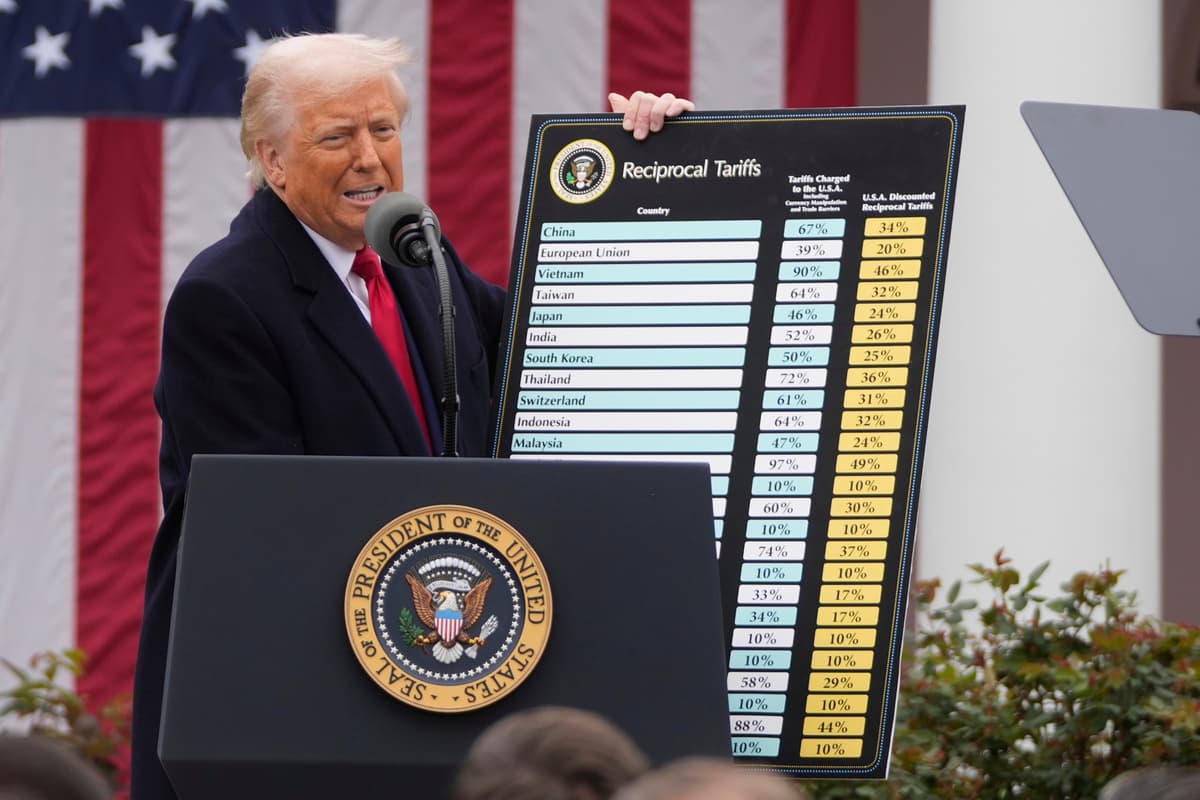
President Trump speaks during an event to announce new tariffs in the Rose Garden at the White House on April 2, 2025, in Washington. AP/Mark Schiefelbein

Trump administration lawyers are asking a federal appeals court to allow the president’s tariffs to remain in place while a legal battle plays out over whether they are legal, spawned by an unfavorable court ruling.

In paperwork filed with the U.S. Court of Appeals for the Federal Circuit, the administration claims blocking the tariffs “would undermine the President’s ability to carry out foreign-policy and national-security objectives.”

President Trump, in early April, invoked the International Emergency Economic Powers Act to empower himself to institute his “Liberation Day” tariffs — a centerpiece of his economic agenda. Mr. Trump claims the trade deficit has created an economic emergency for the United States.

The tariffs triggered two lawsuits — one by a group of Democratic state attorneys general, and one by a group of small businesses that say the import taxes are causing them irreparable harm. 

The little-known Court of International Trade in New York declared the tariffs illegal. In their order, three jurists on the Trade Court — one appointed by President Reagan, one appointed by President Obama, and one appointed by President Trump himself — ruled unanimously that the sitting president had overstepped his authority and functionally taken the power of taxation from Congress for his own.

The following day, the appeals court issued a temporary stay that allowed the tariffs to remain in effect pending further arguments. That stay could be short-lived, however, if the appeals court agrees with the trade court judges that the so-called reciprocal tariffs exceed the president’s authority, even in a time of alleged emergency.

In its response, the administration argues that it would likely prevail on an appeal and claims that the trade court ruling was “an illegal injunction that improperly usurps political choices by the political branches.”

The plaintiffs’ response, conversely, stated that the administration argument that the president has virtually unlimited unilateral tariff authority under IEEPA was “not likely to succeed on appeal.”

It is unclear when the appeals court will decide on whether the tariffs can continue as the lawsuit plays out. The administration’s lawyers asked the court to temporarily extend the stay for seven days to give time for an emergency appeal to the Supreme Court if it decides to deny the stay.


The New York Sun

© 2025 The New York Sun Company, LLC. All rights reserved.

Use of this site constitutes acceptance of our Terms of Use and Privacy Policy. The material on this site is protected by copyright law and may not be reproduced, distributed, transmitted, cached or otherwise used.

The New York Sun

Sign in or  create a free account

or
By continuing you agree to our Privacy Policy and Terms of Use