
Trump Administration Warns of National Security Concerns If White House Ballroom Project Is Delayed

A lawsuit seeks to halt construction on the massive new wing until the plans are reviewed.
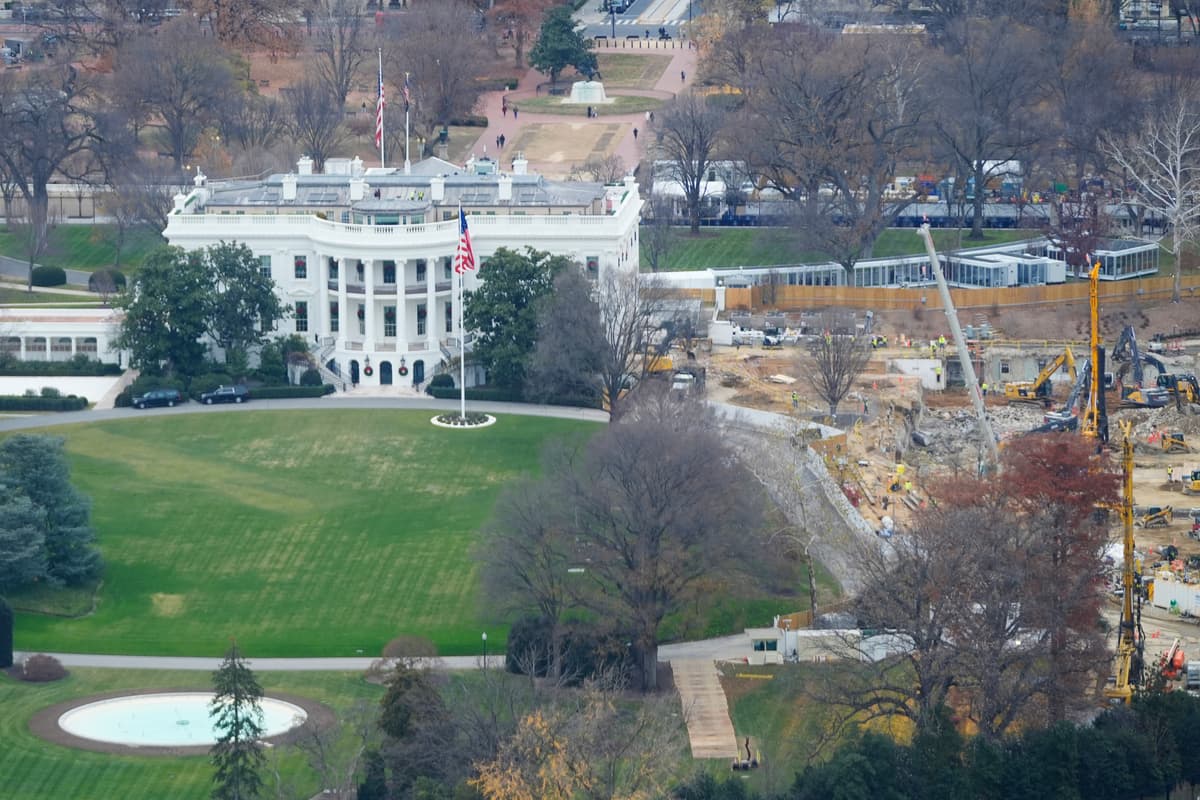
Pablo Martinez Monsivais/AP
Work continues on the construction of a new ballroom at the White House on December 9, 2025. Pablo Martinez Monsivais/AP

A new court filing by the Trump administration claims delays in constructing the new White House ballroom will hurt the security mission of the Secret Service.

Several new details about the project are revealed in a response filed in a lawsuit the administration faces over the massive new wing under construction at the White House.

The National Trust for Historic Preservation is suing President Trump and several federal agencies to block further construction work on the project until it goes through a legally mandated review process. 

The suit, filed in the United States District Court for the District of Columbia, calls the project unlawful.

“The White House is arguably the most evocative building in our country and a globally recognized symbol of our powerful American ideals. As the organization charged with protecting places where our history happened, the National Trust was compelled to file this case,” the organization’s CEO, Carol Quillen, said in a statement.

The suit contends that construction started before plans were filed with the National Capital Planning Commission and that no required environmental impact work was carried out. The suit also states that Congress needs to authorize construction of the building and claims Mr. Trump is violating the Property Clause of the Constitution, which reserves to Congress the right to dispose of and make all rules regarding property belonging to the United States.

The Trump administration disputes that claim. In a response filed on Monday, the administration said, “The President possesses statutory authority to modify the structure of his residence, and that authority is supported by background principles of Executive power.”

The administration’s filing claims that if the court issues an injunction halting construction it will have national security implications. The Secret Service says that continued “improvements to the site are still needed before the safety and security requirements can be met.” The administration claims that a pause in construction would hamper the Secret Service’s “ability to meet its statutory obligations and protective mission.”

The filing didn’t reveal any specifics about those concerns but the deputy director of the Secret Service, Matthew Quinn, offered to provide classified security details with the judge in a private hearing.  

Demolition continues on the below-ground portion of the former East Wing which contained an emergency bunker for the president. The National Park Services revealed in the new filing that it expects work on footings and below-grade structural concrete for the new building will begin in January and continue in February. Construction of the full building is not expected to begin until April at the earliest. The project is not scheduled to be finished until 2028, a few months before President Trump’s second term ends.

The new building will be approximately 90,000 square feet and will be connected to the Executive Mansion through a two-story passageway. The second story will provide direct access from the East Room to the State Ballroom, while  ground-floor access to and from the Executive Mansion will remain.

The filing says that portions of the east façade of the Executive Mansion will need to be removed to tie in both levels. The administration says stones removed for that work will be cataloged and reinstalled.  

The administration says the exterior design of the new East Wing building will be compatible with the Executive Mansion through “classical elements such as columns and pediments.” Materials will include a white painted exterior, historically compatible windows and doors, and an architecturally compatible roof. Interior finishes will include stone slab flooring, decorative plaster moldings, and “high-quality finishes” for elevator cabs.

Mechanical, electrical, and plumbing upgrades will include custom chandeliers, fixture updates, and architectural grilles, along with advanced audio-visual system enhancements.

Mr. Trump has said the ballroom project is a much-needed addition. The White House has long been unable to host large functions without erecting a large tent 100 yards away from the main building. The new ballroom will hold far more people than the East Room with its 200-person capacity. The administration says the ballroom will have a capacity for over 1,000 guests, depending on final design configuration.

The ballroom will allow flexible staging on the south or east sides and provide views to the west, south, and east. A flat tray ceiling with decorative chandeliers is also proposed.

The first floor will continue to serve as the visitor entrance to the building with “monumental” stairs to the ballroom. It will also house storage, mechanical equipment, and space for other needs. There will also be ground-floor restrooms that will be available for use during events on the South Lawn.


The New York Sun

© 2025 The New York Sun Company, LLC. All rights reserved.

Use of this site constitutes acceptance of our Terms of Use and Privacy Policy. The material on this site is protected by copyright law and may not be reproduced, distributed, transmitted, cached or otherwise used.

The New York Sun

Sign in or  create a free account

or
By continuing you agree to our Privacy Policy and Terms of Use