Trump Commandeers Airwaves To Deliver Campaign-Style Speech in an Attempt To Turn Around Approval Rating on Economy
The president’s speech is a preview of the midterm campaign to come.
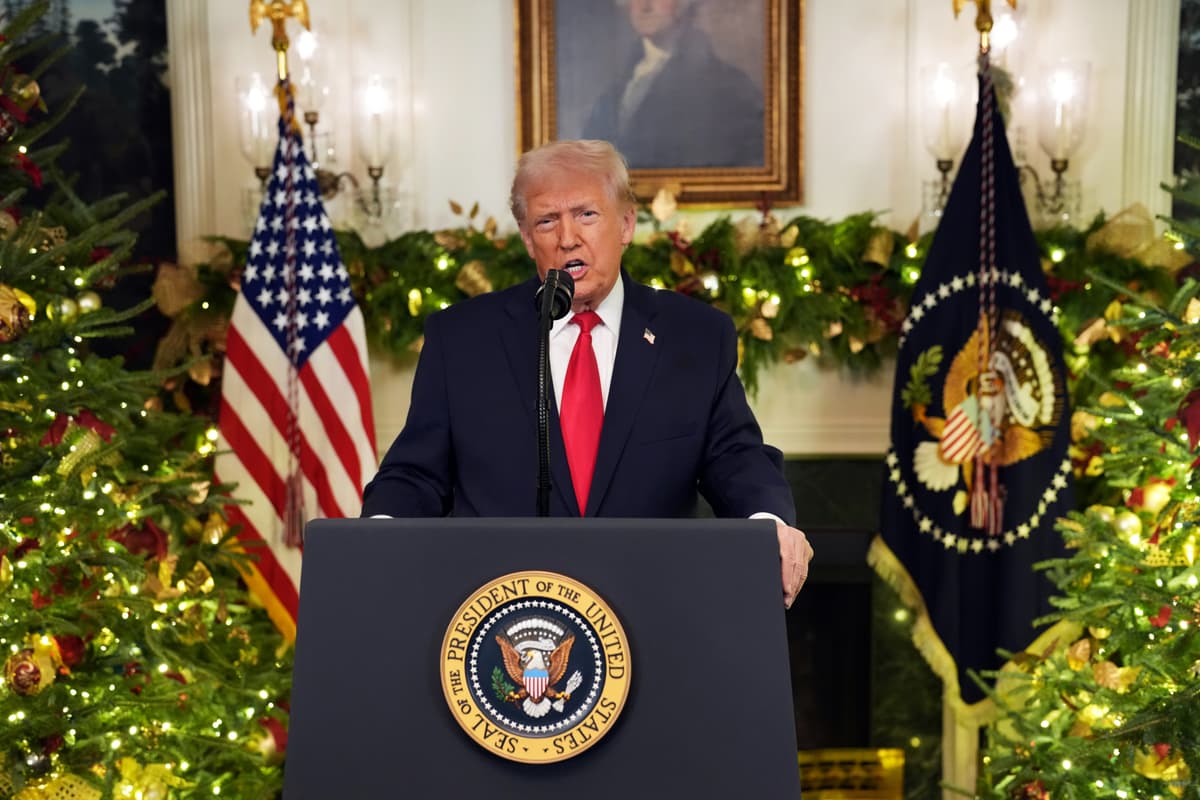
In a rare address to the nation that did not focus on a single issue, President Trump on Wednesday night recapped his first year back in the White House, with a heavy focus on the cost of living. The speech comes at a time when Republicans are growing concerned that rising prices could be the blow that kills their chances in the midterms.
Since the Republicans’ resounding losses in this year’s fall elections, Mr. Trump’s GOP allies have tried to refocus White House messaging on how they can bring down costs. Based on polling, the current affordability crisis could spell a wipeout for Mr. Trump’s party next November.
The president spoke to the nation from a decorated White House, adorned for Christmas festivities.
“Let’s look at the facts,” Mr. Trump told viewers, urging them to understand that he inherited a “mess.”
“Under our leadership, [prices] are coming down and coming down fast,” the president declared, displaying graphs of the prices of certain everyday items and commodities that have fallen in the last 11 months. “Democrat politicians … sent the cost of groceries soaring, but we are solving that, too.”
“It’s not done yet, but boy, are we making progress,” Mr. Trump said.
Despite winning high marks from voters during his first term on the issues of economic management, inflation, and affordability, Mr. Trump now is well below water. Nearly every poll released over the course of the last three months has shown that voters no longer trust the president to deal with making their lives more affordable.
On Wednesday, the highly respected Marist University poll was released showing that Americans are still expressing an elevated level of discomfort about the state of the economy. The survey showed that the vast majority of voters — 61 percent to 39 percent — say the economy is not working well for them, compared to those who say it is working well.
The question of whether or not Mr. Trump is handling stewardship of the nation’s economy well, he gets a poor rating from Americans. Only 36 percent of American adults say they approve of his economic management, compared to 57 percent who disapprove. Among independents, the numbers are even more dire, with 24 percent saying they approve compared to 68 percent who disapprove.
Mr. Trump blamed President Biden for many of the country’s ills during his speech on Wednesday, including the influx of migrants, the persistently high cost of living, and the underemployment of native-born Americans.
The vast majority of the country, however, seems to lay all of the economic blame at Mr. Trump’s feet nearly one year into his second term.
Another poll from Quinnipiac University — another gold-standard survey — shows that 57 percent of Americans believe the country’s current economic state lies at Mr. Trump’s feet, compared to only 34 percent who say Mr. Biden bears responsibility.
The Marist poll shows that Mr. Trump’s approval rating on economic management has slipped into the negative territory far faster than Mr. Biden’s. The same poll found that at the end of the first year of his first term, Mr. Biden was only ten points underwater on the issue of the economy, despite the inflation rate spiking to more than seven percent annually.
Mr. Trump is now in the same range of disapproval rating on the economy as Mr. Biden was at his lowest point. In February 2022, Mr. Biden was 22 points underwater in his economic approval rating. Today, Mr. Biden is 21 points underwater on that same issue.
One of the key points of Mr. Trump’s address was to make the case for direct payments to Americans to deal with a host of issues, seemingly in an attempt to turn his poor poll numbers around.
He announced that more than one million of America’s servicemembers would receive checks for $1,776 before Christmas in honor of the 250th anniversary of the Declaration of Independence. Mr. Trump has also floated the idea of tariff “dividend” checks to help Americans afford basic necessities, and reiterated during his Wednesday speech that he wanted Congress to direct all health insurance subsidy funds to individual accounts for Americans to use.