
Trump, Declassifying Amelia Earhart Records, Wades Into a Mystery That Flies Above Facts
The question is whether disclosing the full file will end the mystery of the fate of the 16th woman to hold a pilots’ license.
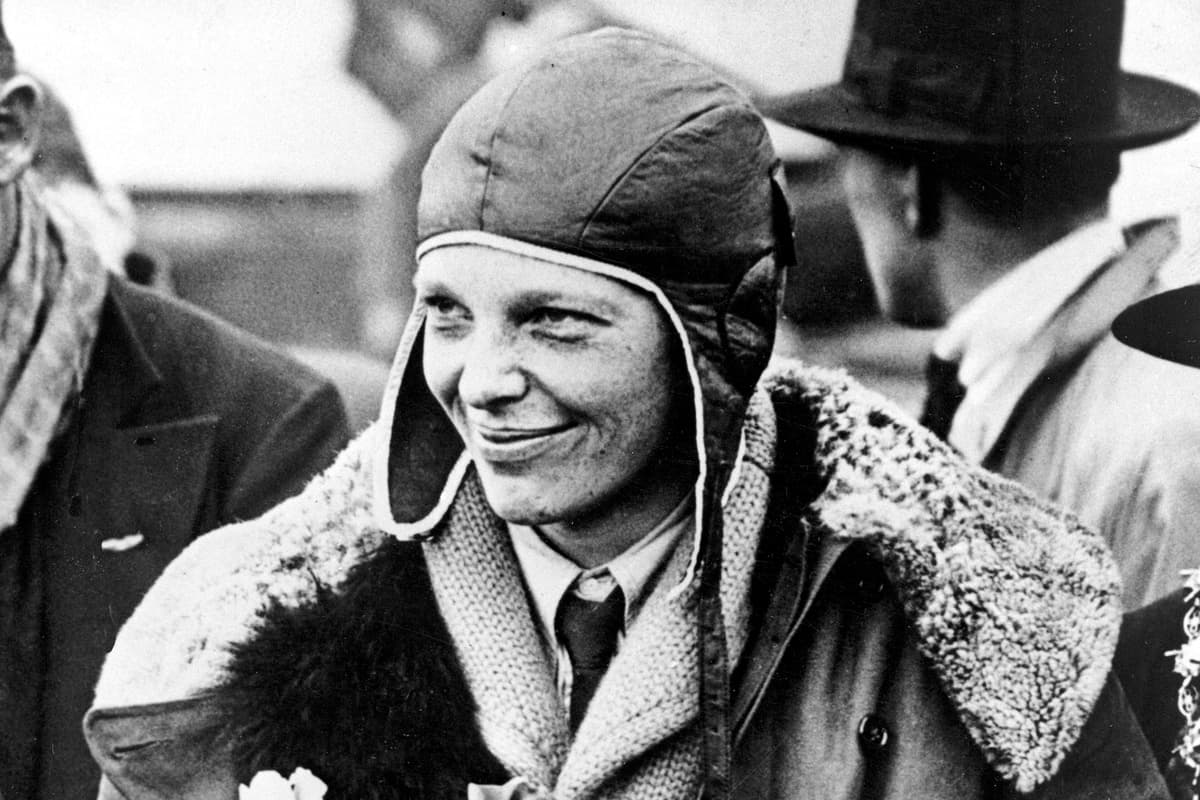

President Trump is ordering his administration “to declassify and release all government records related to” Amelia Earhart and her disappearance 88 years ago over the Pacific Ocean. The aviatrix’s fate is one of history’s most fascinating cold cases, the kind that no document disclosure is likely to solve.
On July 2, 1937, Earhart and her navigator, Fred Noonan, lost radio contact in the final legs of their route to circumnavigate the globe. After they failed to reach their destination on Howland Island, a search was launched. It found no trace of them or their Lockheed Model 10-E Electra.
The author of “The Aviator and the Showman: Amelia Earhart, George Putnam, and the Marriage That Made an American Icon,” Laurie Gwen Shapiro, tells The New York Sun that the fate of the pilot and Noonan is already knowable. It’s just that dreamers refuse to accept the obvious.
“There are no secret files,” Ms. Shapiro says, “waiting to overturn what we already know.” Yet “the truth is more human and more dramatic than any conspiracy.” Earhart was “weakened by dysentery and increasingly strained” with Noonan, “who had been drinking heavily.”
Earhart tried to add a radio operator to her crew at Lae, New Guinea, without success. Although neither “she nor Noonan had mastered Morse code or radio direction finding,” Ms. Shapiro says the aviatrix chose to return to the sky and complete her journey.
“The Smithsonian,” Ms. Shapiro says, “holds more than 200 hours of interviews from the 1970s with those directly involved in that final flight — including men who drank with Noonan and radio operators who heard Earhart calling as she approached Howland Island, low on gas and unable to see it.”
A common belief is that Earhart and Noonan missed Howland and crashed on the island of Gardener, now called Nikumaroro. Alleged evidence has appeared and disappeared over the decades to support that theory. Bones claimed to be Earhart’s, discovered in 1940, were lost, increasing speculation.
On Friday on Truth Social, Mr. Trump posted that he has “been asked by many people” about Earhart. The “interesting story,” he said, has prompted requests for him to “consider declassifying and releasing everything about her — in particular her last, fatal flight!”
Mr. Trump called Earhart “an aviation pioneer, the first woman to fly solo across the Atlantic Ocean.” She was the 16th American woman to earn a pilot’s license and was attempting to become the first to fly around the world when she disappeared.
“Amelia,” Mr. Trump said, showing by using her first name the familiarity that many feel, “made it almost three quarters” of the way “before she suddenly, and without notice, vanished, never to be seen again.” He added that “her disappearance … has captivated millions.”
In July, the Republican congressional delegate from the Northern Mariana Islands, Kimberlyn King-Hinds, urged Mr. Trump to show “transparency.” She said that some of her “elderly” constituents have “credible, firsthand accounts” of seeing Earhart on Saipan, titillating those who imagine she was executed as a spy by Imperial Japan.
The military dismissed the cloak-and-dagger claims in a 1967 declassification. When proof that Earhart was conducting surveillance fails to turn up in whatever the Trump administration releases, expect adherents to cry “coverup” and go right on believing.
Fiction has become indistinguishable from fact, with imaginations filling in the blanks for 88 years. “I Was Amelia Earhart,” Jane Mendelsohn’s 1996 novel, described Earhart and Noonan crashing on a desert island and falling in love. A 1995 episode of “Star Trek: Voyager” portrayed the pair being abducted by aliens.
When a legend disappears, admirers find it hard to accept that they could have been snatched away by something mundane like pilot error or mechanical failure. They achieve immortality and their admirers are impervious to persuasion by anything likely to be found in dusty government files.
After five years of research, Ms. Shapiro agrees with the Smithsonian’s conclusion, not the romantic or fantastic one Earhart’s fans want to believe. The Electra “did not land on some island or lagoon,” Ms. Shapiro says, and although the aviator’s legend lives, her flight “ended in the Pacific Ocean, near Howland, when she ran out of fuel.”