Trump Denounces ‘Highly Partisan Appeals Court’ That Ruled Against Him on Tariffs: Dispute Appears Headed for Supreme Court
The tariffs will be allowed to stay in place as the Trump administration appeals the case.
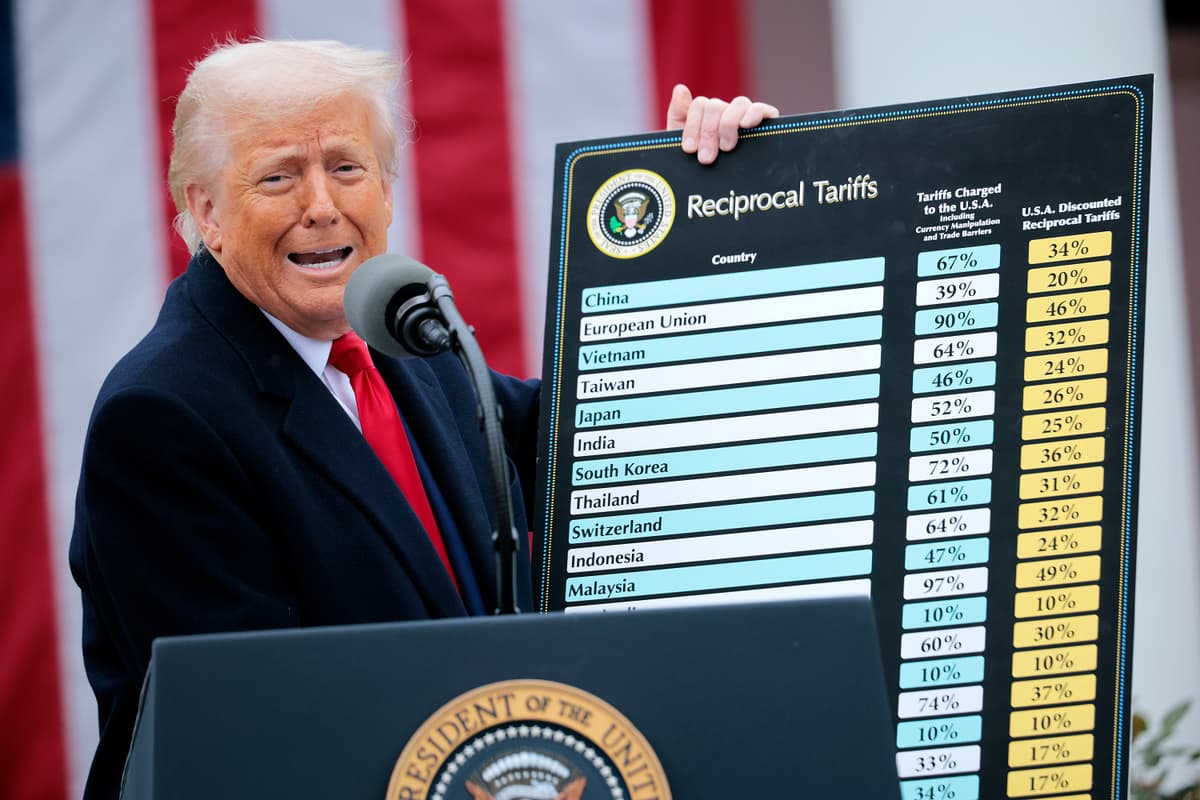
The future of President Trump’s “reciprocal” tariffs is expected to head to the Supreme Court after a federal appeals court panel ruled 7-4 that they overstepped the president’s authority.
The panel of 11 judges from the United States Court of Appeals for the Federal Circuit upheld a decision by a lower court in V.O.S. Selections v. Trump that found the president does not have the power to levy the 10 percent tariffs he declared on most countries on April 2, now known as Liberation Day.
The decision, released late Friday, states that, “Contrary to the Government’s assertion, the mere authorization to ‘regulate’ does not in and of itself imply the authority to impose tariffs. The power to ‘regulate’ has long been understood to be distinct from the power to ‘tax. The appeals court will allow the tariffs to remain in effect through mid-October to give the Trump administration time to file an appeal with the Supreme Court.
Mr. Trump has made the tariffs a cornerstone of his economic policy since returning to the White House. He adjusted the rates earlier this month with countries like Canada facing much higher tariffs.
He criticized the appeals court decision in a post on his Truth Social account. “ALL TARIFFS ARE STILL IN EFFECT! Today a Highly Partisan Appeals Court incorrectly said that our Tariffs should be removed, but they know the United States of America will win in the end,” he said.
“If these Tariffs ever went away, it would be a total disaster for the Country. It would make us financially weak, and we have to be strong,” he went on to say.
Mr. Trump then forecast that he will ultimately prevail. “Now, with the help of the United States Supreme Court, we will use them to the benefit of our Nation,” he said, referring to the tariffs.
The appeals court ruling was hinted at during a hearing last month, when some of the judges on the panel seemed skeptical of the president’s use of the International Emergency Economic Powers Act to declare the federal trade deficit a national emergency as a justification for his import taxes.
“We conclude they are not,” the majority ruling Friday confirmed.
The Constitution gives Congress the power to impose tariffs on imports but Congress has delegated its authority in recent decades by passing several laws allowing the executive branch to impose the levies in various circumstances.
The Congressional Research Service found in April that an Emergency Economic Powers law may give the president authority to impose tariffs under “certain circumstances during specific kinds of national emergencies.”
Judge Richard Taranto, who was appointed by President Obama in 2013 and previously clerked for Justice Sandra Day O’Connor and Judge Robert Bork, indicated during arguments that he was sympathetic to the president’s argument.
In May, a three-judge panel on the United States Court of International Trade ruled that the Emergency Economic Powers law does not give the president “unbounded” authority to impose tariffs. The Trump administration appealed the ruling to the Federal Circuit, which put the lower court’s ruling on hold.
Members of the Trump administration have also claimed the country will suffer devastating economic consequences without the tariffs.
Solicitor General D. John Sauer says millions of jobs will be eliminated and the future of Social Security and Medicare will be threatened if money already collected through tariffs has to be refunded.
Treasury Secretary Scott Bessent claims that the large sums already collected will make it more difficult for the Supreme Court justices to rule against Mr. Trump. The White House has boasted that the administration has already collected a record $150 billion in taxes from imports.
Mr. Bessent previously indicated that any Supreme Court decision will not come until at least January, which would mean billions of dollars more of tariff income will be at stake.