

Trump, in Scheduled Summit With South Korea’s President, Is Expected To Seek ‘Flexibility’ in Military Relationship and Boost in Defense Spending

Coming in the aftermath of Trump’s summit with the Russian president, the Trump-Lee summit on August 25 could lay the groundwork for cooperation against not only North Korea but also Russia and Communist China.
AP/Ahn Young-joon
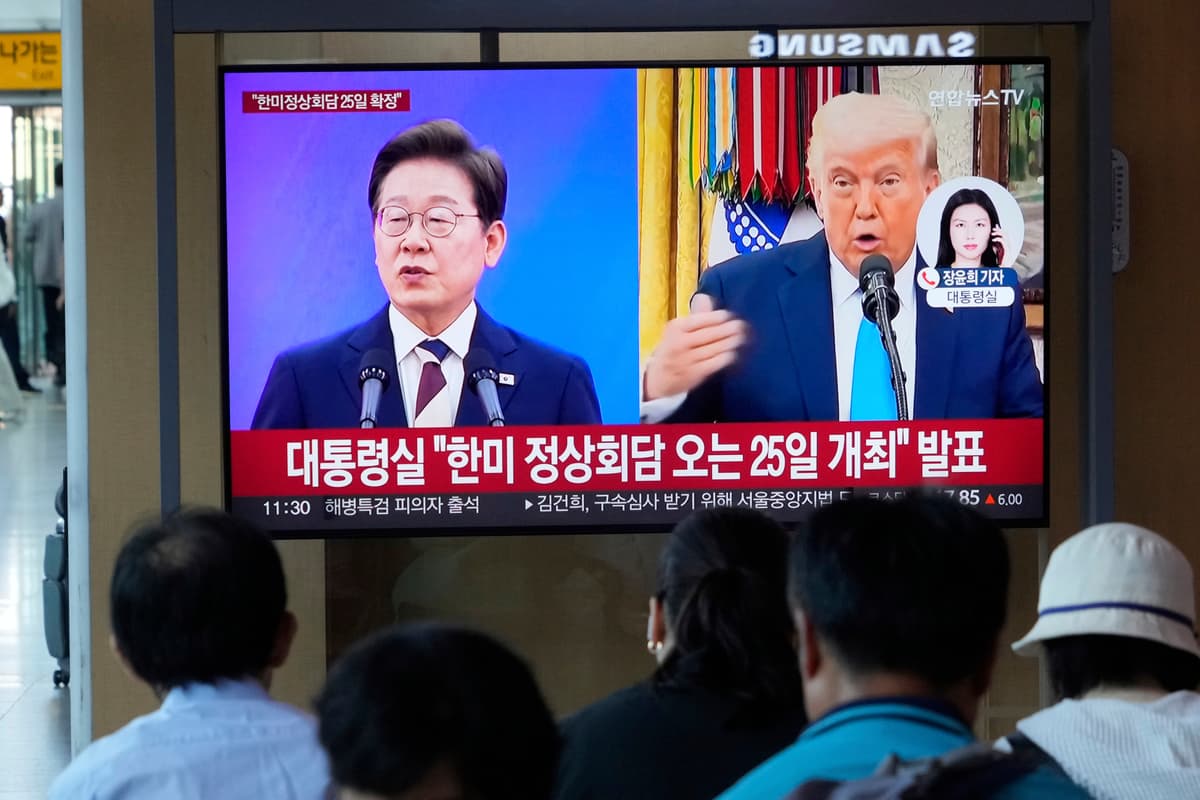
A TV screen at the Seoul Railway Station shows a file image of the South Korean president, Lee Jae Myung, and President Trump during a news program, August 12, 2025. AP/Ahn Young-joon

President Trump faces one of his most portentous meetings with a foreign leader when he hosts South Korea’s president, Lee Jae-myung, at the White House nearly two weeks from now.

Coming in the aftermath of Mr. Trump’s summit with President Vladimir Putin in Alaska on Friday, the Trump-Lee summit on August 25 could lay the groundwork for cooperation against not only North Korea but also Russia and Communist China. The commander of America’s 28,500 troops in South Korea, General Xavier Brunson, signaled the significance of the summit when he remarked at a briefing, “What’s being asked of Korea is to be stronger against” North Korea so that “we might have the flexibility as we modernize our alliance so that we could go do other things.”

The terms “burden-sharing” and “strategic flexibility” are sure to resonate as Mr. Trump and his team, including the defense secretary, Pete Hegseth, and the secretary of state, Marco Rubio, in his dual role as national security adviser, try to persuade Mr. Lee to invest more in South Korea’s defense budget, which this year stands at $44.2 billion, 2.3 percent of the country’s 2025 gross domestic product. 

Mr. Trump may ask South Korea to boost its defense budget to almost 5 percent of GDP and to offer far more for the American troops and bases defending the South. Mr. Trump during his first presidency suggested the South pay $5 billion a year, but Seoul now contributes about $1.1 billion a year under a deal negotiated during Mr. Biden’s presidency.

Messrs. Trump and Lee, however, have both been talking about reopening dialogue with the North. It has been stymied while the North’s leader, Kim Jong-un, avoids any dealings with Seoul after declaring South Korea the “enemy.”

Mr. Trump has said he would “reach out” to Mr. Kim, whom he first met in Singapore in 2018 and then twice more in 2019, at Hanoi and then on the line between the two Koreas. Mr. Lee has often said he too wants to meet Mr. Kim, and  as a sign of his desire for reconciliation he’s halted propaganda blasts into the North via loudspeakers.

While declaring that North Korea won’t yield to American demands for “complete, verifiable, irreversible denuclearization,” Mr. Kim’s younger sister has signaled her brother’s possible assent by stating his relationship with Mr. Trump is “not bad.”

Messrs. Trump and Lee may differ when it comes to “strategic flexibility.” That phrase means America’s troops in South Korea should be able to go anywhere from bases in the South — most notably in case of war with China over Taiwan.

Mr. Lee is not likely to endorse that idea, considering that China is the South’s biggest trading partner and North Korea’s strongest ally, believed responsible for dissuading Mr. Kim from ordering more nuclear tests since the North’s sixth, most recent test nearly eight years ago. Allowing America to respond to “China-related contingencies,” Seoul’s Yonhap News said, would be a departure from the “traditional dedication” of American forces “to deterring North Korean threats.”

Messrs. Trump and Lee should also talk about American-Korean joint military exercises, which begin in several days and will be going on when Mr. Lee gets to Washington.

As leader of the South’s left-leaning Minju, or Democratic Party, Mr. Lee has toned down the hawkish policies of his conservative predecessor, Yoon Suk-yeol, who was impeached, ousted, jailed, and is on trial for his abortive attempt at imposing martial law last December. Yet Mr. Lee did not cancel the military exercises, as some had feared.  

The South, however, has decided “to reschedule certain training events to next month,” a South Korean military spokesman said, delicately implying they may be canceled. North Korea is responding to the war games with the usual rhetoric, warning of “negative consequences” and “resolute counteraction,” according to Pyongyang’s Korean Central News Agency.

Yet the idea of peace is sure to dominate much of the Trump-Lee summit. South Korea’s unification minister, Chung Dong-young, has hinted he will present a proposal for reconciliation similar to “Make America Shipbuilding Great Again,” Seoul’s promise to invest hundreds of millions of dollars in America in exchange for Mr. Trump holding down tariffs.

A Korean spokeswoman seemed confident Messrs Trump and Lee would see eye to eye. Yonhap quoted her as saying they “share the position that they are open to dialogue with North Korea to promote peace on the Korean Peninsula and peacefully resolve North Korean nuclear issues.”


The New York Sun

© 2025 The New York Sun Company, LLC. All rights reserved.

Use of this site constitutes acceptance of our Terms of Use and Privacy Policy. The material on this site is protected by copyright law and may not be reproduced, distributed, transmitted, cached or otherwise used.

The New York Sun

Sign in or  create a free account

or
By continuing you agree to our Privacy Policy and Terms of Use