Trump Lawyer Faces Skeptical Judges at Hearing in Case That Could Limit President’s Power To Set Tariffs

The White House says it has collected $150 billion in taxes from American importers so far in 2025.

AP/Matt Rourke
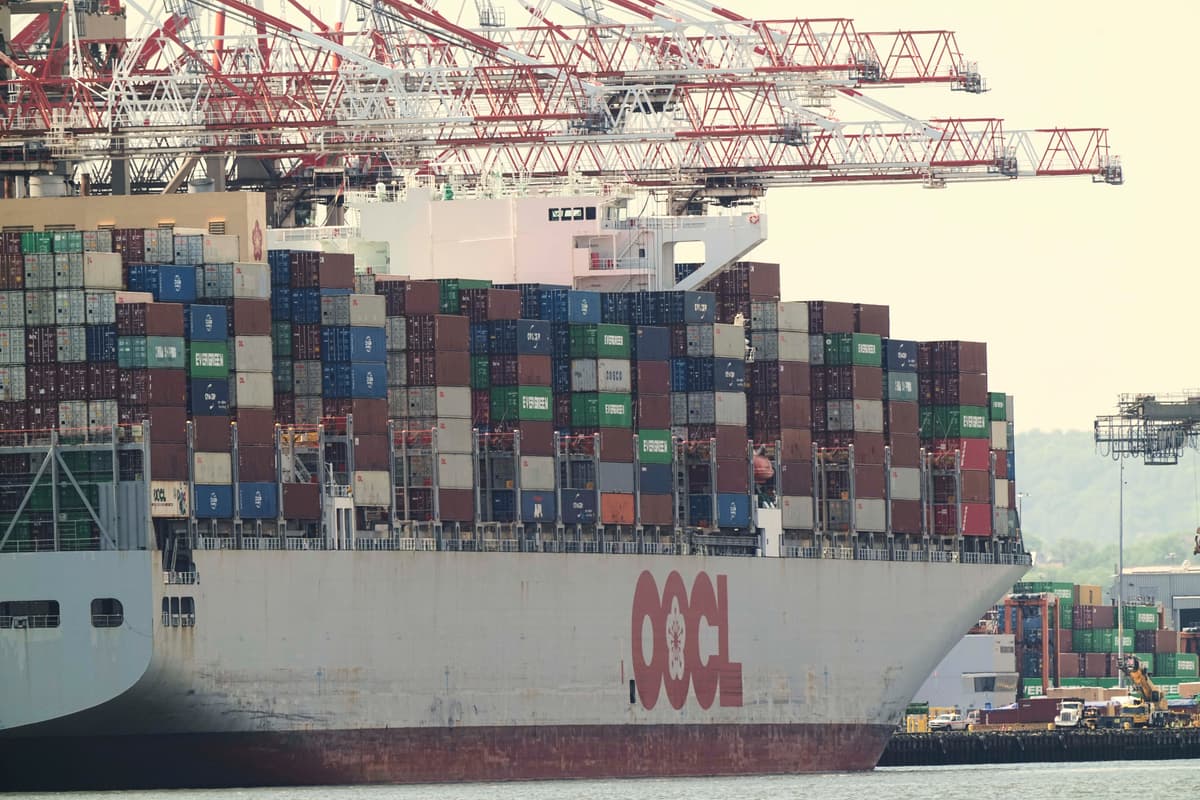
A container ship is moored at the port of New York, May 12, 2025. AP/Matt Rourke

A unique federal appeals court will soon decide the fate of President Trump’s “reciprocal” tariffs plan after a lawyer opposing the levies argued the president is making a “breathtaking claim to power.”

A panel of 11 judges from the United States Court of Appeals for the Federal Circuit heard arguments Thursday in the case. The circuit judges are reviewing a decision by a lower court in V.O.S. Selections v. Trump that found the president does not have the power to levy the 10 percent tariffs he declared on most countries on “Liberation Day” in April.

Some judges on the panel seemed skeptical of the president’s use of the International Emergency Economic Powers Act to declare the federal trade deficit a national emergency as a justification for his import taxes.

The White House boasted earlier this week that the administration has collected a record $150 billion in taxes from American importers so far in 2025, 

A Department of Justice lawyer admitted the act has never been used to levy tariffs, but argued that its language giving the president power to “regulate” trade gives Mr. Trump wide-ranging authority, including the option of using tariffs.

“These tariffs deal with the emergency by giving the president leverage,” the justice department attorney, Brett Shumate, argued, saying that the levies are being used as bargaining chips.

An Obama administration solicitor general, Neal Katyal, argued for the plaintiffs that the act doesn’t even mention the word tariffs and that Mr. Trump has made a “breathtaking claim to power that no president has asserted in 200 years, and the consequences are staggering.”

Mr. Katyal said the United States has had trade deficits for 50 years. Mr. Shumate argued that they had accelerated in the past five years and had reached a “tipping point” that threatened American security.

The Constitution gives Congress the power to impose tariffs on imports but Congress has delegated its authority in recent decades by passing several laws allowing the executive branch to impose the levies in various circumstances.

The Congressional Research Service found in April that the Emergency Economic Powers law may give the president authority to impose tariffs under “certain circumstances during specific kinds of national emergencies.”

Mr. Shumate leaned on the precedent of United States v. Yoshida International, Inc. to argue the administration’s case. That case involved an emergency 10 percent tariff President Nixon imposed for a few months in 1971, prior to the Emergency Economic Powers law’s enactment. A federal appeals court upheld Nixon’s right to apply temporary targeted tariffs. Mr. Trump’s tariffs are more sweeping, though, and appear to be open-ended.

Judge Richard Taranto, who was appointed by President Obama in 2013 and previously clerked for Justice Sandra Day O’Connor and Judge Robert Bork, indicated during arguments that he was sympathetic to the president’s argument.

In May, a three-judge panel on the United States Court of International Trade ruled that the Emergency Economic Powers law does not give the president “unbounded” authority to impose tariffs. The Trump administration appealed the ruling to the Federal Circuit, which put the lower court’s ruling on hold.

The judges of the Court of Appeals that held Thursday’s hearing have been nominated by every administration since President Reagan, with the exception of Mr. Trump, who has no appointees on the bench.

Thursday’s hearing ended without a decision and it is unclear when the court will rule. Regardless of the outcome, the case is expected to be appealed and eventually end up at the Supreme Court.

A director at the Cato Institute, which filed a brief in support of the case against the government, was hopeful after the hearing. A ruling that the Emergency Powers law doesn’t authorize tariffs would be the “cleanest and simplest way to resolve this case, and it appears that the Federal Circuit may be leaning toward that result,” Thomas Barry stated on X

Mr. Trump has claimed the tariffs are a matter of survival for the country. Before the hearing he posted to Truth Social, “Good luck in America’s big case today. If our Country was not able to protect itself by using TARIFFS AGAINST TARIFFS, WE WOULD BE ‘DEAD,’ WITH NO CHANCE OF SURVIVAL OR SUCCESS.”


The New York Sun

© 2025 The New York Sun Company, LLC. All rights reserved.

Use of this site constitutes acceptance of our Terms of Use and Privacy Policy. The material on this site is protected by copyright law and may not be reproduced, distributed, transmitted, cached or otherwise used.

The New York Sun

Sign in or  create a free account

or
By continuing you agree to our Privacy Policy and Terms of Use