Trump Looks to South Korea To Help ‘Make American Shipbuilding Great Again’
An American admiral waxes enthusiastic about a South Korean nuclear submarine.
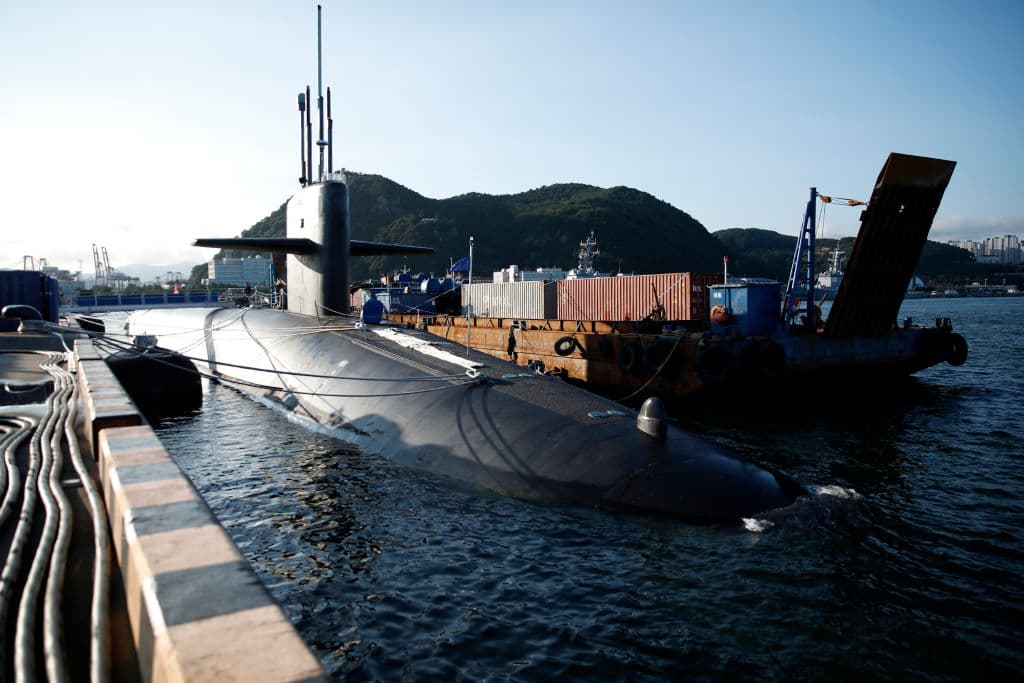
SEOUL —The Pentagon sees a South Korea nuclear submarine as a powerful new force in the struggle against Communist Chinese military expansionism in the Indo-Pacific.
America’s top sailor, Admiral Daryl Caudle, visiting South Korea, predicts a South Korean nuclear submarine would join allied warships in confronting Chinese threats from the South China Sea to the waters surrounding the independent Chinese province of Taiwan to the Yellow Sea between the Korean peninsula and northeastern China.
Korea “shares concerns with China,” Admiral Caudle, chief of naval operations, remarked as he toured Korea’s two biggest shipbuilders, Hyundai Heavy Industries and Hanwha Ocean. “Utilization of that submarine to counter China is a natural expectation.”
Admiral Caudle waxed enthusiastic about a South Korean nuclear submarine after the White House and the South Korean government released a “fact sheet” on President Trump’s meeting with South Korea’s President Lee Jae-myung in Busan in October welcoming South Korea’s vision of its first nuclear sub and agreeing on reprocessing the nuclear fuel to keep it afloat.
Admiral Caudle avoided saying whether the nuclear sub would be built in Philadelphia, as Mr. Trump had indicated, or in South Korea, as South Korean officials have urged, but his outlook reflects American pressure on Seoul to increase military strength for potential conflicts far beyond the Korean peninsula.
South Korea’s president, Lee Jae-myung, has opposed exercises that would antagonize China, the South’s biggest trading partner, while acceding reluctantly to. demands for “flexibility “in deploying American forces in Korea elsewhere in the region.
South Korean shipbuilders, in contrast, are totally supportive of President Trump’s vision of resurrecting American shipbuilding exemplified by the slogan to “Make American Shipbuilding Great Again” — better known by the acronym MASGA. Hanwha, whose shipyard in Korea has provided 24 diesel-powered submarines for the American Navy, now owns the “Philly Shipyard” where it hopes to build the nuclear submarine, a project that would take between six years and ten years.
South Korea “will build its own submarines, and the U.S. will provide support, including ways to provide the enriched uranium fuel for the reactors,” said a former senior American diplomat in Korea, Evans Revere, but Korean officials cite the inexperience of the Philly Shipyard in military shipbuilding as a reason to build the South’s first nuclear submarine in Korea.
“The Philly shipyard does not have the capacity to build subs, either ours or those of the ROK (Republic of Korea),” Mr. Revere told The New York Sun. South Korea is “also seeking American approval to expand civilian uranium enrichment and reprocess spent reactor fuel, and it sounds as if some progress was made on these issues.” Still, he said, “more work needs to be done” though “the direction has been set.”
There’s no avoiding, however, the danger of provoking China. Mr. Revere said “the ROK under President Lee has been mindful not to alienate the PRC [People’s Republic of China].” Also, he said, “very conscious of the North Korean threat,” Seoul has been “careful about using provocative rhetoric against the North.”
In the face of American emphasis for “flexibility” in deploying forces from South Korea, Mr. Revere said Mr. Lee was “frustrated with U.S. demands and under fire from some domestic critics.”
Admiral Caudle, however, was upbeat. Seoul’s Yonhap News quoted him as saying that Washington would expect, “working as an alliance together,” for South Korea “to meet our combined goals on what the United States considers to be our pacing threat, which is China.”
South Korea “shares concerns with China as well,” he said. “That capability should be part of that equation.”