
Trump, Pressuring Venezuela With ‘Largest Armada’ in the Hemisphere’s History, Resurrects the Monroe Doctrine

In escalation against Maduro, president is declaring Venezuela’s airspace closed, launching a ‘blockade’ to enforce sanctions, and seizing an oil tanker.
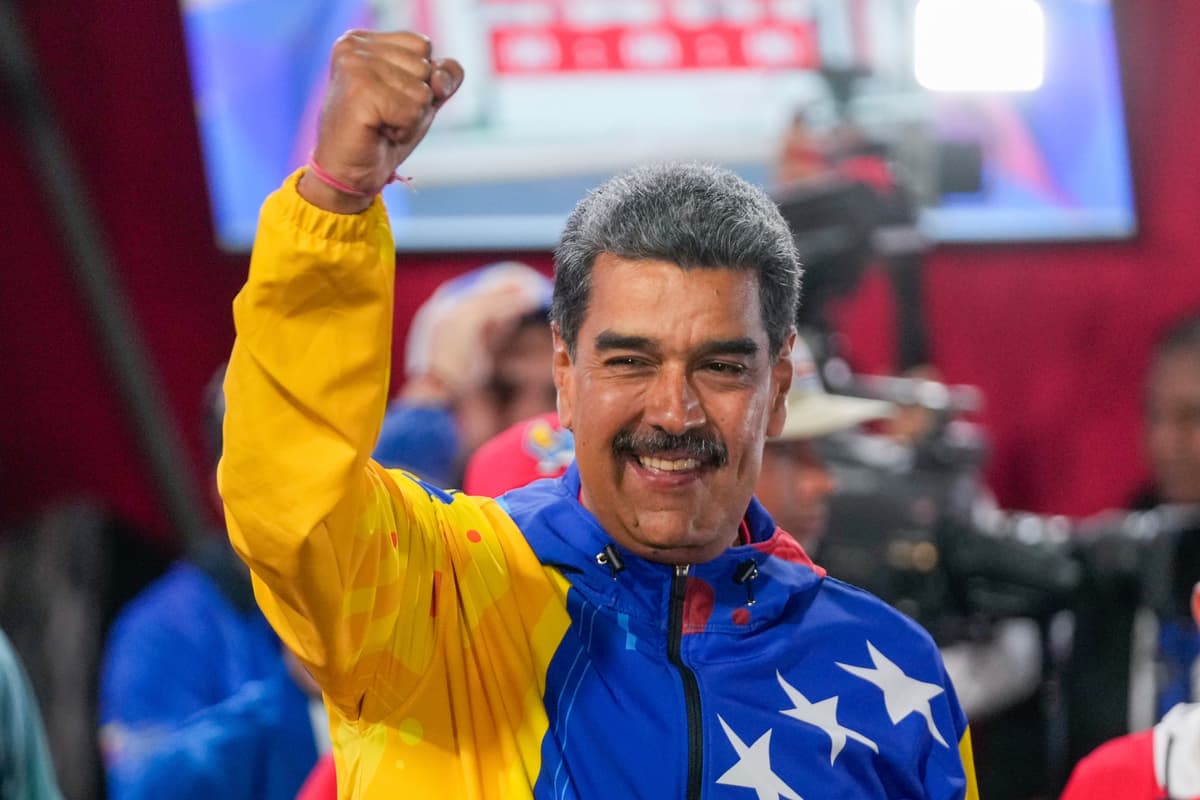
AP/Fernando Vergara
President Maduro at Caracas, Venezuela, July 29, 2024. AP/Fernando Vergara

President Trump is putting military pressure on Venezuela’s president, Nicolas Maduro, an ally to Russia. The policy invokes President Monroe’s doctrine of 1823 closing the Western Hemisphere to colonization, and President Theodore Roosevelt’s corollary asserting a will to act as an “international police power” in Latin America.

Mr. Trump wrote in a Truth Social post on Tuesday that “the illegitimate Maduro Regime” is using oil revenue “from these stolen oil fields to finance themselves, drug terrorism, human trafficking, murder, and kidnapping.” He said the country “is completely surrounded by the largest armada ever assembled in the history of South America.”

Last week at Joint Base Andrews, Mr. Trump told reporters that he seeks to get “land, oil rights, whatever we had” returned by Mr. Maduro. “They took it away,” he said of the nationalizations by the socialist government, “because we had a president that maybe wasn’t watching.”

President Vladimir Putin spoke with Mr. Maduro last week to, according to a Kremlin statement, stress his support “in the face of growing external pressure.” Mr. Trump is pushing for Maduro’s removal, declaring Venezuela’s airspace closed, launching a “blockade” to enforce sanctions, and seizing an oil tanker.

TR
A cartoon from 1904 depicts President Theodore Roosevelt wielding his ‘big stick’ in the Caribbean. Via Wikimedia Commons

The blockade is a stark escalation. During the Cuban Missile Crisis, President Kennedy sent the United States Navy to intercept Soviet ships when he discovered that the Kremlin was building nuclear sites on the island. However, he made a point to call it a “quarantine,” as a blockade is an act of war.

Mr. Maduro accused Mr. Trump of “warmongering and colonialist pretense” on Tuesday. Since 2024 under President Biden, America has held that Mr. Maduro rigged his reelection and recognized an opposition leader, Edmundo Urrutia, as Venezuela’s legitimate leader.

On Sunday’s “Meet the Press,” the 2024 Nobel Peace Prize winner, María Machado, backed America’s gunboat diplomacy. “I absolutely support,” she said, “President Trump’s strategy, and we, the Venezuelan people, are very grateful to him and to his administration, because I believe he is a champion of freedom in this hemisphere.”

America’s embrace of the Monroe Doctrine ebbed as America turned its attention to Europe. The doctrine’s biggest test was during Venezuela’s 1895 boundary dispute with British Guiana. When the U.K. threatened to draw a new border with force, President Cleveland threatened war. London agreed to arbitration.

In 1902, Germany, Italy, and the U.K. blockaded Venezuela when it refused to pay its debts. TR pressured the belligerents and — after a ruling against Caracas at The Hague — announced his corollary to prevent future European militarism. 

Now, Mr. Trump is reasserting the Monroe Doctrine as part of a global strategy. On Tuesday at the United Nations, Beijing bristled at the president’s efforts to limit their influence over the Panama Canal, built by TR. The White House has also reimposed the Kennedy-era embargo on Cuba.

President Kennedy, 1963.
President Kennedy, 1963. AP

According to a declassified State Department memo in October, Havana supplies more foreign troops to Russia’s war in Ukraine than any nation except North Korea. Facts like that are a reminder that what happens in Latin America can impact on Washington’s foreign policy goals elsewhere.

In the 1930s, President Franklin Roosevelt repudiated his distant cousin’s corollary in favor of the Good Neighbor Policy. Yet the Monroe Doctrine surged back during the Cold War. Presidents Eisenhower and Kennedy invoked it when Cuba joined the Soviet Bloc as did President Reagan to confront Nicaragua’s Kremlin-backed Sandinistas.

By 2013, the Cold War was long over and President Obama’s secretary of state, Senator John Kerry, announced the “era of the Monroe Doctrine is over” at the Organization of American States. His remark received what the Wall Street Journal described as “tepid applause,” prompting him to say it was “worth applauding” and “not a bad thing.”

Mr. Kerry may have thought Latin America viewed the Doctrine as a relic of imperialism. But Latin Americans had good reason to fear being picked at by less-benevolent powers. Russia, Communist China, and Iran soon began expanding into the region, with the Kremlin leasing a port for its navy on Venezuela’s La Orchila island in 2018.

Furthering America’s interests in what Mr. Kerry called its “backyard” and being a “good neighbor” is a delicate balance. As Mr. Trump tries his hand at being the “international police power,” the world will see if Monroe’s policy for the hemisphere can deliver on its vision for the peace and security of all who live in it.


The New York Sun

© 2025 The New York Sun Company, LLC. All rights reserved.

Use of this site constitutes acceptance of our Terms of Use and Privacy Policy. The material on this site is protected by copyright law and may not be reproduced, distributed, transmitted, cached or otherwise used.

The New York Sun

Sign in or  create a free account

or
By continuing you agree to our Privacy Policy and Terms of Use