Trump Signs Japan Trade and Investment Deal, Offering a Ray of Hope to Beleaguered Japanese Prime Minister
With Ishiba fending off reports that he would be resigning in a month following poor election results, the Japanese agree to pour $550 billion into investments in America while Washington imposes a 15 percent tariff on most Japanese products.
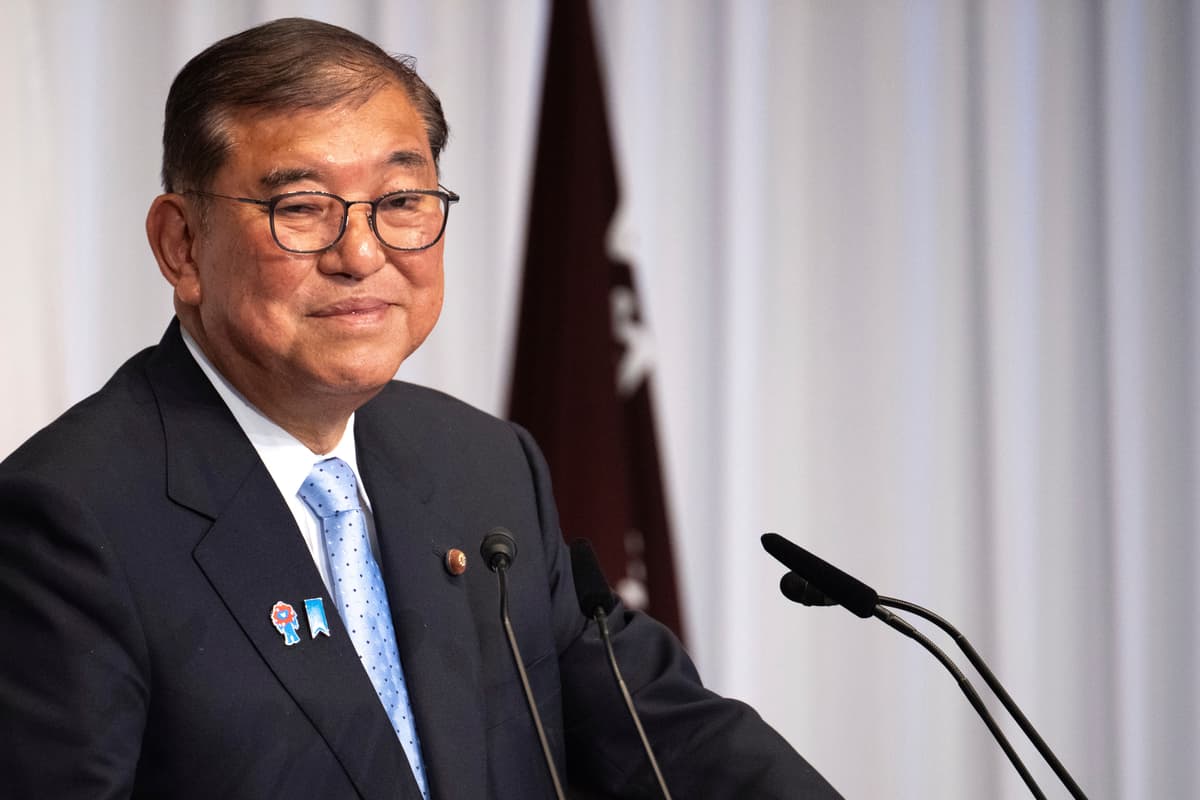
President Trump has come to the rescue of Japan’s beleaguered prime minister, Shigeru Ishiba, just as the Japanese leader was reeling from the blow of the humiliating results of elections for the upper house of the Japanese parliament, the Diet.
No sooner was Mr. Ishiba fending off reports that he would be resigning in a month than his top trade talker, Ryosei Akazawa, was off to Washington and a head-to-head with Mr. Trump on getting him to pare down the steep tariffs that were about to go into effect.
It was Mr. Akazawa’s eighth negotiating mission to Washington. By the time the talk was done, he and Mr. Trump had shaken hands on an agreement for the Japanese to pour $550 billion into investments in America while Washington imposes a 15 percent tariff on most Japanese products, notably motor vehicles.
That may seem high but is a lot better than the 25 percent tariff that Washington was going to slap on Japanese products beginning August 1. Nor does it mean both sides are getting a break on everything — Washington is still imposing 50 percent tariffs on Japanese steel and aluminum while Japan is not yielding on tariffs on American agricultural products, notably rice.
Messrs. Trump and Ishiba were both exultant — and obviously relieved — after coming to terms without jeopardizing the critical American-Japanese military alliance that forms a bulwark against Communist Chinese aggression from northeast Asia to the South China Sea and the western Pacific.
Not since Mr. Trump roiled markets by announcing sky-high “Liberation Day” tariffs in April — most of which have been watered down — has he put his name on such an important deal. His comments showed his enthusiasm for terms that could form a guideline for deals with others.
Mr. Trump, on Truth Social, predicted, “We will continue to always have a great relationship with the Country of Japan.” The prospect of $550 billion in fresh Japanese investment in American business and industry, he said, would “create hundreds of thousands of jobs” for Americans. “There has never been anything like it” — a claim that reflected the difficulties faced by American companies over the years while the Japanese flooded America with their products.
Back in Tokyo, Mr. Ishiba said the 15 percent tariff on Japanese exports to America was “the lowest figure to date among countries with trade surpluses with the United States.” Japanese exports to America last year exceeded imports by more than $63 billion — far below the $270 billion reaped by China but still a matter of concern to negotiators who have tried for decades to pry open often closed Japanese markets.
There was no doubt the deal would benefit Mr. Ishiba as he attempts to shake off the inroads that far-right parties have made on the conservative Liberal-Democratic-Party, in charge in Japan almost constantly since its founding in 1955. Mr. Ishiba was reluctant to say how long he would stay on the job but said he hoped to meet Mr. Trump soon — or at least talk to him by phone.
The agreement resulted from “our consistent advocacy and strong efforts to reach out to the United States,” Japan’s Kyodo news agency quoted Mr. Ishiba as saying. “We have engaged in negotiations to protect what must be protected and reach a deal that suits the national interests of both nations. This is a great achievement.”
The enthusiasm of Japanese business interests for the deal suggested that Japan would be the ultimate winner in a perpetual duel for markets that American business interests have always found frustrating while the forces of Japanese business and industry, often referred to as Japan Inc., stuck together.
“Persistent negotiations over a long period that focused on national interests bore fruit,” the chairman, Yoshinobu Tsutsui, of the Japan Business Federation, Keidanren, told a Japanese newspaper, Asahi Shimbun. The chairman of the Japan Foreign Trade Council, Tatsuo Yasunaga, was quoted as calling the deal a “major milestone.”