Trump Turns to Supreme Court for Authority To Deploy National Guard in Chicago

The Supreme Court has given the Illinois Attorney General’s office until 5 p.m. Monday to respond to the president’s filing.

Erin Hooley/AP
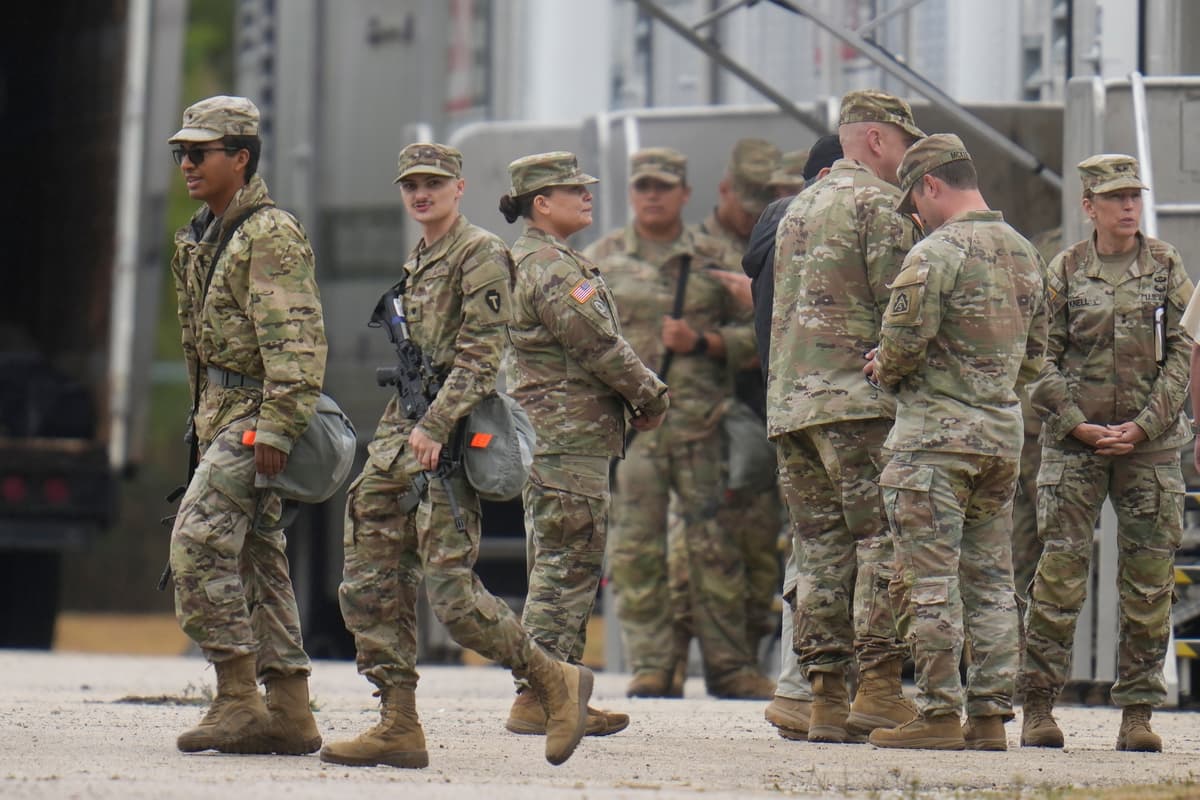
Military personnel wearing Texas National Guard patches are seen at a U.S. Army Reserve Center near Chicago on October 7, 2025. Erin Hooley/AP

The Illinois Attorney General’s office has been given until Monday to respond to President Trump’s latest move in the legal battle over immigration enforcement – a request that the Supreme Court overrule lower courts by allowing the immediate deployment of National Guard troops in the Chicago area.

In a 43-page filing submitted on Friday, Solicitor General John Sauer argued that federal judges lack the authority to interfere with presidential military decisions, calling lower court rulings “indefensible” and accusing them of “micromanaging” the Commander in Chief.

“A federal district court lacks not only the authority but also the competence to wrest control of the military chain of command from the Commander in Chief,” Mr. Sauer wrote.

The Supreme Court gave the Illinois Attorney General’s office until 5 p.m. Monday to respond to the filing.

In a social media post Friday afternoon, Governor J.B. Pritzker said: “Donald Trump will keep trying to invade Illinois with troops — and we will keep defending the sovereignty of our state. Militarizing our communities against their will is not only un-American but also leads us down a dangerous path for our democracy,” he wrote.

A series of lower courts haver ruled against the Trump administration on the issue. On October 9, U.S. District Judge April Perry issued a temporary restraining order, preventing the deployment of 300 Illinois National Guard members, along with 200 Texas guardsmen and 16 California troops that Mr. Trump had ordered federalized on October 4.

Judge Perry ruled there was “no credible evidence that there is a danger of rebellion in the state of Illinois.” Her decision came after the administration sought to deploy troops to protect federal immigration agents during enforcement operations in the Chicago area.

The 7th Circuit Court of Appeals upheld Judge Perry’s order this week, with a three-judge panel saying that “political opposition is not rebellion.” The panel included Trump-appointed Judge Amy St. Eve.

Mr. Sauer’s Supreme Court filing detailed alleged attacks on federal immigration agents, including incidents of slashed tires on Customs and Border Patrol and Immigration and Customs Enforcement vehicles. He said protesters have “aimed fireworks at agents and have thrown bottles, rocks, and tear gas at them.”

The filing accused Judge Perry of having “disregarded outright the evidence of violence proffered by federal officials” and “instead accepting the implausibly rosy assessment of state and local officials.”

Mr. Sauer argued that continued delays in deploying guardsmen puts agents’ lives at risk and described what he called “a disturbing and recurring pattern” of similar cases in Los Angeles and Portland, Oregon, where local federal judges have ruled against National Guard deployments.

Judge Perry – who was appointed to the bench last year after President Biden’s attempt to make her U.S. attorney for the Northern District of Illinois was blocked by Vice President J.D. Vance, then a senator – expressed skepticism about federal claims during last week’s hearing.

The judge noted that protests outside the ICE facility had “never exceeded 200 people” and said the Department of Justice’s arguments contributed to “a growing body of evidence that DHS’ version of events are unreliable.”

Judge Perry also suggested that federal agents were often the aggressors in clashes with protesters and predicted that deploying the National Guard “will only add fuel to the fire that the defendants themselves have started.”

State and city attorneys argue that Mr. Trump violated federal law by attempting to federalize the National Guard. They cite a federal statute that permits such action only under three specific conditions: invasion or threat of invasion, rebellion or danger of rebellion against the U.S. government, or when the president cannot execute federal laws through “regular forces.”


The New York Sun

© 2025 The New York Sun Company, LLC. All rights reserved.

Use of this site constitutes acceptance of our Terms of Use and Privacy Policy. The material on this site is protected by copyright law and may not be reproduced, distributed, transmitted, cached or otherwise used.

The New York Sun

Sign in or  create a free account

or
By continuing you agree to our Privacy Policy and Terms of Use