Trump v. Newsom: Appeals Court To Address California National Guard Deployment To Tamp Down Anti-ICE Unrest

Trial could set precedent on limits of presidential authority to deploy military forces on American soil.

AP/Eric Thayer
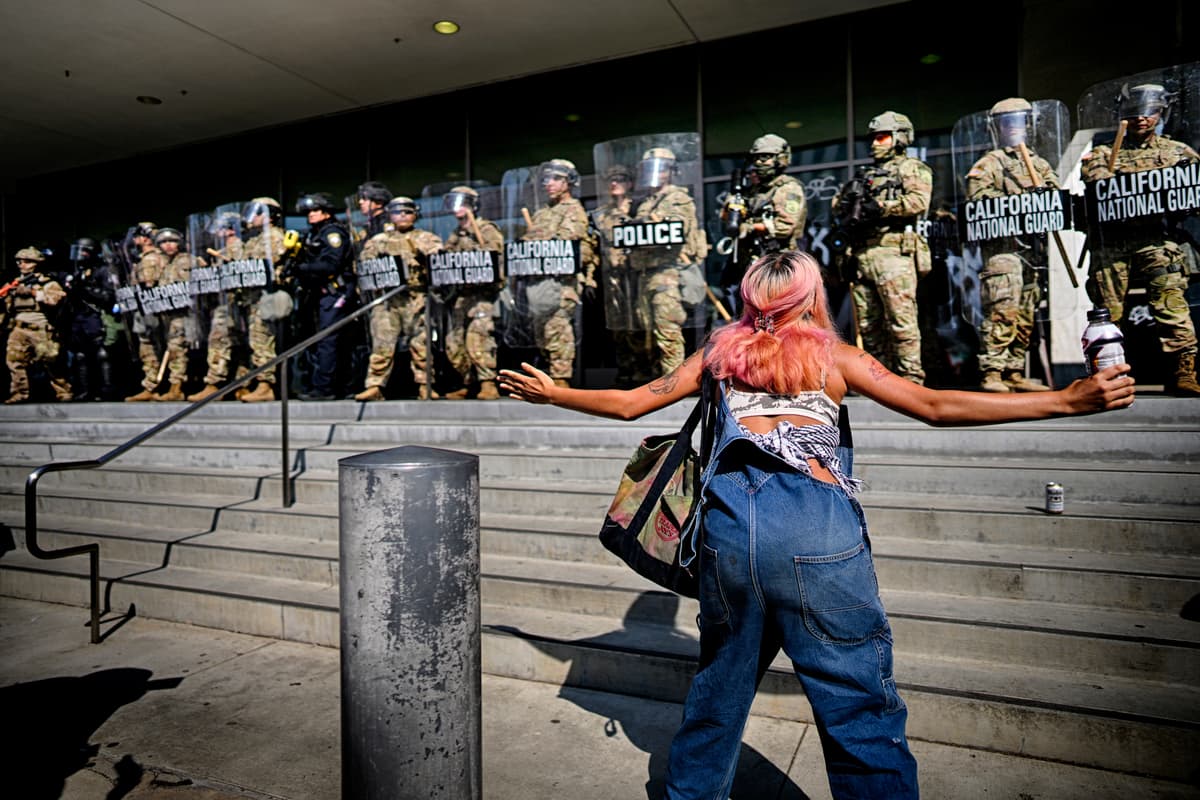
A protester taunts a line of California National Guard protecting a federal building at downtown Los Angeles. AP/Eric Thayer

Advocates for President Trump and California’s governor, Gavin Newsom, are preparing to face off in a federal court this week in a case that could redefine the president’s power to deploy military assets on American soil in cases of civil unrest.

Mr. Newsom is challenging Mr. Trump’s decision to deploy National Guard troops to Los Angeles during anti-ICE demonstrations earlier this summer. The Trump administration’s deployment of the National Guard over his objections, Mr. Newsom alleges, is an unlawful federalization of the state’s guard.

A federal appeals court initially ruled in favor of the Golden State, but San Francisco’s 9th U.S. Circuit Court of Appeals agreed to hear the Trump administration’s appeal and will review the case Monday.

Mr. Newsom, along with California’s attorney general, Rob Bonta, originally filed the lawsuit on June 9 against Mr. Trump and Defense Secretary Hegseth, alleging that they violated the Tenth Amendment and bypassed a requirement to gain consent from the governor’s office. The troops at issue were withdrawn from Los Angeles after the tumult died down.

Mr. Trump sought to have the case halted, arguing that its primary assertions — that the deployment was a violation of the 1878 Posse Comitatus Act, which prohibits the use of the military as a domestic police force — “fail as a matter of law.”

Mr. Newsom says that Mr. Trump’s decision to take control of California’s National Guard and deploy troops to Los Angeles following protests over federal immigration raids was an overreach that trampled on California’s sovereign authority over its own National Guard.

Mr. Trump’s legal team will argue that the deployment was fully justified under the Insurrection Act, which allows use of military forces in cases of widespread civil disorder or armed rebellion against the government of the United States.

The state of California says the criteria for enacting the deployment under the Insurrection Act were not met, asserting that there was no rebellion on the streets of Los Angeles, no breakdown of local governance, nor a request from the state for help. They allege that Mr. Trump’s order was an unlawful use of the military force and a violation of the Constitution.

The landmark case could reshape the boundaries of presidential power for generations, establishing crucial precedent for when and how a commander-in-chief can unleash military forces on American soil.

If the court sides with Mr. Newsom, the decision will strengthen boundaries around federal interference in military matters overseen by states while bolstering safeguards that prevent military forces from being used stateside. If Mr. Trump prevails in court, the ruling could broaden presidential powers during emergencies.

Mr. Trump has long been fond of the idea of dispatching military troops on American soil, repeatedly floating the idea during his first term and taking action to make it closer to a reality during his second term when he dispatched more than 2,000 troops to Los Angeles.

Last week, the president brought up the idea of using troops to protect the upcoming 2028 Olympic Games at the City of Angels. “We’ll do anything necessary to keep the Olympics safe, including using our National Guard or military, okay?” he said. “I will use the National Guard or the military — this is going to be so safe — if we have to.”

The following day, he suggested federalizing law-enforcement at Washington, D.C., after reports that a former DOGE staffer, Edward “Big Balls” Coristine, was violently attacked by a mob of teenagers during a carjacking.

“And what a shame. The rate of crime, the rate of muggings, killings, and everything else,” he  told reporters in the Oval Office. “We’re not going to let it — and that includes bringing in the National Guard maybe very quickly too.”


The New York Sun

© 2025 The New York Sun Company, LLC. All rights reserved.

Use of this site constitutes acceptance of our Terms of Use and Privacy Policy. The material on this site is protected by copyright law and may not be reproduced, distributed, transmitted, cached or otherwise used.

The New York Sun

Sign in or  create a free account

or
By continuing you agree to our Privacy Policy and Terms of Use