Trump’s Executive Order on Qatar Could Backfire on His Own Abraham Accords in the Middle East
‘Unprecedented’ promise of support if attacked emerges as the price of the new entente between Washington and Doha while the world waits for Hamas.
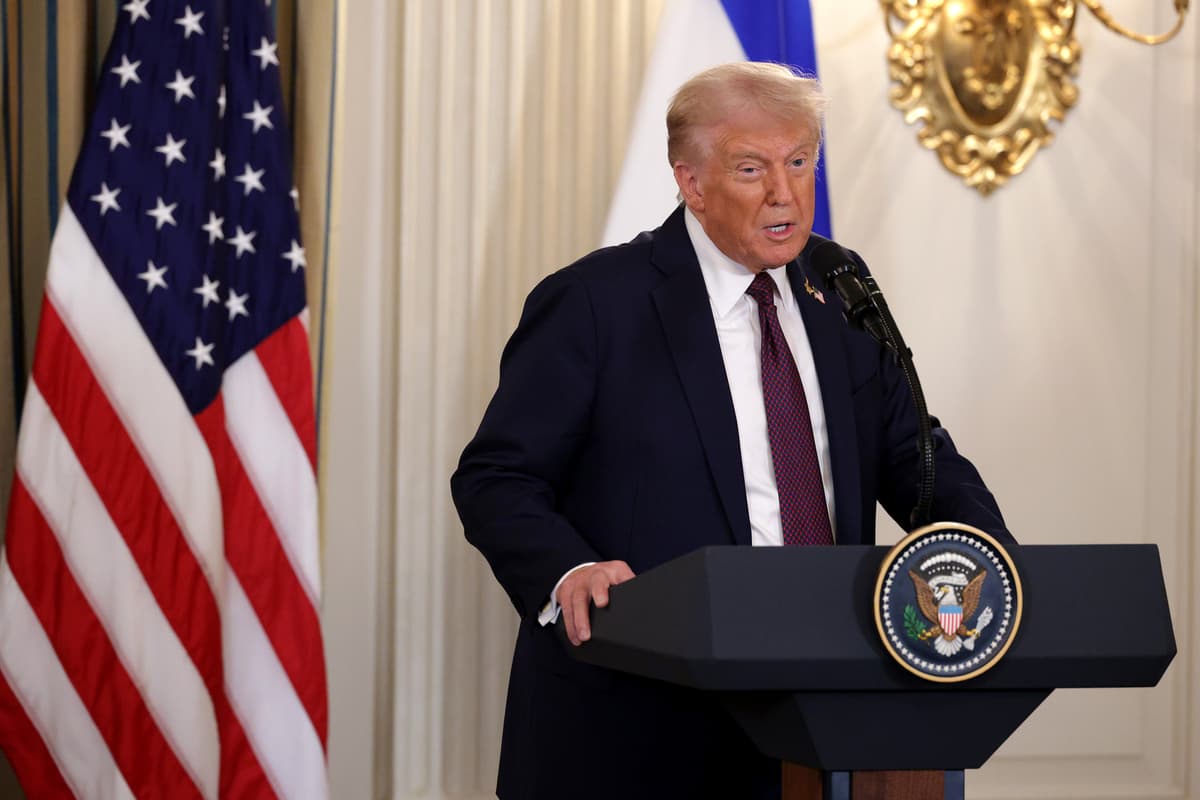

President Trump, in a move that could undermine his own hopes of widening the Abraham Accords, is extending to Qatar unprecedented defense privileges of which no other Arab ally of America could dream.
“The United States shall regard any armed attack on the territory, sovereignty, or critical infrastructure of the State of Qatar as a threat to the peace and security of the United States,” Mr. Trump writes in an executive order that was published by the White House on Monday.
The president of the Middle East Media Research, Yigal Carmon, tells the Sun that the “unprecedented order, which was demanded by Qatar following the Israeli bombing of Hamas, will have a counter effect as far as president Trump’s goals and expectations” that new countries will sign peace treaties with Israel.
“America’s true allies — Saudi Arabia, the United Arab Emirates, Bahrain, Jordan, Egypt — will see it as yet another proof that the only country President Trump considers as worthy is Qatar,” Mr. Carmon adds. “They will not show it, but the message will go deep down.”
Arabs have resented Qatar’s ruling Thani clan for decades. Some of the resentment is due to competition over regional leadership. Doha, though, also has long supported the Muslim Brotherhood, which undermines other Arab leaders. The government-owned Al Jazeera channel has encouraged rebellion in countries that attempt to modernize and push back against fundamentalist adherents of political Islam.
In 2017, therefore, the Saudi-led Gulf Cooperation Council canceled Qatar’s membership and launched a campaign to isolate the country. During a visit to Doha that year, this reporter heard growing grievances against Riyadh and its partners, highlighting the bad blood that one source characterized as “ancient feuds between Arab ruling clans.”
Officials and academics at Doha were outraged. In one highlighted episode, prized camels that the Saudis were scheduled to return to Qatar were instead stuck in the desert, dying of hunger and thirst on the border, which was sealed by Riyadh.
One of the architects of the 2017 Qatar isolation campaign was Mr. Trump. “We had a decision to make: Do we take the easy road, or do we finally take a hard but necessary action,” Mr. Trump said. “We have to stop the funding of terrorism,” he added. “Qatar, unfortunately, has historically been a funder of terrorism at a very high level.”
Qatar was returned to the Arab fold in 2021 under pressure from the Biden administration. This year, soon after Mr. Trump’s return to the White House, the 47th president scheduled, in May, his first trip abroad — to Riyadh and Doha. Despite a seeming united front, Arab regimes still resent Qatar’s leader, Emir Tamim bin-Hamad al-Thani, who maintains support for the Muslim Brotherhood and Hamas.
Mr. Trump’s defense pact with Qatar, therefore, is “bad policy, absent something concrete we don’t see yet,” a National Security Council member during Mr. Trump’s first term, Richard Goldberg, tells the Sun. One such unseen benefit may be pressure that Qatar could exert on the Hamas leaders it hosts, finances, and advocates for.
Such pressure could force Hamas to accept Mr. Trump’s plan to end the Gaza war. Until now the Biden and Trump administrations have considered Doha a mediator even as it in fact acted as a Hamas advocate. Critics say that even now Qatar is unlikely to turn on Hamas.
Last year Mr. Goldberg, now with the Foundation for Defense of Democracies, wrote an op-ed urging Washington to issue an ultimatum to Doha: “Shut down all support for Hamas and deliver the hostages, or suffer the consequences.” One such consequence, he wrote, could be to drop Qatar’s status as a non-NATO ally, and to designate it a state sponsor of terroism.
Instead, Mr. Trump’s new executive order is titled “Assuring the Security of the State of Qatar.” While such an order, unlike a Senate-ratified treaty, can be revoked, it effectively upgrades defense cooperation between the countries to nearly the same level as that of America and members of the North Atlantic Treaty.
Mr. Carmon, a longtime Qatar watcher, says he is detecting growing internal dissatisfaction with the despotic Thani family that rules Doha. Just recently, he notes, Qatari authorities issued a decree ordering the confiscation of unauthorized weapons, apparently for fear of an armed resurrection.
“In the end, President Trump will remain with only the ruling family of Qatar as his ally, since both Qatar’s neighbors and the emirate’s citizens will turn their back on him,” Mr. Carmon says.