Trump’s Firing of a Fed Governor, Lisa Cook, Heads Into Uncharted Legal Territory as Central Banker Prepares To Sue

The clash could test a century-old federal law and a Supreme Court precedent governing presidential authority over the central bank.

AP/Patrick Semansky
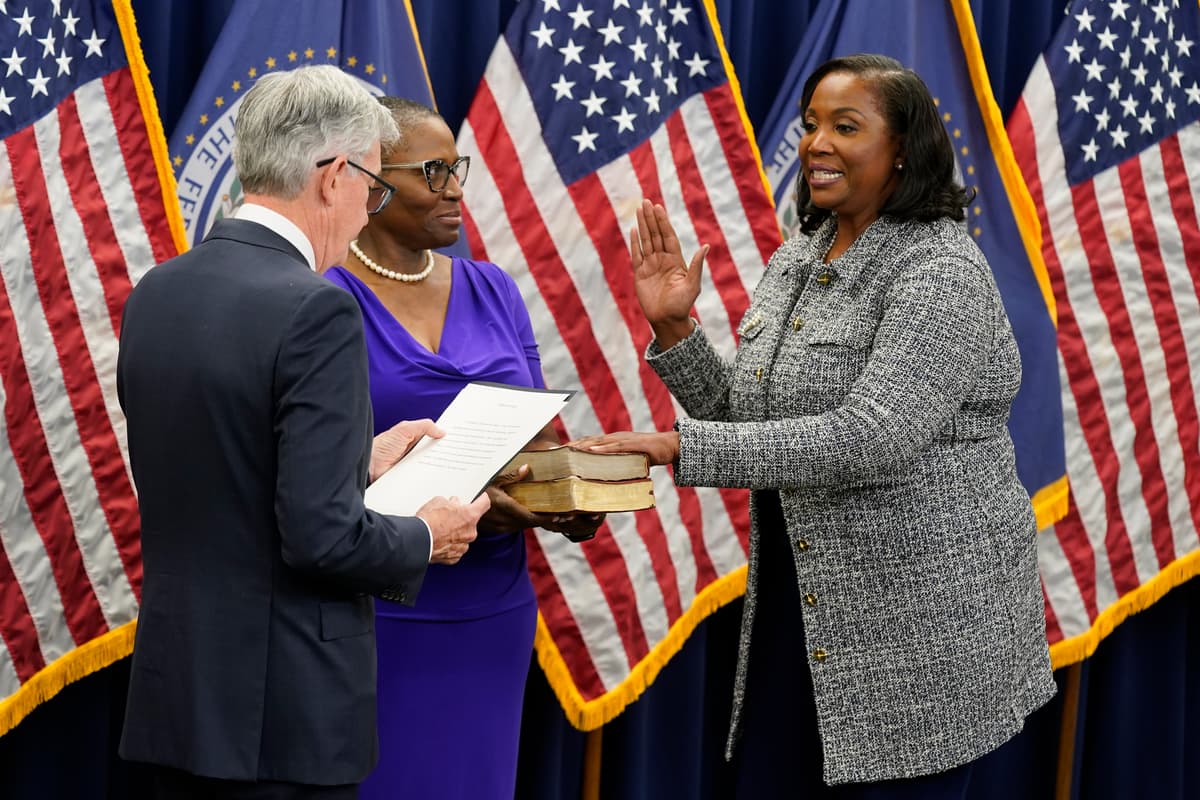
Lisa Cook takes the oath of office to become a member of the Federal Reserve Board at Washington, D.C., on May 23, 2022. AP/Patrick Semansky

Governor Lisa Cook of the Federal Reserve is preparing a lawsuit to challenge President Trump’s unprecedented attempt to remove her from office over alleged mortgage fraud, setting up a constitutional battle that could reach the Supreme Court and redefine the central bank’s independence.

“President Trump has no authority to remove Federal Reserve Governor Lisa Cook,” her attorney, Abbe Lowell, stated on Tuesday, escalating the constitutional showdown that began when Mr. Trump became the first president in the Fed’s 111-year history to fire a central bank governor.

“His attempt to fire her, based solely on a referral letter, lacks any factual or legal basis. We will be filing a lawsuit challenging this illegal action.”

In response to questions from The New York Sun, the Federal Reserve said, “Long tenures and removal protections for governors serve as a vital safeguard, ensuring that monetary policy decisions are based on data, economic analysis, and the long-term interests of the American people.

“The Federal Reserve will continue to carry out its duties as established by law.”

It is not yet clear who will be named as a defendant in the legal filing. Mr. Lowell has not responded to the Sun’s request for comment. The legal battle, though, will likely test the boundaries of a century-old federal law that broadly defines when a president can remove a Fed governor. The clash may also force the judiciary to re-examine Supreme Court precedent regarding the central bank’s independence.

The Federal Reserve Act of 1913 states that a president can fire a Federal Reserve Board member only “for cause,” but provides no clear definition of what constitutes adequate cause. Because no president has ever attempted to fire a Fed board member, the courts have never addressed this standard.

Mr. Trump’s case against the Fed governor centers on claims that Ms. Cook made false statements on mortgage applications before joining the Fed. The accusations were raised  last week by the Federal Housing Finance Agency director, Bill Pulte, and prompted the Department of Justice’s special attorney for mortgage fraud, Ed Martin, to open a criminal investigation. 

Mr. Pulte points to documents showing that Ms. Cook obtained mortgages for properties in Michigan and Georgia and listed both as her principal residence. He accuses her of “falsifying residence statuses” to “potentially secure lower interest rates and more favorable loan terms.” The documents in question would have been signed before Ms. Cook joined the Fed in 2022. Ms. Cook has not yet been charged with a crime. 

The president argues that Mr. Pulte’s evidence offers “sufficient cause” under the Federal Reserve Act to remove Ms. Cook from her position. In a termination letter sent to Ms. Cook on Monday, Mr. Trump claimed that her “deceitful and potentially criminal conduct in a financial matter” eroded his and the public’s “confidence” in her “integrity.”

“At a minimum, the conduct at issue exhibits the sort of gross negligence in financial transactions that calls into question your competence and trustworthiness as a financial regulator,” the president averred. 

The case opens legal issues extending far beyond the “for cause” standard. The Supreme Court signaled in a May 2025 preliminary ruling in Trump v. Wilcox that Fed governors enjoy special protections that other agency heads lack. While the court allowed Mr. Trump to remove two members from the National Labor Relations Board and Merit Systems Protection Board, it acknowledged limits to presidential firing power.

“The Federal Reserve is a uniquely structured, quasi-private entity that follows in the distinct historical tradition of the First and Second Banks of the United States,” the majority stated. 

The court’s carve-out was criticized by Justice Elena Kagen, who argued, “The majority closes today’s order by stating, out of the blue, that it has no bearing on ‘the constitutionality of for-cause removal protections’ for members of the Federal Reserve Board or Open Market Committee.” 

That case challenged a Supreme Court precedent set in a 1935 case, Humphrey’s Executor v. United States, which bars the president from firing heads of independent, multimember agencies for reasons other than “inefficiency, neglect of duty, or malfeasance in office.” The 1935 case was brought to the high court after President Roosevelt tried to oust a commissioner from the Federal Trade Commission, William Humphrey, over his policy positions. 

The Humphrey’s Executor precedent has for nearly a century curbed the president from exercising “illimitable power of removal” and shielded agencies with “quasi-judicial” or “quasi-legislative” powers, like the Federal Trade Commission and the Securities and Exchange Commission, among others, from White House influence. 

The Supreme Court appeared to lay groundwork for overruling Humphrey’s Executor in the 2020 case Seila Law v. Consumer Financial Protection Bureau, ruling that Congress cannot completely insulate agency heads from presidential removal. However, that case involved an agency headed by a single director, not a multimember board like the Fed.

Should Mr. Trump succeed in ousting Ms. Cook, it would give the president the opportunity to appoint a new governor and tip the balance toward Republican appointees — creating a four-to-three majority among the Fed’s board members. All board members hold voting rights on the Federal Open Market Committee, the 12-person body that sets interest rates, alongside five regional Federal Reserve Bank presidents.

Ms. Cook is the first black woman to sit on the Fed’s powerful board that sets interest rates. She is widely considered the board’s most liberal member. The Berkeley Ph.D. was confirmed in 2023 by a 51 to 50 vote of the Senate with Vice President Kamala Harris casting the tie-breaking vote. Republicans had accused Ms. Cook of being a left-wing extremist who supports reparations. She is in the second year of a 14-year term.

Mr. Trump had already gained an early opportunity to reshape the board this month when a Biden-appointed board member, Adriana Kugler, departed abruptly. The president nominated a White House economist and ally, Stephen Miran, to temporarily fill that seat while searching for a permanent nominee to serve a 14-year term.


The New York Sun

© 2025 The New York Sun Company, LLC. All rights reserved.

Use of this site constitutes acceptance of our Terms of Use and Privacy Policy. The material on this site is protected by copyright law and may not be reproduced, distributed, transmitted, cached or otherwise used.

The New York Sun

Sign in or  create a free account

or
By continuing you agree to our Privacy Policy and Terms of Use