
Trump’s First Six Months Have Been One Big Beautiful Bill

Contrary to the Democrats’ claims, the GOP’s new tax relief overwhelmingly benefits working-class families.

AP/Evan Vucci
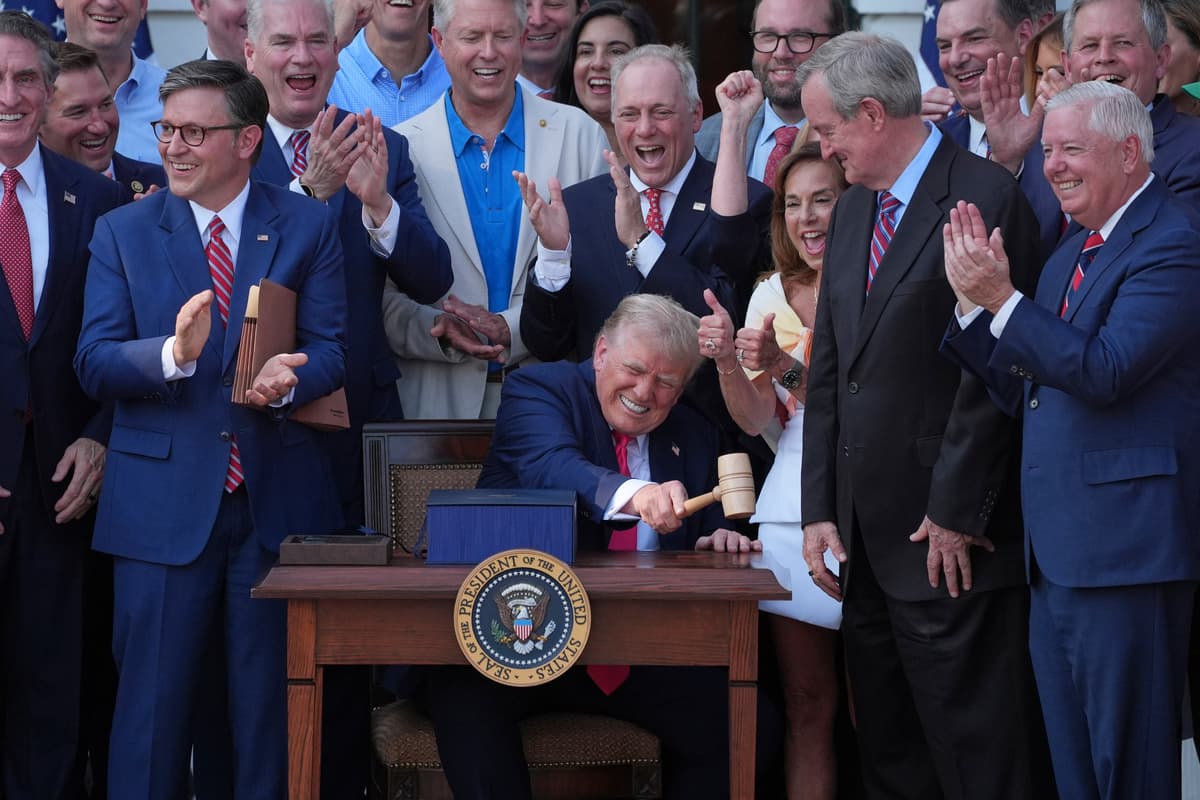
President Trump after signing the Big, Beautiful, Bill at the White House, July 4, 2025. AP/Evan Vucci

Over the past fortnight, President Trump has had a phenomenal run of successes, culminating in the signing of the One Big Beautiful Bill on July 4th — 249 years after the signing of the Declaration of Independence.

And let’s not forget what happened in this run-up.

Mr. Trump launched a bunker-buster raid on Iran, obliterating its nuclear facilities.

The Supreme Court gave him a thumbs up to deport illegal migrants to countries that are not their nation of origin.

NATO leaders agreed to 5 percent of GDP spending on defense.

The Supreme Court ruled that lower courts cannot set blanket nationwide injunctions.

Canada scrapped a digital services tax against American companies.

Border Patrol arrested just more than 6,000 people for illegal crossings — a new record low.

A trade deal was announced with Vietnam, a top 10 trading partner.

And there was an unexpectedly positive jobs report — which, among other things, showed that since January, native-born jobs increased by more than 2 million, and foreign-born jobs fell by 543,000.

And blue collar wages are rising, roughly twice as fast as prices.

And then — there’s the One Big Beautiful Bill.

Contrary to hysterical opposition by Democrats, who would have favored a $4 trillion tax hike, there are a couple of very important points to the huge tax cut and deregulation bill. These include new financing for border security and the military.

One point is that the new tax relief overwhelmingly benefits working-class families.

A study by the Joint Committee on Taxation — no friend of tax cuts — shows that the largest proportional tax benefits go to working Americans and families making less than $50,000 a year.

The single biggest tax cut is a 27 percent drop for those making between $15,000 and $30,000 a year.

Those earning between $30,000 and $40,000 a year get a 9.5 percent tax cut.

Those making between $40,000 and $50,000 a year get a 7.2 percent cut.

And those making $50,000 to $60,000 get a 5.6 percent cut.

If you make more than a million bucks a year — and there’s nothing wrong with that, by the way, I welcome their success — your tax cut is only 3.3 percent.

So the Democrats’ knee-jerk reaction about tax cuts for the rich is completely untrue.

Just as it has always been completely untrue.

Then there’s the Democratic charge that the bill will gut the safety net — also completely untrue.

So-called safety net savings come from cutting waste, fraud, and abuse — and especially from part-time work requirements, such as volunteering just 20 hours a week in order to get Medicaid or food stamps.

The public overwhelmingly supports these work requirements.

Democrats used to do so — when President Clinton worked with Speaker Gingrich on a successful policy to substitute workfare for welfare.

But these are not your father’s Democrats.

The party is moving rapidly toward socialism — and that is a political loser.

Meanwhile, as Steve Moore has pointed out, the bill advances school choice, medical savings accounts, mining and drilling on federal lands, prevents student loan forgiveness and electrical vehicle mandates, expands opportunity zones for the inner cities, and lowers tax rates for small businesses.

There’s tax relief for service workers’ tips, overtime pay, and a higher deduction for seniors on Social Security.

Full-cost expensing will be made permanent for machinery and equipment.

And, in one of the most powerful economic growth stimulants, factories will be eligible for immediate expensing over the next couple years.

That’s a huge winner for blue collar jobs and wages, and productivity, and — not least — for onshoring.

The administration estimates rocket-booster economic growth.

Real wages for working people could increase by $7,000 a year — and business investment by as much as 10 percent.

Meanwhile, real GDP could add a full percentage point increase that could drive the economy into the 3 percent to 4 percent growth zone.

And as a result, the growth dividend will increase revenues and cut borrowing by more than $5 trillion — and when added to nearly $3 trillion from tariff revenues, plus $1.5 trillion from interest savings and $1.6 trillion in discretionary spending cuts, the total deficit reduction could come to more than $11 trillion.

That will go a long way toward ending President Biden’s tax and spend and regulate and borrow policies that have done so much damage to the affordability of blue-collar Americans.

Mr. Trump calls it a new golden age.

Given all of the success of just the first six months of his new term — I’d say he’s right.

I’m taking the over.

From Mr. Kudlow’s broadcast on Fox Business Network.


The New York Sun

© 2025 The New York Sun Company, LLC. All rights reserved.

Use of this site constitutes acceptance of our Terms of Use and Privacy Policy. The material on this site is protected by copyright law and may not be reproduced, distributed, transmitted, cached or otherwise used.

The New York Sun

Sign in or  create a free account

or
By continuing you agree to our Privacy Policy and Terms of Use