
Trump’s New New Deal Overlooks Failure of FDR’s Depression-Era Attempt To Run the Economy From Washington

Kindred spirits on the left and right believe in a New Deal fable, as economist George Selgin makes clear in his new book, ‘False Dawn.’
Alex Wong/Getty Images
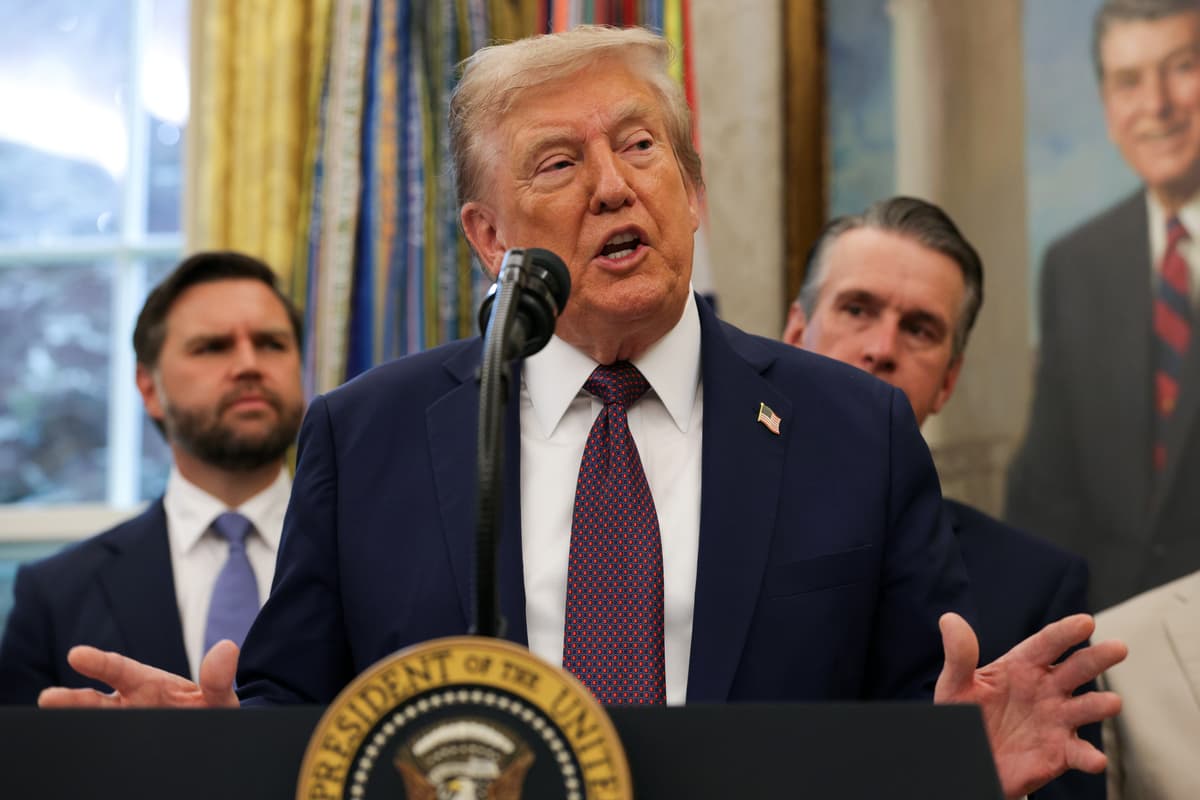
President Trump at the Oval Office on September 2, 2025. Alex Wong/Getty Images

Progressives’ retrospective aspiration for a new New Deal is shared by “national conservatives.” They, enthusiastic about the current administration, also believe government should comprehensively intervene in the economy, politically allocating capital (and therefore opportunity) to improve on the rationality of free markets.

Yet economist George Selgin’s latest book refutes progressives’ triumphalist nostalgia for the New Deal. It thereby demonstrates that “national conservatives” are oblivious regarding the cautionary lessons of President Franklin Roosevelt’s experience. These kindred spirits on the left and right should read “False Dawn: The New Deal and the Promise of Recovery, 1933-1947.”

Mr. Selgin mines a mountain of scholarship to prove this: New Deal measures failed to achieve, and often impeded, recovery from the Depression. Roosevelt’s most constructive achievement, executed on his second day in office, was the national bank holiday, a measure incubated by his predecessor, Herbert Hoover. This week-long banking shutdown in 1933 largely arrested the economy’s contraction. Recovery, however, required a decade, and World War II.

The Depression was, Mr. Selgin says, the first economic crisis the federal government tried to end by using all its resources. Yet the economy did not recover: It did not reach production consistent with full employment of the workforce until 1943.

At the end of the 1930s, the unemployment rate was 14.6 percent, higher than the October 2009 Great Recession peak of 11 percent. Until World War II, GDP was sometimes more than 30 percent, and never less than 20 percent, below its pre-Depression trend.

Direct payments to farmers (then 22 percent of the workforce) were funded by taxes on food processors (raising more revenue than either the personal or corporate income taxes). These costs were passed on to consumers. Crop-reduction programs raised farmers’ incomes by raising prices consumers paid. Yet taking acreage out of production — prosperity through scarcity? — added 2 million agricultural workers to the unemployed. Farm income in 1939 was still substantially below the 1929 level.

The New Deal’s core idea was a non sequitur: In a Depression prices fall, therefore recovery would come if prices were forced to rise. Hence the National Recovery Administration wrote (with business interests dominating the process) “codes of fair competition” cartelizing about 550 industries, outlawing competition that might lower prices. One manufacturer received this menacing letter:

“I feel sure that you will want to revise your prices so that they will bear a closer relation to those of your competitors [to avoid] an investigation to ascertain whether this price can be justified … such a procedure is of course unpleasant and costly.”

The NRA mandated cuts in employees’ weekly hours while forbidding cuts in total pay. So unemployment — as conventionally measured — declined, but largely because of such “work sharing.”

The 1940s began as 1939 had: Seventeen percent of the labor force was completely unemployed or on work relief, adults were working 20 percent fewer hours than in 1929, industrial production was still 10 percent below the 1929 peak. FDR’s incessant regulatory fidgets, and vocal hostility toward business, produced a climate of uncertainty that paralyzed investing, until war came.

The government-centric mentality that produced the New Deal produced apocalyptic forecasts of post-war distress from demobilized industrial capacity and manpower (10 million transitioning from military to civilian life). Instead, as government spending fell 40 percent in a year, federal revenue soared and the unemployment rate plummeted as the private sector hummed.

Post-war political culture reflected this learning: The war had been won by capitalism’s prodigious productivity: Defense industries were not nationalized during the war. And, Mr. Selgin writes, “the war gave a bad odor to anything that smacked of fascism, including the activist managerial state.”

Lessons are, however, forgotten. President Trump’s administration, ardently admired by “national conservatives,” is the most economically interventionist administration — by this important metric, it is the most progressive administration — since the New Deal.

The administration reportedly might give farmers, especially soybean growers, billions to replace the billions they are losing because — who could have anticipated this? — other nations, particularly Communist China, have imposed retaliatory tariffs in response to Mr. Trump’s protectionist spasms. 

Having semi-nationalized U.S. Steel, the administration has forbidden, surely for political reasons, the closure of an Illinois plant that the company thinks it would be economically rational to close. Such systemic inefficiencies multiply, draining dynamism from the economy. But progressives and “national conservatives” should purr contentedly: A new New Deal is here.

History has been called an early warning system. Mr. Selgin’s history warns us. So does this truism: What we learn from history is that we do not learn from history.

The Washington Post


The New York Sun

© 2025 The New York Sun Company, LLC. All rights reserved.

Use of this site constitutes acceptance of our Terms of Use and Privacy Policy. The material on this site is protected by copyright law and may not be reproduced, distributed, transmitted, cached or otherwise used.

The New York Sun

Sign in or  create a free account

or
By continuing you agree to our Privacy Policy and Terms of Use