Trump’s Real Estate Background Could Give Him Insight Needed To Forge Comprehensive Settlement With Israel and Its Neighbors
Because everything Trump does is automatically obscured in controversy, it is difficult for most to see the proportions of his accomplishment.
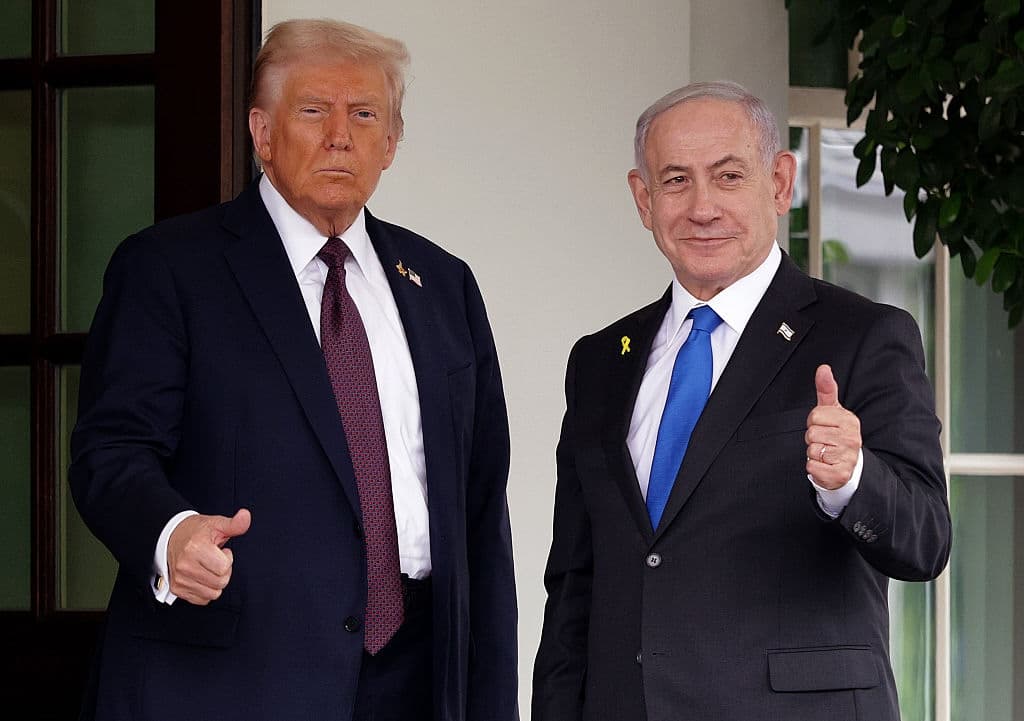

Events have moved so quickly and President Trump has done such an astonishingly efficient job of rounding up such a wide arc of support for a comprehensive settlement of relations between Israel and its neighbors that it is difficult not to be somewhat optimistic, suddenly, in an area and on a subject that has justified so little optimism for so long. Because everything Mr. Trump does is automatically obscured in controversy, it is difficult for most to see the proportions of his accomplishment.
It is a widely parroted view that as Mr. Trump has little direct experience in dealing with Middle Eastern factions, he has little natural skill at making progress in that uniquely complicated area. Yet it may be, as some discerning commentators have recently suggested, that his background as a real estate developer is precisely what gives him the insight to make the progress that he has in the Middle East.
The problem began in its modern phase of Jewish-Arab relations when the British government took it upon itself in 1917, when the area was ruled by the Ottoman Turks, to promise what had been known as Palestine as a homeland for the Jews without compromising the rights of the Arabs, effectively selling the same real estate to two parties simultaneously.
It has been fashionable as well as intellectually rigorous in the nearly two years of the present Gaza war to state that Israel cannot be expected to accept incorrigible terrorist entities on its borders. At the same time, the opinion has taken hold that extreme Arab nationalist organizations that consider the existence of a Jewish state in their midst to be so intolerable, it deprives them of any sense of their own sovereignty, cannot accept a two-state solution any more than Israel can.
Yet there is no other practical solution and the sequence of events that will bring it about is the destruction of the terrorist leadership of the neighboring Arab jurisdictions and their replacement by people who will accept the contiguity of a Jewish state as long as they are enabled to make a success of their own sovereignty.
We now know that when Hamas violated a cease-fire and invaded Israel two years ago and massacred more than 1,000 Israelis and took about 250 hostages, many of whom it has now murdered, Hamas and its Iranian masters thought that they had an excellent chance of raising a general Arab uprising in Israel and the West Bank and of sending a flying column to the walls of Jerusalem. This was not just another border skirmish, of which there have been many hundreds in the previous 75 year history of the state of Israel. It was an authentic threat to the continued existence of the Jewish state.
The Israeli response has profoundly altered the correlation of forces in the Middle East. The hostile Assad regime in Syria has fallen and been replaced with a fragile, and not entirely credible, government led by a former jihadist claiming to seek durable peace with Israel. Hezbollah, long the most powerful political force in Lebanon, which was also able to prop up Bashar Al-Assad in his later years in Damascus, has been so severely defeated and reduced by Israel that it can no longer avoid being disarmed by the miniature Lebanese army.
Iran, which is the ancient foe of the Arabs and which became the chief terrorism sponsor of the world and placed all its strategic bets on the development and deployment of nuclear weapons, was severely defeated in the air war with Israel and its entire $1 trillion nuclear military program was obliterated, Mr. Trump reported, in a matter of minutes by the United States, which suffered no casualties doing so.
No one publicly anticipated that Mr. Trump would, in the circumstances, be able to recruit all Western European and Arab opinion, as well as that of the leading non-Arab Muslim powers, Turkey, Indonesia, and Pakistan, to support the removal of Hamas influence in Gaza and of Hamas itself from Gaza, and to accept the legitimacy of the Jewish state of Israel, and commit to the reconstruction and deradicalization of Gaza and the profound reform of the West Bank in a general collective effort to rebuild a two state solution.
Because this arose so suddenly, and because Mr. Trump did it, there has been little recognition that it is the greatest diplomatic achievement in the Middle East since the founding of the state of Israel and is a gigantic step forward toward peace.
The days when the Arab governments distracted their populations from the misgovernment most of them inflicted upon them with the Palestinian issue, and there was a general canvas in the Arab world for the Palestinians has given way to a recognition of Israel’s value to the Arab world as a powerful ally against Iran, and even Turkey, whose historic encroachments upon the Arabs do not fade easily from their memories.
No one should be unaware of how close we now are to the general acceptance of the legitimacy of the state of Israel and the potential for peaceful development in that terribly blood-stained and hate-ridden area. It is almost impossible to believe that even so obtuse and fanatical an organization as Hamas does not now realize its choice is between the survival of those who are still alive, though defeated, and a miserable death beneath the rubble of Gaza. Despite their much publicized ambition for martyrdom, they are unlikely to choose this option.
Once again, America has shown itself to be the indispensable state. What an agreeable contrast this has been to the pusillanimous waffling of the Biden administration and the prostrations of appeasement of militant Islam of the Obama administration.