Trump’s Tariffs Are Raising Costs, Crimping Earnings for American Manufacturers That the Levies Were Meant To Aid
Bad news for Whirlpool and John Deere is being replicated across the economy, producing a paralytic uncertainty that is likely taking a toll on hiring.
Whirlpool, the American appliance maker, still is not happy. Vladimir Putin, however, seems to be. The American president is floundering on several fronts.
In 2006, Whirlpool paid $1.7 billion to buy its largest competitor, Maytag, and said competition from foreign producers would prevent it from wielding unseemly market power. Yet American consumers continued to like imported machines’ prices and qualities.
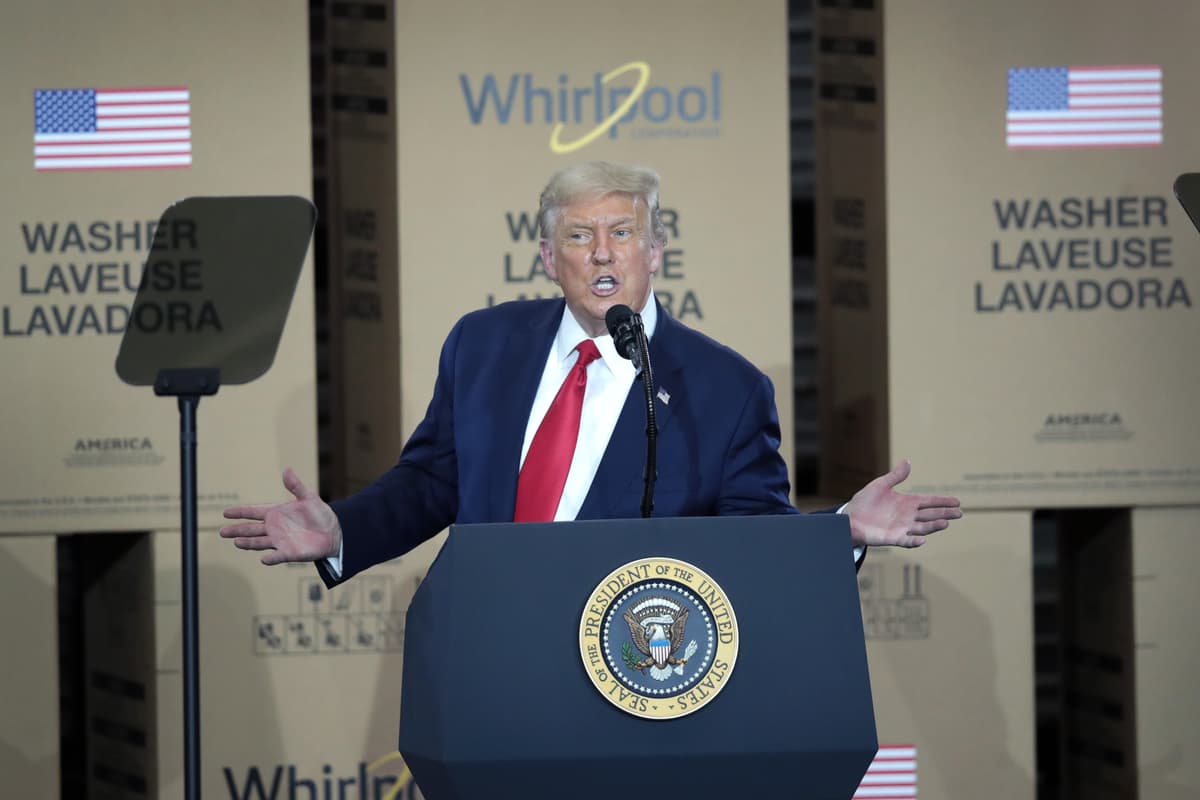
So, early in his first term, President Trump imposed tariffs on washing machines to protect Whirlpool from the competition it had said it welcomed. In August 2020, Mr. Trump visited a Whirlpool factory, where, strangely, he bragged about imposing tariffs on Canadian aluminum, raising Whirlpool’s manufacturing costs.
Now, the Wall Street Journal reports, Whirlpool says perfidious foreigners are fibbing, paying lower tariffs by claiming low values on appliance imports, valuations not reflected in prices charged to American consumers. Presumably the government will deftly untangle the mess its protectionism has produced.
Meanwhile, protectionism’s caroms are costly for the largest American manufacturer of agricultural machinery. John Deere, the New York Times reports, expects higher steel and aluminum tariffs to add $600 million to this year’s manufacturing costs.
And because Communist China retaliated against Mr. Trump’s tariffs with tariffs on soybeans, American exports of this crop are down 51 percent and $3.4 billion from 2024. So, growers will buy fewer John Deere machines.
Similar stories are multiplying across the economy, producing a paralytic uncertainty that probably is taking a toll on hiring. Even before Mr. Trump’s eruption of capricious tariffs, business wariness was perhaps reflected in what the Bureau of Labor Statistics recently reported: a downward revision — by 911,000 — of the number of jobs previously thought to have been created in the 12 months ending just before Mr. Trump’s April 2 announcement of tariffs by the bushel. Or perhaps the Biden administration, behind its facade of normality, cooked the pre-election books. Trust nothing.
Mr. Trump’s seamless unseriousness has surely been noticed abroad. Since Mr. Putin took Mr. Trump’s measure in Alaska last month, Russia’s intensified assault on Ukraine has been matched by Russia’s undisguised contempt for him. The Post reports a senior Russian politician dripping with disdain: “Trump is in a normal state, either waiting to talk to Putin, talking to Putin or explaining how well he talked to Putin.”
Before Alaska, Mr. Trump threatened Russia with “very severe consequences” unless it took certain steps toward a Ukraine settlement. When Russia took none of them, and suffered no consequences, Mr. Trump emitted another gust of bluster: He would put a recalcitrant Russia in a “rough situation.” It is probable that Mr. Putin yawned when, last Friday, Mr. Trump said his patience was “running out fast” and “we’re going to have to come down very, very strong.”
Mr. Trump’s idea of strength can be gauged by his response on social media when a swarm of Russian drones violated Poland’s airspace. About what the Economist called the “most serious incursion into NATO territory since the alliance began in 1949,” Mr. Trump’s less-than-Churchillian response was: “What’s with Russia violating Poland’s airspace with drones? Here we go!”
In Poland 86 Septembers ago, World War II began in Europe, with Germany and the Soviet Union together dismembering that nation. Poland is where — with the Solidarity movement led by an electrician, Lech Walesa, at the Gdansk shipyard — the Warsaw Pact, and with it the Soviet Union, began to crumble.
Eighty-six Septembers ago, Gdansk was called Danzig, and the slogan “Why die for Danzig?” was coined by a French socialist (later, a collaborator with Germany’s occupation of France). The slogan encouraged appeasing Adolf Hitler by acceding to his demand that the city of Danzig be given to Germany. Mr. Putin, marinating in his ample contempt, might think the appeasement reflex is recurring: “Why die for Finland?”
While Mr. Trump brandishes social media like an overstimulated adolescent (“Here we go”), Mr. Putin’s government is talking about Finland as it talked about Ukraine before the 2014 and 2022 invasions. The Washington-based Institute for the Study of War reports this language from Moscow: “The collapse of Finnish statehood forever” will result if Finland under its fascism-saturated government becomes a “springboard” for attacking Russia, which has a right to protect ethnic Russians from Finnish “genocide,” and to oppose attempts to “exterminate” Finland’s Slavic population through cultural erasure.
From Benton Harbor, Michigan (Whirlpool), to Moline, Illinois (John Deere), to the skies where NATO aircraft downed some but not all Russian drones, the world becomes more serious as the president becomes less so. There is an eerie disconnect between events and his flippant “Here we go.”
The Washington Post