


Trump’s ‘Triumphant’ Wins at the Supreme Court Come as Conservatives Celebrate the Court While Liberals Despise It, New Poll Finds
Gallup adduces that 75 percent of Republicans approve of the high court — and 11 percent of Democrats feel the same.
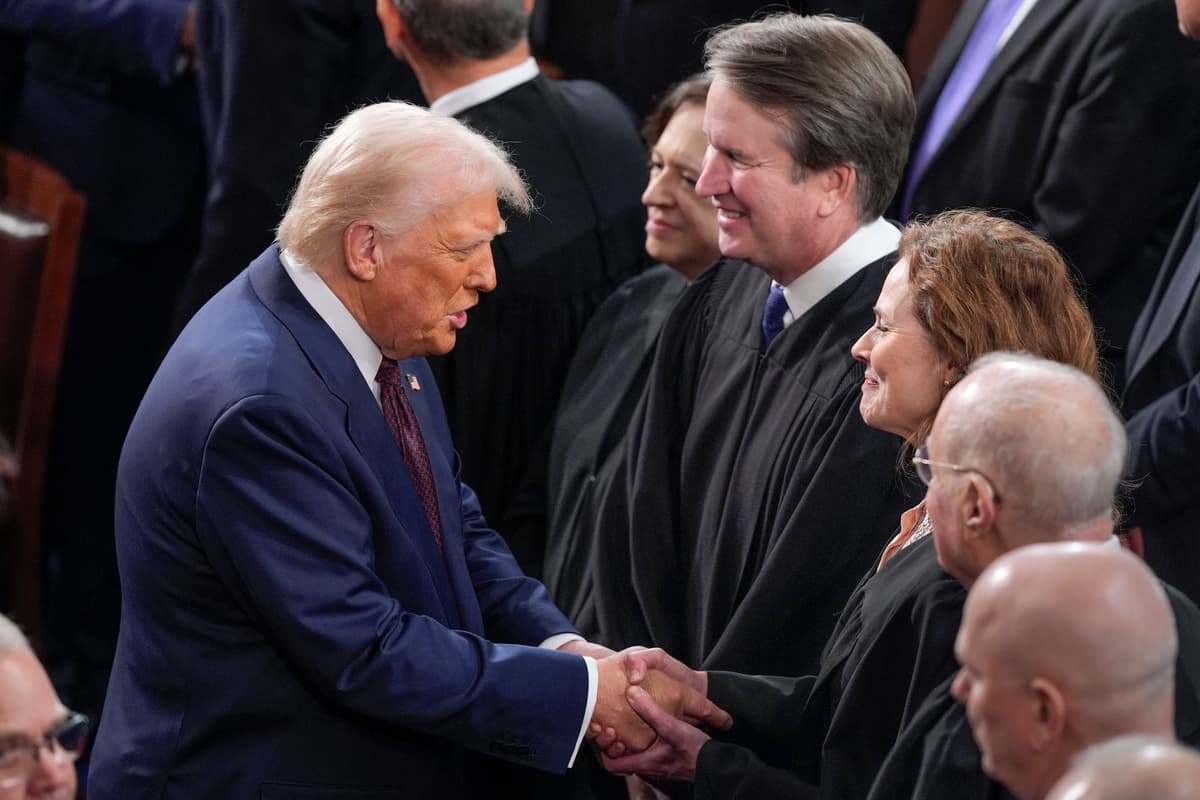
A new poll out from Gallup showing a 64 point partisan gap in how Americans view the Supreme Court underscores the decisive role the justices are playing in supporting President Trump’s key initiatives in the face of legal pushback from the left.
The poll, which was conducted last month, discloses that 75 percent of Republicans versus 11 percent of Democrats approve of the job done by the Supreme Court, which has a six-to-three conservative supermajority after Mr. Trump was able to appoint three justices during his first term, including a replacement for a liberal, Justice Ruth Bader Ginsberg, who died in office.
That 64 percent chasm is the largest ever recorded. It exceeds the 61-point gap tallied after the Nine handed down Dobbs v. Jackson Women’s Health in June 2022. That decision overturned Roe v. Wade — which had been law for a half-century — to hold that there is no constitutional right to an abortion.
Gallup reports that for the first time the high court’s overall approval rating among Americans has sunk below 40 percent. That number is 34 percent among those who identify as political independents. The court’s standing has fallen from when Gallup first measured it a quarter-century ago. At the beginning of this century, before Bush v. Gore, some 60 percent of Americans approved of its performance.
The 75 percent of Republicans who approve of the court’s work appear to back the rulings emerging from the tribunal. The high water mark for GOP celebration of the court came in January 2001, after the justices handed down Bush, which effectively gave the White House to President George W. Bush. Democratic approval declined after Bush, but has been in free fall since Dobbs was decided.
While no case since Dobbs returned abortion to the states has been as much of a lightning rod, Mr. Trump has amassed an impressive record before the high bench. In summer 2024 — with President Biden in office and Mr. Trump facing two criminal federal indictments from Special Counsel Jack Smith, an appointee of Mr. Biden’s attorney general, Merrick Garland — the justices handed down Trump v. United States, which reversed both Judge Tanya Chutkan and the D.C. Circuit to hold that official presidential acts are presumptively immune from prosecution.
Mr. Trump’s record at the Supreme Court this past term was even more successful — the Times’s Adam Liptak categorizes it as “triumphant.” Yet the most significant victory for Mr. Trump and his solicitor general, John Sauer, came in Trump v. Casa, where the justices curtailed the use of nationwide injunctions by federal district judges. Those injunctions, issued at unprecedented rates, have gummed up Mr. Trump’s agenda.
Casa bubbled up to the court in the context of Mr. Trump’s effort to outlaw birthright citizenship. The justices demurred on deciding that issue on the merits — it concerns constitutional bedrock in the form of the 14th Amendment — but could take up that question when the court reconvenes next term. The injunction issue percolated through the so-called shadow or emergency docket, which the administration has centered in its appellate strategy.
The administration also successfully, at least temporarily, defended its use of the 1798 Alien Enemies Act, an antique law that allows the president to deport migrants with minimum due process. The use of that statute was frozen by a district court judge, James Boasberg, who also found “probable cause” to launch contempt proceedings against the Trump administration for failing to turn around two planes full of alleged gang members.
The administration denies that it disobeyed Judge Boasberg, and a panel of the D.C. Circuit agreed. The court granted the government a writ of mandamus vacating the contempt order. Judge Neomi Rao wrote that prior to Judge Boasberg “no district court has threatened criminal contempt against Executive Branch officials as a backdoor to coercing compliance with an order that has been vacated by the Supreme Court.”
The two-to-one decision rebuking Judge Boasberg, though, could soon be heard on appeal before the entirety of the D.C. Circuit, which leans left. The next step, possibly, would be the Supreme Court.