Trust in the Press Is Evaporating
New poll finds that no more than 8 percent of Americans have a ‘great deal’ of trust in newspapers, television, and radio.
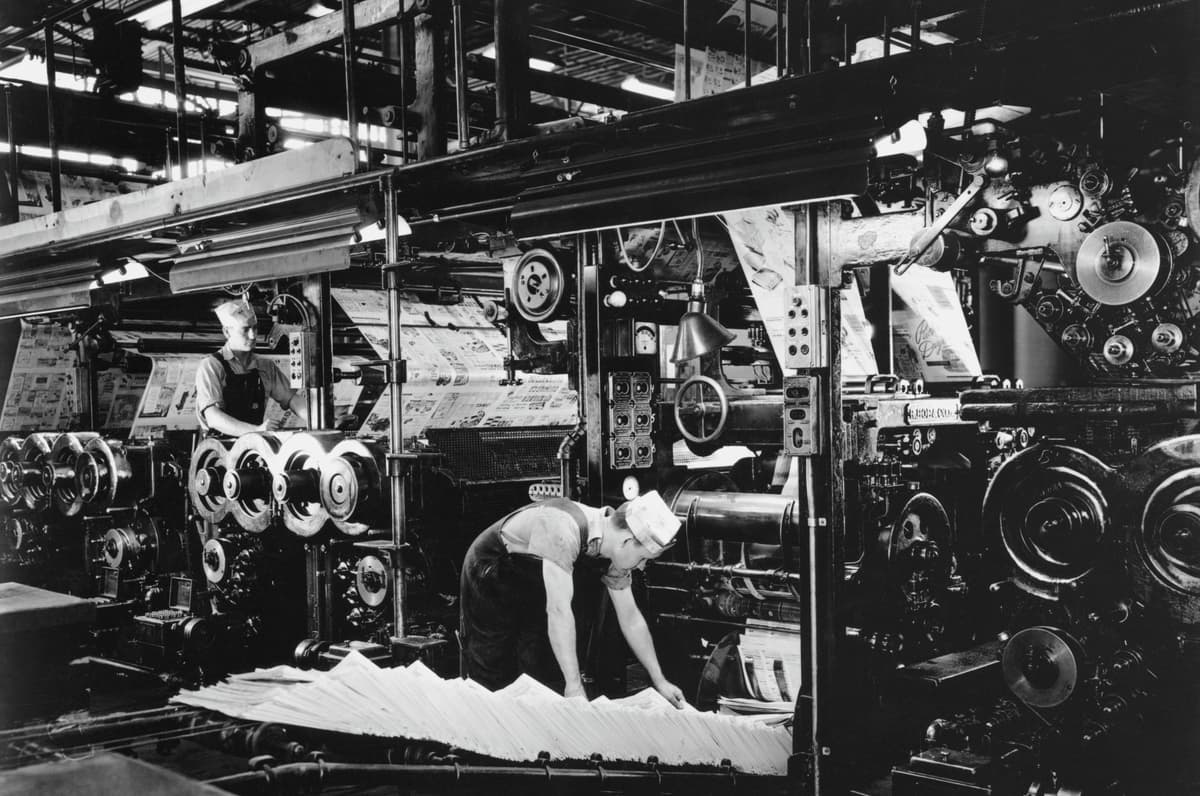

The reputation of the press is plumbing new depths, if the latest polling from Gallup is any guide. Just 8 percent of Americans, the pollster finds, have a “great deal” of trust in the press — defined by Gallup as “newspapers, television and radio” — to “ fully, accurately and fairly” report the news. Some 20 percent have a “fair amount.” That’s a drop from the 40 percent who trusted the press five years ago and from the 31 percent who did last year, per Gallup.
Viewed through a partisan lens, the collapse of confidence in the press is even starker. Among Republicans, who in recent decades have tended to trust the press less, just 8 percent say they trust the purveyors of news. That marks the first time GOP confidence in the press has reached single digits, Gallup says. Among Independents, only 27 percent express confidence in the press. Only a bare majority of Democrats, 51 percent, say they trust the press.
This partisan divide over trust in the press, one could argue, has been brewing since the Watergate scandal. The zeal with which the press sought to take down President Nixon helped to expose the left-leaning bias among so many journalists. Members of both parties had higher confidence in the news business in 1973, the Pew Charitable Trusts reports, with 74 percent of Democrats and 68 percent of Republicans trusting the press.
The Pew’s Jesse Holcomb suggests that the plunge in the GOP’s confidence in the press reflects the fact that “the journalism profession has become more highly educated and more politically lopsided” alongside the trend that “fewer and fewer in the business tend to identify as Republican.” That tendency, to be sure, has been self-reinforcing as the political hue of the press has become increasingly blue.
This “political polarization,” Pew reports, is “sorting the news audiences’ affective responses along increasingly partisan lines.” On this head, Gallup points to the 2016 election as a kind of watershed in public trust in the press. In that year, Gallup says, “confidence had collapsed amid the divisive 2016 presidential campaign.” That year, Gallup found 32 percent of Americans had a fair amount or a great deal of trust in the press, down from 40 percent in 2015.
It’s no coincidence that 2016 was the year that many in the press, unnerved by the candidate who would become President Trump, jettisoned what these columns have called “the cardinal rule of journalism: objectivity.” The Times’s own press reporter, Jim Rutenberg, endorsed this tactic in a column that seemed, we said, “to give cover to those toiling in the galleys of the press to indulge their disdain — politically and personally — for Mr. Trump.”
Mr. Rutenberg proposed new rules to cover this “abnormal and potentially dangerous candidate.” This required tossing out “the textbook American journalism has been using for the better part of the past half-century,” he said. The idea was to adopt an adversarial tone — a departure from the reporter’s traditional role as a neutral arbiter. The Times’s managing editor, Dean Baquet, said Mr. Rutenberg had “nailed it.”
It’s hard to avoid the sense that the press’s anti-Trump crusade is a factor in the public’s fading trust. It calls to mind a warning by an early editor of the Sun, Charles Dana, “if the press goes wrong,” as he said pro-slavery papers had gone wrong before the Civil War. In that case, the power and credibility of the press “is wiped out,” Dana said. “You look for it and it is there no longer, and all their efforts have disappeared as the dew disappears when the sun rises.”