
Turkey’s Aid in the Palestinian Territories Is Helping Hamas, Hurting Palestinians
President Recep Tayyip Erdogan’s priority is not the welfare of Palestinian civilians, but the future of Hamas.
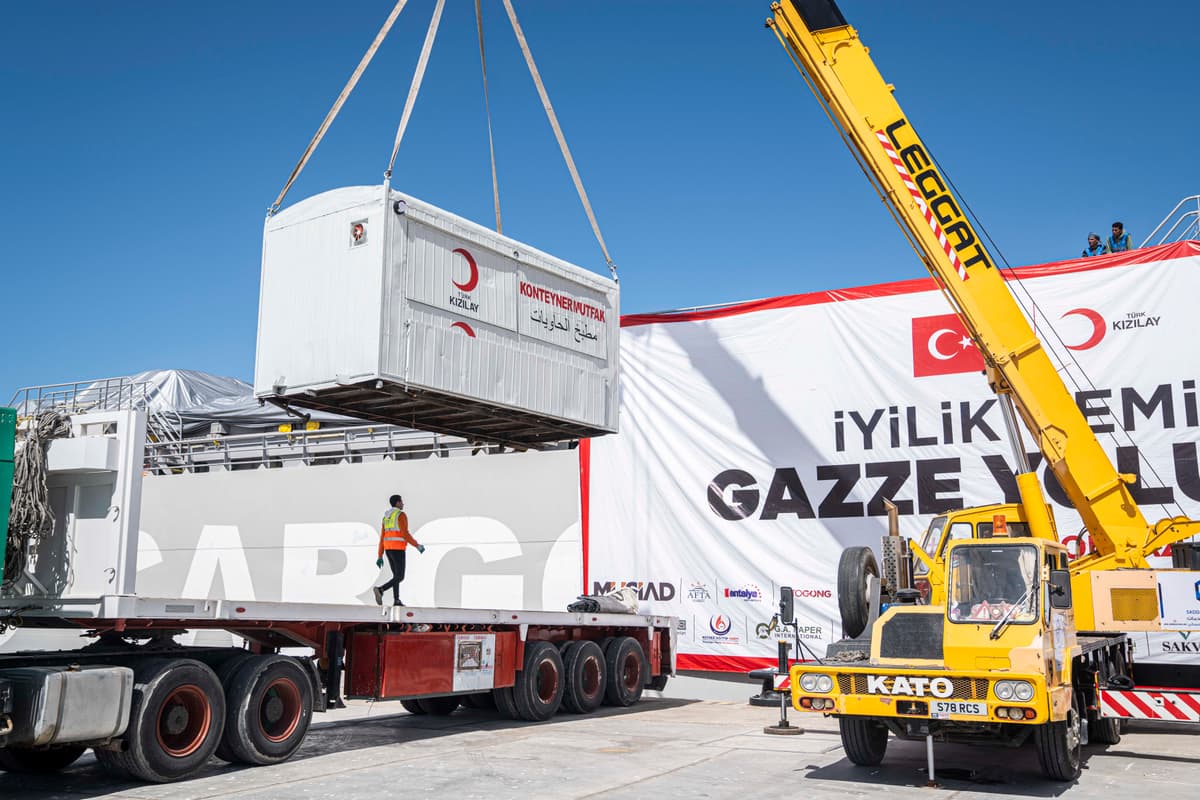
A close look at Turkish aid agencies in the Palestinian Territories shows that President Recep Tayyip Erdogan’s priority is not the welfare of Palestinian civilians, but the future of Hamas.
Israeli cabinet members, irate over Erdogan’s continued praise of Hamas, demanded that Ankara’s consulates and aid groups leave Israel, the West Bank, and Gaza on November 23. The chief object of their outrage is the Turkish Cooperation and Coordination Agency, known as TIKA, a bureau of Turkey’s Ministry of Culture.
Israelis have reason to view Turkey’s missions in the West Bank and Gaza with suspicion. While TIKA delivers aid, it also has a long history of lining Hamas terrorists’ pockets. As long as Hamas is allowed to corrupt foreign aid initiatives, terrorists will subsist while robbing Palestinian civilians blind.
TIKA has a longtime presence in the Palestinian Territories: it first opened its doors in Ramallah in 2005 and set up a Gaza office in 2012. Their projects are significant, too: Turkish state press reported in 2017 that the Palestinian Territories received 30 percent of all TIKA aid allocated to the Middle East and Africa.

Unfortunately, TIKA’s projects overlap with areas where terrorist groups have been strongest. Gaza has long been under Hamas control, and Hamas hides its weapons and fighters in civilian buildings. The Turkish hospital that TIKA built to the south of Gaza City is a damning example. In February 2024, the IDF identified a Hamas tunnel network with several shafts directly beneath the hospital grounds.
Terrorist groups like Palestinian Islamic Jihad are also waging war against the Palestinian Authority in the West Bank. These insurgents exert major zones of control in the Northern West Bank, where Ramallah’s authority over longtime terror hubs verges on nonexistent. Still, TIKA prides itself on major projects there, including schools and hospitals, all vulnerable to the same terrorist exploitation seen in Gaza.
Building hospitals and schools is a good humanitarian mission on its own. Yet TIKA does so in ways that lets terrorists take cover behind human shields, while Ankara does nothing to promote stabilization.
TIKA’s staffing decisions have also drawn justified scrutiny from Israel’s security services. In 2017, Israel’s internal security agency, Shin Bet, arrested TIKA’s representative in Gaza, Muhammad Murtaja, on charges of aiding Hamas. The indictment linked Murtaja to Hamas’ Izz ad-Din al-Qassam Brigades. He and his Hamas associates were accused of diverting TIKA food-aid packages — intended for Gaza’s needy — and selling them for profit.
Murtaja, who speaks fluent Turkish, was also charged with trying to obtain sensitive images of Israeli military sites for Hamas targeting. He also worked as a translator for senior Hamas figures Ismail Haniyeh and Ismail Radwan, assisting their meetings with Turkish organizations.

Before joining TIKA, Murtaja worked with the Turkish Humanitarian Relief Foundation, which Israel designated a terrorist organization for operating in the Muslim Brotherhood’s “Union of Good” — an American-listed terrorist entity — and organizing the 2010 Mavi Marmara flotilla that tried to breach Israel’s naval blockade of Gaza.
Recruited by Hamas in 2008, Murtaja was sentenced in 2018 to nine years in prison for diverting TIKA’s aid funding to Hamas’s terror projects, among other charges. Turkey’s Foreign Ministry initially protested his arrest but fell silent after court evidence sealed his conviction.
Shin Bet also named IHH’s Gaza representative, Mehmet Kaya, in the indictment for helping to siphon charity money to Hamas. Kaya evaded arrest, his name reappearing in a 2021 report outlining his role in transferring Turkish funds to senior Hamas leaders Haniyeh and Raed Saad. Those funds helped Hamas acquire weapons and build a naval training facility, likely to prepare its amphibious assaults in southern Israel on October 7.
TIKA and IHH function as key charity fronts for Hamas. IHH has played a leading role in Gaza’s post-ceasefire operations, and the Turkish government reportedly seeks to deploy a 2,000-strong military force in Gaza for the planned international stabilization force. Israel and several Arab states oppose this with good reason.
The Turkish military has no place in Gaza. If Ankara’s “aid” bureaus cannot be trusted to avoid empowering terrorists, there is little reason to believe Turkish military forces would behave differently. President Erdogan has repeatedly described Hamas as resistance fighters defending Palestinian rights.
Consequently, Turkey — through both its aid agencies and its military — seems uninterested in dismantling Hamas. If Turkey is to play any role in Gaza, it should be limited strictly to verifiable humanitarian assistance—nothing more.
_____________
The Turkey Program Research Intern at Foundation for Defense of Democracies, William Doran, contributed to the authorship of this article.