Two Tough Questions for Senate Holdouts on Graham’s Proposal To Stiffen Penalties on Putin’s Russia

The Palmetto State solon’s bill proves two things: the possibility of bipartisanship about large questions and Congress’s relevance in making foreign policy.
Amir Levy/Getty Images
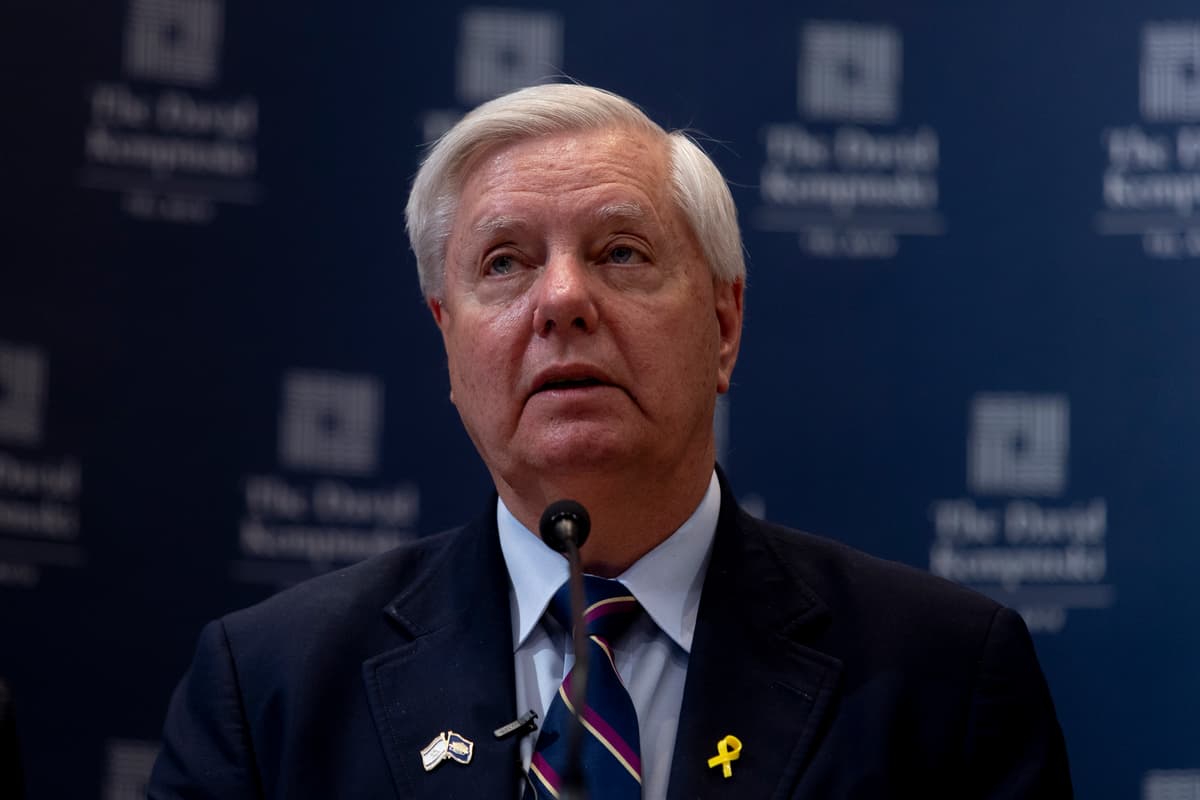
Senator Graham on February 17, 2025 at the Kempinski Hotel, Tel Aviv. Amir Levy/Getty Images

The Senate, recently passive regarding its prerogatives and deferential regarding presidential assertiveness, might insert itself into policymaking concerning Ukraine. 

And the Senate — hopefully with the House concurring — might do so where presidents are most protective of their ability to act unilaterally: foreign affairs. 

The Senate’s contemplated action has been “coordinated” with the current president, who is a notably aggressive assertor of executive prerogatives.

A South Carolina republican, Senator Graham, has introduced legislation that, having attracted 82 supporters (counting Mr. Graham), proves two things: the possibility of bipartisanship about large questions and Congress’s relevance in making foreign policy.

In a letter to the Wall Street Journal, Mr. Graham writes that he has “coordinated” with the White House concerning his legislation, which he jointly introduced with a Democratic colleague, Senator Blumenthal of Connecticut. 

The legislation would impose a 500 percent tariff on goods sent to the United States from “any country that buys Moscow’s energy products” (e.g., oil, gas, uranium). The countries that matter most are China and India.

Whatever coordination has occurred with the current president, he and many of his advisers and admirers are advocates of a “unitary executive” with untrammeled control of that branch of government. 

As a matter of temperament if not of logic, they might go further and deem Mr. Graham’s measure for congressional involvement in foreign policy constitutionally dubious. It is not.

In “The President Who Would Not Be King: Executive Power Under the Constitution,” published in 2020, Michael W. McConnell of Stanford Law School and the Hoover Institution notes: Just as the Constitution assigns “some powers of a legislative nature” to the president (e.g., the veto, the power to recommend legislation, the power to convene Congress), it also involves Congress in foreign policy. 

The most important involvement is through Congress’s power “to regulate commerce with foreign nations,” which Madison called the “most essential” of all the powers “in relations with other nations.” (Courts may decide whether Congress has constitutionally, or clearly, delegated this power to presidents.)

Congress has additional powers pertinent to foreign policy, such as declaring war and maintaining and exercising plenary power over the armed forces. The president cannot raise a military or fund it. The Senate has special foreign-policy standing: It confirms ambassadors and consents to presidential ratifications of treaties.

In “Imperial From the Beginning: The Constitution of the Original Executive,” published in 2015, Saikrishna Bangalore Prakash of the University of Virginia’s law school notes that Chief Justice Marshall said at the end of the 18th century that the executive is entrusted “with the whole foreign intercourse of the nation.” 

Yet although the president is (in Secretary of State Jefferson’s formulation) “the only channel of communication between this country and foreign nations,” Congress can shape, and restrict presidential shaping of, the policies communicated. 

Prakash says that in Macon’s Bill No. 2,  from1810, “Congress authorized the president to impose an embargo for fifteen days, but only when Congress was not in session,” thereby proving that “neither the president nor Congress believed that the president enjoyed any constitutional power to lay an embargo.”

Because the president is, in Mr. Prakash’s words, “the only constitutional officer on duty twenty-four hours a day, seven days a week,” he or she must be able unilaterally “to take temporary steps” to prevent or mitigate crises. Yet the policy stipulated by Mr. Graham’s legislation is well within Congress’s purview.

As of Thursday afternoon, Mr. Graham’s legislation had 82 sponsors — 41 Republicans (including Mr. Graham), 40 Democrats, and one independent who caucuses with the Democrats. The non-co-sponsoring senators include 12 Republicans, five Democrats, and one independent who caucuses with the Democrats.

Those Republicans are: Indiana’s Jim Banks, Tennessee’s Marsha Blackburn and Bill Hagerty, Wisconsin’s Ron Johnson, Missouri’s Josh Hawley and Eric Schmitt, Utah’s Mike Lee, Kansas’s Roger Marshall, Florida’s Ashley Moody, Ohio’s Bernie Moreno, Kentucky’s Rand Paul, and South Carolina’s Tim Scott. 

The Democrats are: Nevada’s Catherine Cortez Masto, Illinois’ Tammy Duckworth, Connecticut’s Chris Murphy, Georgia’s Jon Ossoff and Oregon’s Ron Wyden, along with Vermont independent Bernie Sanders.

For these 18, two questions. What are you thinking? And why do you want to be senators?

If enacted, Mr. Graham’s legislation would notify President Putin that there can be steep costs to continuing the war. Congress’s atrophied policymaking muscles, and diminished institutional pride, would be strengthened.

Mr. Graham has unfurled the banner of his boon companion, Senator McCain, a steady advocate of American — and Republican — internationalism. McCain was his party’s presidential nominee 17 years ago. 

Support for Graham’s legislation, especially from recently inert Senate Republicans, gives fresh reason to hope that William Faulkner was right: “The past is never dead. It’s not even past.”

The Washington Post


The New York Sun

© 2025 The New York Sun Company, LLC. All rights reserved.

Use of this site constitutes acceptance of our Terms of Use and Privacy Policy. The material on this site is protected by copyright law and may not be reproduced, distributed, transmitted, cached or otherwise used.

The New York Sun

Sign in or  create a free account

or
By continuing you agree to our Privacy Policy and Terms of Use