
Two-Year Delay of Navy’s Newest Aircraft Carrier Reflects Decline of American Shipbuilding, Shows Weakness to Communist China
There are serious strategic-readiness implications, as it will leave the Navy one carrier-group short of the 11 that Congress has mandated.
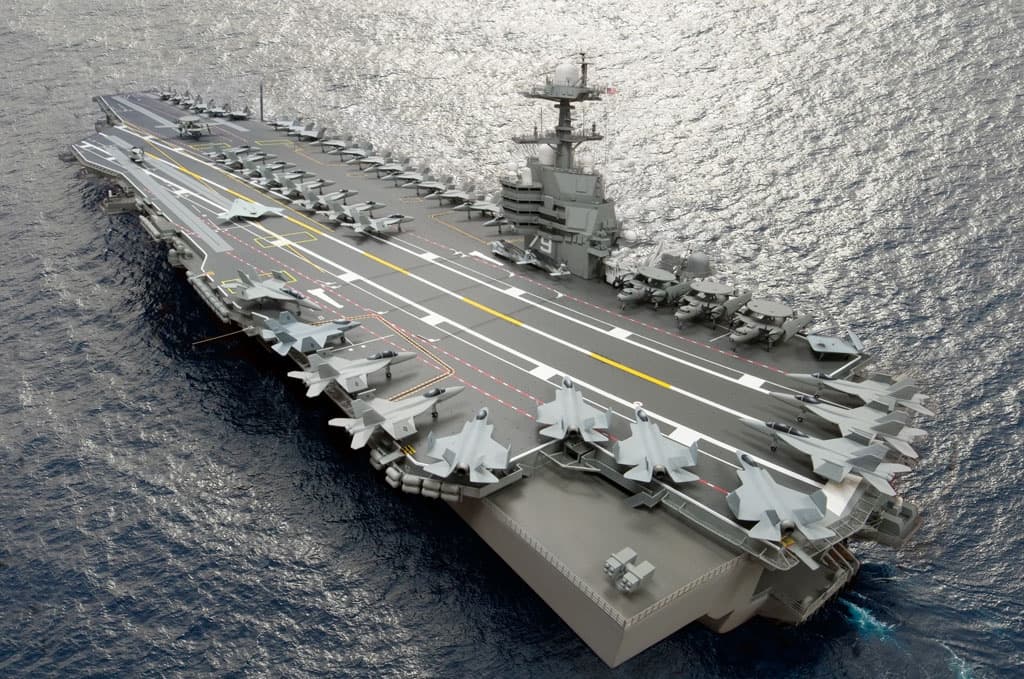

In the first six months of President Trump’s second term the mantra seems to be, “Move fast and don’t be afraid to break things.” One institution apparently never got the message: the United States Navy.
Two weeks ago, the Navy announced that the delivery of its newest nuclear-powered aircraft carrier, United States Ship John F. Kennedy, would be delayed another two years. And in a head-scratching example of who-could’ve-seen-it-coming timing, the delay was announced just weeks before the ship was to be delivered.
The delay has serious strategic-readiness implications: it will leave the Navy one carrier-group short of the 11 that Congress has mandated. Typically, the Navy can deploy just four carrier groups at once — with the others undergoing maintenance.
Reducing fleet availability by one carrier is significant: When the Navy deployed a second carrier group to support Israel in its action against Iran, it had to remove the Nimitz battle group from the high-priority South China Sea. And showing weakness — or limited resources — to Communist China is never a smart move.
The problem was exacerbated last week when the Navy quietly disclosed that two “big deck” amphibious assault ships currently under construction would also be delayed by a year. These vessels — 844 feet long and displacing some 45,000 tons — are slightly smaller than U.S.S. John F. Kennedy.
Yet the vessels not only carry vertical-launch planes (such as the special variant F-35B stealth fighter, helicopters, and V-22 Osprey) but can deploy some 1,700 Marines from landing craft stored in its well deck. These ships are major combat assets, particularly in the Pacific.

These delays not only threaten our defense readiness, but make a mockery of America’s industrial prowess. All of the ships are being built by the Huntington Ingalls Industries, the largest shipbuilder for the Navy.
Apparently having a stranglehold on American shipbuilding is good for business if bad for the country. HII reported 2024 revenues of $11.5 billion, more than $1 billion higher than the previous year.
HII’s net operating profit of over half-a-billion dollars and margin of 5 percent were down slightly from the previous year, but the company was proud to boast it had more than $48 billion in backlog orders.
The firm, too, paid its investors a larger dividend ($5.25 per share) in its under-performing year than it did the previous year when it gave investors $5.02 per share.
No one here is denying HII’s — or any other company’s — right to earn a profit or keep its shareholders happy. Yet doesn’t it also have an obligation to its biggest customer, the federal government, or more accurately, the American taxpayer?
Defense contractors, HII among them, regularly blame Congress for causing the delays and cost overruns. The trope goes something like this: Because Congress has difficulty passing legislation authorizing and appropriating multi-year budgets for large defense projects, it is hard to keep a skilled workforce.
Experienced, capable welders — they are always at the crux of the story — can and do go to other, more stable jobs. And it is true: uncertainty about the economy, particularly during and after Covid, has caused significant labor “perturbation,” according to another defense chief executive.
The other major factor causing delays and cost overruns is the Navy itself. It is no secret that the Navy seems congenitally incapable of sticking to a ship design — even after construction has begun.
The infamous littoral combat ship — LCS alternatively known as “little crappy ship” – was derailed because neither the Navy nor the contractor (which had no shipbuilding experience) had analyzed the difference between commercial and combat construction standards.
United States Ship Gerald Ford suffered from construction delays in part because the Navy was insistent on incorporating unproven technologies (particularly elevators and arresting gear).
And the Navy began constructing the first-in-class Constellation frigate when the design was only 80 percent complete, and naval officials can still make design changes as construction proceeds.
This repeating pattern of dysfunction — and expecting a different outcome — is the classic definition of insanity. It needs to end. The new secretary of the Navy, John Phelan, whose primary qualification for the job may have been his ability to raise money for President Trump’s campaign, seems to be missing in action.
And Secretary Hegseth — who fired the chief of naval operations, Admiral Lisa Franchetti, without cause or explanation because he insinuated she was a DEI hire — has yet to show an appetite to take on the defense industry establishment.
Unfortunately, one person who could prove a worthy competitor to entrenched interests — Elon Musk — is currently persona non grata in the White House.
So, what should Mr. Trump do? If he can’t make up with Mr. Musk, he should turn to someone else who knows how to get things done in the Pentagon.
Someone like, say, Raj Shah or Christopher Kirchhoff, who successfully ran the Defense Innovation Unit — “Unit X” — that built bridges to Silicon Valley and terrified the “prime” defense contractors.
The stakes are too high to accept the status quo which allows the Navy’s shipbuilding oligopoly to continue business as usual. China may be counting on just that.