

UN Security Council Readies Vote for Stabilization Force, Interim Governance at Gaza as Israel Rejects Palestinian Statehood

President Trump’s 20-point peace plan remains largely intact as a vision for the region, though pressure from France and Arab states has led to stronger calls for statehood and a Board for Peace.
AP/Abdel Kareem Hana
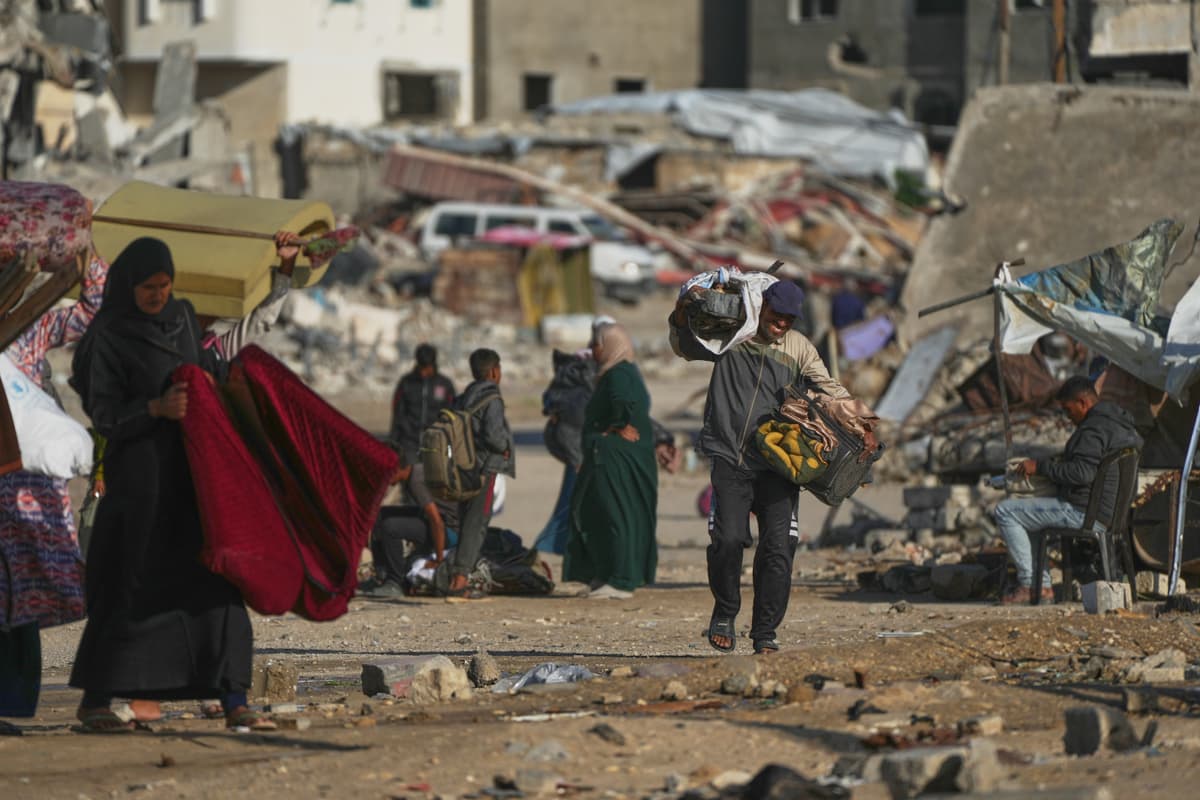
A Palestinian man carries firewood collected from the rubbish at Khan Younis in the southern Gaza Strip, November 15, 2025. AP/Abdel Kareem Hana

The United States says its proposal for a 20-point peace plan for a security force in Gaza is ready for a vote Monday in the United Nations and won’t be revised despite objections from Israel’s prime minister, Benjamin Netanyahu, or Russian officials who countered last week with a last-minute 10-point plan of their own.

The American-led proposal, emanating from the September 29 peace summit at Sharm el Sheik, Egypt, includes all the major facets of President Trump’s 20-point Comprehensive Plan to End the Gaza Conflict. The deal calls for a transitional governing body known as the Board of Peace that would govern Gaza until the end of 2027 and a stabilization force made up of international participants that could include Turkey, Qatar, or other longtime allies of Hamas.

The vote on the proposal, first developed in October, is expected to pass despite objections from Communist China and Russia, whose counter-proposal focused on a two-state solution and a contiguous state between Gaza and the West Bank and rejected the notions of a Board of Peace and stabilization force. The United States and its partners have warned Russia to beggar off that plan.

“We are issuing this statement as the Member States that gathered during High-Level Week to begin this process, which offers a pathway to Palestinian self-determination and statehood,” the United States Mission at the United Nations wrote in a joint statement on Friday with Qatar, Egypt, the United Arab Emirates, the Kingdom of Saudi Arabia, Indonesia, Pakistan, Jordan, and Turkey. 

“The Plan provides a viable path towards peace and stability, not only between the Israelis and the Palestinians, but for the entire region. We are looking forward to this resolution’s swift adoption.”

While Mr. Trump has vacillated over a two-state solution in the past, objections by France and other nations that have already recognized a state of Palestine led negotiators to strengthen the plan’s original language to include clear conditions for Palestinian statehood. Earlier versions of the plan also faced objections by nations expected to participate in the stabilization force who want stronger definitions for their roles so as not to appear as occupiers. 

With acceptance by the Security Council — Russia and China are likely to abstain rather than vote against it — the plan could move forward as early as January despite protests by Israel’s defenders, who say the deal gives free rein to the United Nations to undermine Israel’s sovereignty by allowing stabilization force members to move freely in and out of Gaza. 

The deal could also deprive Israel of its ability to impose a naval blockade and protect its land borders and creates an immunity trap for the stabilization force, writes the editor of the Substack channel GlobalDisconnect, Leslie Kajomovitz.

“Monday’s vote is no longer about reconstruction or humanitarian logistics. It is a geopolitical contest over who will control Gaza, and by extension, who will dictate the boundaries of Israel’s security doctrine,” wrote Ms. Kajomovitz.

Under pressure from the right wing of his party, Mr. Netanyahu rejected any fait accompli in the United Nations. He said Sunday that no Palestinian state would even be considered until Hamas is fully disarmed and removed from power. 

“There will be no such thing” as a Gaza with a Hamas-armed and controlling authority, Mr. Netanyahu said during his weekly cabinet meeting.

“In the 20-point plan, and in any other case, this area will be demilitarized and Hamas will be disarmed — either the easy way or the hard way. That is what I have said, and that is what President Trump has also said,” he said.

Speaking more forcefully, Israel’s defense minister, Israel Katz, posted on X that Gaza will be “de-fortified down to the last tunnel and Hamas will be disarmed” in the 47 percent of the territory not currently controlled by the IDF. This will occur either “by the international force — or by the IDF.”

The IDF’s chief of staff, Lieutenant General Eyal Zamir, reinforced that sentiment Sunday, saying that the military is ready to re-enter Gaza as needed. 

“We will continue to insist that Hamas’s rule will not exist on the other side of the border. Even if it takes time, we will persist in the mission of dismantling Hamas and demilitarizing the Strip, achieving this either through an agreement or through military means,” he added. 


The New York Sun

© 2025 The New York Sun Company, LLC. All rights reserved.

Use of this site constitutes acceptance of our Terms of Use and Privacy Policy. The material on this site is protected by copyright law and may not be reproduced, distributed, transmitted, cached or otherwise used.

The New York Sun

Sign in or  create a free account

or
By continuing you agree to our Privacy Policy and Terms of Use