Ukraine Peace Negotiations Will Test Whether ‘Europe’ Is More Than a Geographical Expression
Putin wants to win the war, Trump wants to end it, and as George Orwell said, the quickest way to end a war is to lose it.
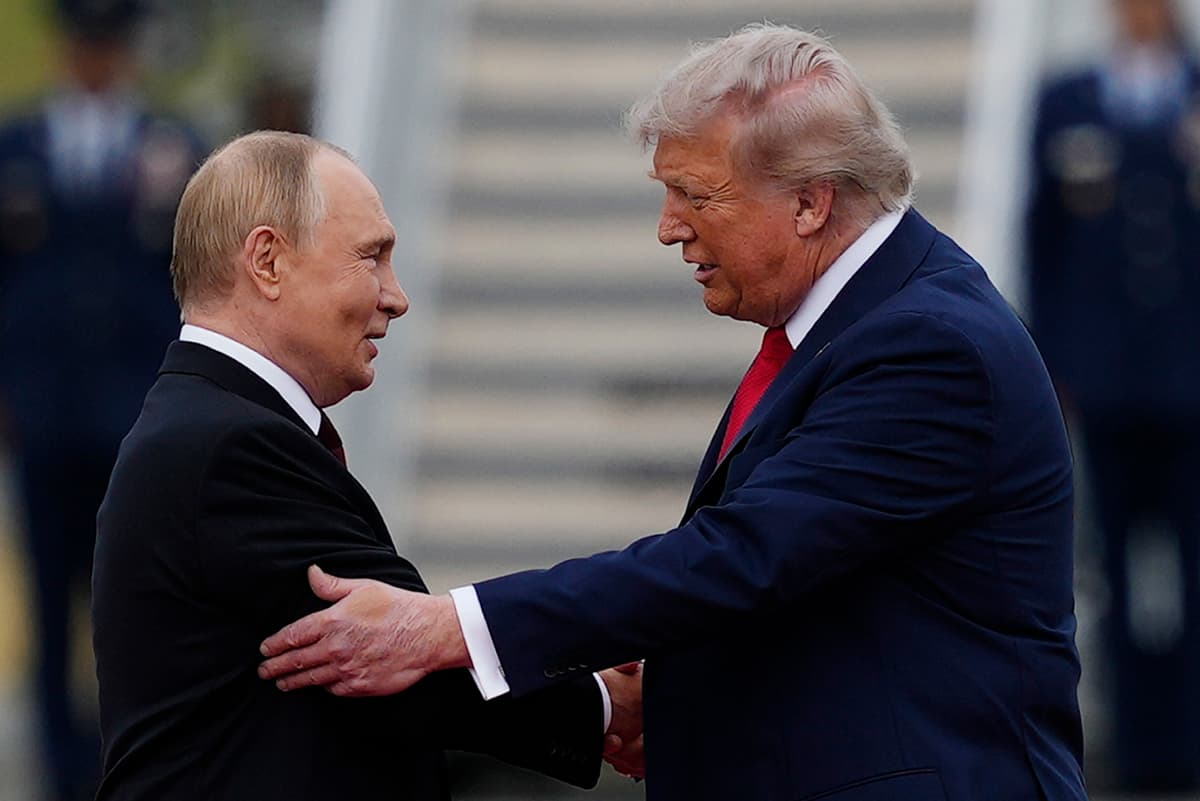

As flaccid as a boned fish, President Trump crumpled quicker than even Vladimir Putin probably anticipated. The former KGB agent currently indicted for war crimes felt no need to negotiate with the man-child. The president’s thunderous demands — a 50-day deadline, a 10-day deadline, “severe consequences,” a cease-fire before negotiations — all were just noise.
As Mark Twain said, thunder is impressive but lightning does the work. Into Mr. Trump’s post-Alaska vagaries about progress and agreements on “many points,” an old question intrudes: Can the phrase “insipid beyond words” be applied to words?
Alaska clarified what was unclear only to the obtuse: Mr. Putin wants to win the war, Mr. Trump wants to end it, and as George Orwell said, the quickest way to end a war is to lose it. Mr. Putin insolently did not suppress his smirk while on the red carpet that Mr. Trump rolled out for him. He almost certainly already had dangerous clarity about Mr. Trump.
For a nation, more dangerous than an enemy’s hatred is his contempt, which makes him reckless and implacable. Speaking to some of his generals in August 1939, Hitler said, “Our enemies are little worms. I saw them at Munich.” And the war came days later.
Let us hope that America’s domestic political degradations have not rendered it incapable of embarrassment, which is a prerequisite for recuperation. Alaska was not just another drop in our overflowing bucket of mortifications. It was proof that for the next 41 months, no interlocutor can believe a word the American president says.
The problem is not that he is endlessly cynical, which would be an improvement. Rather, he seems promiscuously sincere, believing everything equally, no matter how discordant his beliefs today are with yesterday’s. It has been well said that our most important ideas are those that contradict our feelings. Does Mr. Trump have any such?
Does he have an inkling of the coarse culture that produced Mr. Putin? When Dwight Eisenhower asked the foremost Soviet hero of World War II, General Georgy Zhukov, how the Red Army cleared minefields, Zhukov replied that it marched through them. Mr. Putin has been marinated in lore about that war, and about “the West” trying “to cancel a whole 1,000 year culture, our people.” He is delusional, but serious.
He articulates his seriousness while his American adversary advertises his lack thereof. Hence Mr. Trump’s inability to recognize the continuity between the Soviet Union and Mr. Putin’s Russia.
Speaking last week on Russian state television, a leader in Mr. Putin’s political party, Konstantin Zatulin, said of Ukraine: “Everywhere that a Russian soldier has put his feet will undoubtedly be kept by Russia.” The Brezhnev Doctrine has been tweaked.
This doctrine was enunciated by a Soviet leader, Leonid Brezhnev, in 1968, three weeks before Soviet forces intervened to crush the “Prague Spring” liberalization in Czechoslovakia. It was: Wherever socialism had been planted, socialist regimes had a duty to preserve it.
Mr. Putin’s yearning to restore the supposed grandeur of the Soviet Union’s decrepitude is worse than mere nostalgia, as sociologist Robert Nisbet defined it: “a rust of memory.” A corrosion.
The Soviet nomenklatura, of which Mr. Putin and some of his satraps were members, derived psychological as well as material income from the USSR’s status as a superpower. Russia’s foreign minister, Sergei Lavrov, arrived at his Alaska hotel wearing a “CCCP” sweatshirt, the Cyrillic initials for the USSR.
Mr. Trump, too, resembles a fly in amber, frozen decades ago. Speaking on Fox News, referring to nuclear arsenals, he said of Russia, “We are number one and they are number two in the world.” They, however, have one-third of the European Union’s population and one-tenth its GDP.
As this is written, leaders from a continent thickly planted with military cemeteries have come to Washington, soon to go home. Then we shall learn whether, at long last, “Europe” is more than a geographical expression.
Eighty-five summers ago, the United States, which began as an emanation of Europe, was saluted by Britain’s prime minister in the House of Commons. On a dark day (June 4, 1940) he anticipated the day when “the New World, with all its power and might, steps forward to the rescue and the liberation of the old.”
Now it is the Old World’s turn to rescue the United States. It needs to be liberated from the chimera that it has no substantial stake in the outcome of high-intensity, state-on-state violence inflicted by a nuclear power obedient to a man who has actual beliefs: Crackpot, but real, and menacing.
The Washington Post

