Vance Calls Supreme Court’s Landmark Decision Defending Flag Burning ‘Wrong,’ Endorses Rehnquist’s Fierce Dissent
‘The American flag, then, throughout more than 200 years of our history, has come to be the visible symbol embodying our Nation,’ the chief justice wrote in 1989.
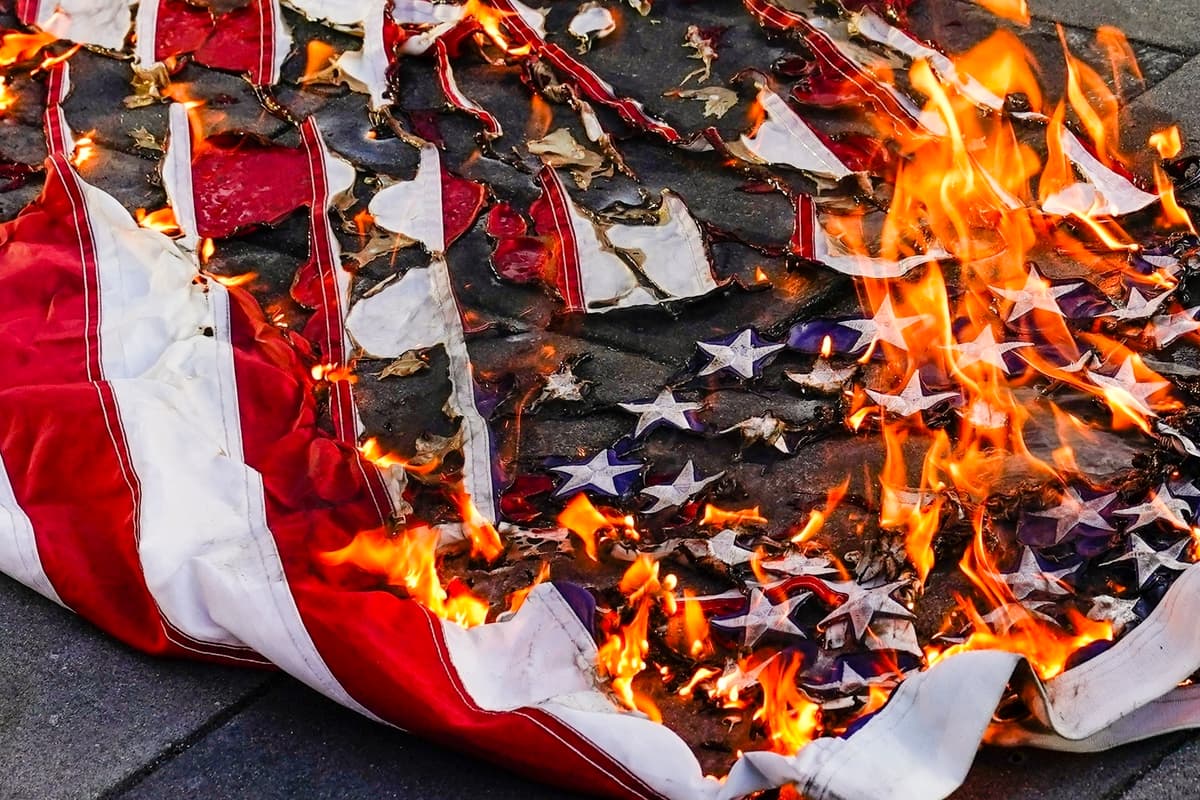

As First Amendment advocates on the right come out against President Trump’s executive order aimed at cracking down on flag burning, Vice President JD Vance is going one step further by publicly arguing against a landmark 1989 Supreme Court decision defending the practice. On Tuesday, Mr. Vance endorsed the dissent from the then-chief justice.
Mr. Trump signed his executive order Monday. It directs the attorney general and other law enforcement officials to consider charging people with crimes like incitement of riots if they burn the flag. Free speech absolutists — many of whom are fans of the president and Mr. Vance — were quick to denounce the order.
A conservative radio host, Erick Erickson, wrote that “burning the flag is a matter of free speech and the executive does not get to create crimes.” Fox News’s Brit Hume pointed out that President George H.W. Bush campaigned for an anti-flag-burning constitutional amendment in 1988, which inherently acknowledged the constraints of the executive on banning the practice. A popular conservative podcaster, Jesse Kelly, called the executive order “garbage.”
On Tuesday morning, Mr. Vance pushed back against that criticism, saying that the landmark Supreme Court case affirming the right to burn the flag, Texas v. Johnson, was wrongly decided.
“1) Antonin Scalia was a great Supreme Court Justice and a genuinely kind and decent person,” Mr. Vance wrote on X. “2) The President’s EO is consistent with Texas v. Johnson. 3) Texas v. Johnson was wrong and William Rehnquist was right.”
In the 5–4 decision, issued in 1989, the court held that burning the American flag is a protected form of free expression. Associate Justice Antonin Scalia, whose defense of flag burning has been oft-quoted in the last 24 hours, was a surprise swing vote in that case.
“If it were up to me, I would put in jail every sandal-wearing, scruffy-bearded weirdo who burns the American flag,” Scalia said at Princeton University in 2015, according to excerpts provided by the National Constitution Center. “But I am not king.”
Mr. Vance’s endorsement of the dissent from Chief Justice Rehnquist nearly 40 years ago is not necessarily surprising, if one knows anything about the vice president’s beliefs and writings about national pride, virtue, and reverence for the United States.
In his dissent, which was joined by Associate Justices Byron White and Sandra Day O’Connor, Rehnquist wrote that the flag symbolizes the nation as a whole, and the state and federal laws protecting it ought to be upheld.
“The American flag, then, throughout more than 200 years of our history, has come to be the visible symbol embodying our Nation. It does not represent the views of any particular political party, and it does not represent any particular political philosophy,” the chief justice wrote, after telling many stories about the role of the flag in times of both war and peace, from the American Revolution to its simple displays in courthouses across the country.
“The flag is not simply another ‘idea’ or ‘point of view’ competing for recognition in the marketplace of ideas,” he continued. “Millions and millions of Americans regard it with an almost mystical reverence, regardless of what sort of social, political, or philosophical beliefs they may have.”
“I cannot agree that the First Amendment invalidates the Act of Congress, and the laws of 48 of the 50 States, which make criminal the public burning of the flag,” he concluded.