Venezuelan Opposition Activists Wondering Whether Leader’s Nobel Peace Prize Will Help Their Cause

Maria Corina Machado has essentially been rewarded for her struggle against Nicolas Maduro’s oppressive narco-Socialist regime, which is backed by Beijing, Moscow, Havana, and Tehran, and which America is confronting in the Caribbean.
Jesus Vargas/Getty Images
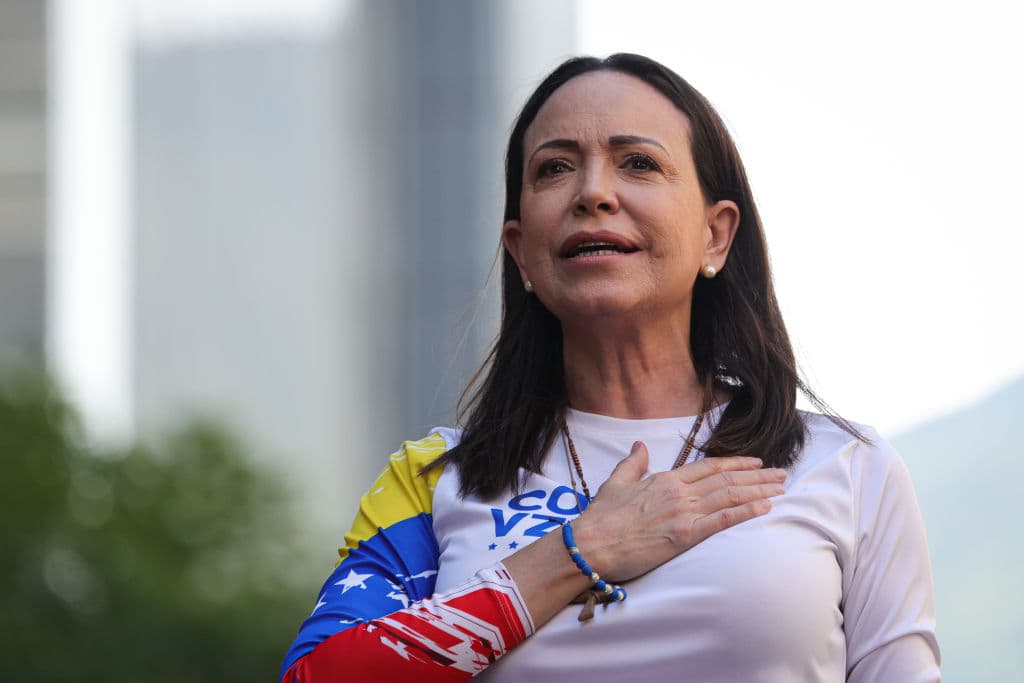
Opposition leader Maria Corina Machado during an anti-government protest on January 9, 2025, at Caracas, Venezuela. Jesus Vargas/Getty Images

The 2025 Nobel Peace Prize winner, Maria Corina Machado, is widely seen as worthy of the award. Yet Venezuelan opposition activists are wondering if her recognition will help end Caracas’s much-despised despotic regime or, conversely, help President Nicolas Maduro exile her and neutralize his most formidable internal foe. 

The Oslo-based committee’s Friday decision is atypical, as Ms. Machado does not fully fit its politics. It is a “brave, extreme, symbolic, anti-woke, and absolutely worthy” choice, a former Mexican foreign minister, Jorge Castaneda, who is a professor of Latin American studies at the Sorbonne, tells the Sun.

Ms. Machado was essentially rewarded for her struggle against Mr. Maduro’s oppressive narco-Socialist regime, which is backed by Beijing, Moscow, Havana, and Tehran, and which America is confronting in the Caribbean. The Venezuelan opposition won last year’s presidential election by a landslide, yet Ms. Machado is now sheltering in the American embassy at Caracas, where she is protected from Mr. Maduro’s troops that seek her arrest.

“I’m mostly concerned that Maduro wanted Maria Corina to win the Nobel, and that the regime is happy” with the Friday announcement, a New York-based Venezuelan journalist and activist close to the opposition, Maibort Petit, tells the Sun. “The Nobel committee will now demand that Maduro let Machado go to Oslo in December to receive the award. Maduro will agree — and then won’t allow her to come back.”

One indication that Caracas is satisfied comes from Mr. Maduro’s closest Latin ally, President Gustavo Petro of Colombia, who congratulated Ms. Machado for winning the Nobel. “I hope that she helps her country achieve dialogue to maintain peace,” he wrote on X. 

President Trump, who has quite openly lobbied Oslo to award him the prize, has been on a campaign in recent months to block Venezuelan boats loaded with narcotics en route to America. Ms. Machado has been praising Mr. Trump, and told her supporters that he would eventually send troops to unseat Mr. Maduro. 

That is quite unlikely to happen, as Mr. Trump has often expressed his aversion to placing boots on the ground in foreign countries. Shortly before his inauguration in January, though, Mr. Trump praised Ms. Machado. 

Ms. Machado is “peacefully expressing the voices and the will of the Venezuelan people with hundreds of thousands of people demonstrating against the regime,” Mr. Trump wrote on Truth Social at the time. “These freedom fighters should not be harmed, and must stay safe and alive!” 

On Friday, though, Washington officials declined to congratulate Ms. Machado. “The Nobel Committee proved they place politics over peace,” the White House deputy spokesman, Steven Cheung, wrote on X. “President Trump will continue making peace deals, ending wars, and saving lives.”

The Nobel committee, though, awards the peace prize for events of the previous year, so in this case it was considering a time when Mr. Trump was yet to assume the presidency. In 2024 the Maduro regime barred Ms. Machado from running in the July presidential election. An aging diplomat, Edmundo Gonzalez, her party’s candidate, won the vote with up to 70 percent support, even as the regime contended that the president won re-election. 

A month later, members of Congress, including then-Senator Marco Rubio, urged the Nobel committee to award the peace prize to Ms. Machado. “As policymakers who strive for democracy and human rights in the face of dictatorial regimes in the Western Hemisphere and beyond, we have rarely witnessed such courage, selflessness, and firm grasp of morality as we have in Maria Corina Machado,” they wrote.    

Secretary Rubio, a son of Cuban refugees, has long been a Latin America hawk. While Washington is yet to fully embrace regime change in Venezuela, its Caribbean operations targeting ships of Caracas-backed narco traffickers is an indication of a growing involvement in the hemisphere. 

At the same time, America’s geopolitical foes are deepening ties with their hemispheric allies. As Mr. Maduro attempts to appease Washington, he is also signing lucrative oil deals with Communist China. In defiance of American sanctions, Beijing is consuming 80 percent of Venezuela’s oil exports, keeping the Maduro regime afloat. Russia is arming Caracas, while Cuban troops oppress the Venezuelan opposition. 

Ms. Machado has long been tied to the pro-American global camp. She recently told an Israeli television channel, for one, that as president she would move Venezuela’s embassy to Jerusalem from Tel Aviv.

Most Venezuelans despise the regime that bankrupted their crime-ridden country. The well-deserved Nobel aside, though, “no Venezuelan government can stay in power without army support,” Ms. Petit says. “Americans may seek to turn members of the armed forces against Maduro, but he still has power over the army.”


The New York Sun

© 2025 The New York Sun Company, LLC. All rights reserved.

Use of this site constitutes acceptance of our Terms of Use and Privacy Policy. The material on this site is protected by copyright law and may not be reproduced, distributed, transmitted, cached or otherwise used.

The New York Sun

Sign in or  create a free account

or
By continuing you agree to our Privacy Policy and Terms of Use