
Veteran Iranian Official Racing to Iraq and Lebanon, as They Weigh Disarming Iran’s Proxy Militias

The Islamic Republic is attempting to rearm its former top militia, Hezbollah, and is exerting pressure on Beirut.
AP/Bilal Hussein
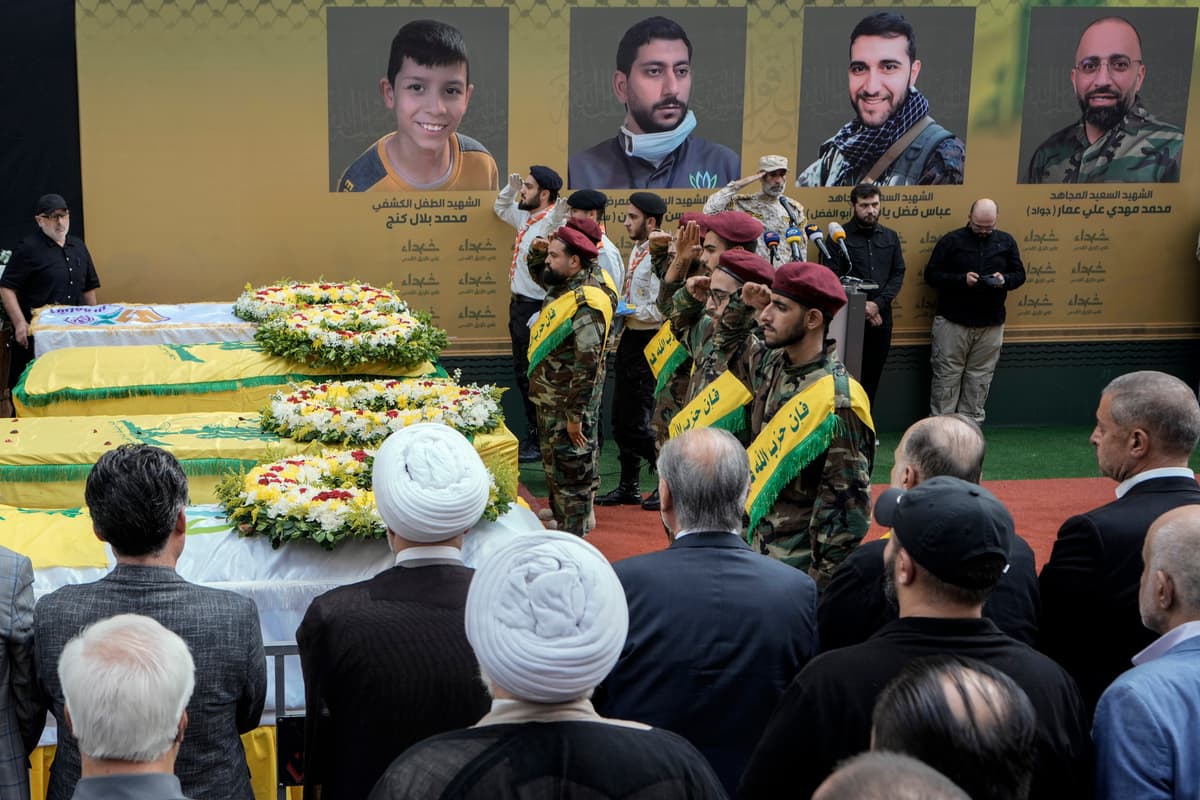
Hezbollah fighters salute as they stand next to the coffins of four victims who were killed September 17, 2024, after their handheld pagers exploded. AP/Bilal Hussein

A veteran Islamic Republic official who has recently re-entered the upper echelon of Tehran’s power structure, Ali Larijani, is launching a tour of Iraq and Lebanon, where the governments are weighing attempts to disarm Iran’s proxy militias. 

Mr. Larijani landed at Baghdad Monday, armed with a draft for an “important security deal” between Iran and Iraq. His four-day trip will also take the recently installed secretary of Tehran’s supreme national security council to Lebanon. 

The governments of both countries are increasingly voicing their intentions to disarm Iran-backed militias and ensure that the states have monopolies over their militaries. In early August the American ambassador to Turkey, Thomas Barrack, a native of Lebanon, presented the Beirut government with a new proposal for disarming Hezbollah by the end of the year, as well as for ending Israel’s military operations in the country.

Hezbollah is resisting the plan, and Mr. Larijani “wants to make sure that no Shiite official blinks,” the founder of the northern Israel-based Alma research center, Sarit Zehavi, tells the Sun. “Each time the Americans take the Lebanese government forward, some Iranian comes over to draw red lines. Mr. Larijani’s message to Hezbollah: ‘We prefer death to disarmament.’” 

Prime Minister Salam Fayyad of Lebanon accepted the American plan and announced that he and President Joseph Aoun are instructing the Lebanese army to prepare a plan for disarming all non-government militias by the end of the year. 

Separately, Iraq’s premier, Mohammed Shia al-Sudani, said recently that there is “no reason” for anything other than state institutions to hold weapons. He also noted that he successfully prevented Iran-backed arms militias, like the Popular Mobilization Force, from attacking Israel during the 12-day war between Israel and Iran in June.

For now, even as a cease-fire agreement between Israel and Lebanon is largely intact, the Israel Defense Forces continuously strikes positions near the countries’ border in an effort to prevent its rearming after last winter’s attack against Hezbollah’s top officials and its rocket arsenal.

The Islamic Republic, though, is attempting to rearm its former top militia, and is exerting pressure on Beirut. “Our cooperation with the Lebanese government is long and deep,” Mr. Larijani told Tehran government-controlled television Sunday. “We are talking to Lebanese officials and influential figures in Lebanon.”   

During his trip Mr. Larijani “could wield threats,” the policy director at United Against Nuclear Iran, Jason Brodsky, tells the Sun. Tehran’s leverage, he adds, is making clear to the Beirut government that “Hezbollah has the ability to threaten the stability of Lebanon.” 

Hezbollah politicians and their Shiite allies of the Amal party walked out before the August 5 government decision to adopt the American proposal to disarm all militias. Hezbollah terrorists, additionally, ran amok recently at Beirut on motorcycles in an attempt to intimidate the government. 

“The Lebanese government fears a civil war and wants to avoid it,” Ms. Zehavi says. “The Iranians and Hezbollah are sending signals, in the unmistaken language of the Middle East, of their intentions if talk of disarmament becomes serious.”  

Following heavy Israeli-inflicted losses to Hezbollah and other Iranian proxies, as well as the consequent fall of Syria’s Assad regime, Tehran is being forced to recalculate a strategy it has built decades ago. The Revolutionary Guards’ top general, Qassem Soleimani, who was killed by an American drone in 2020, had erected a network of armed militias that had created a “ring of fire” around Israel in order to “erase” the Jewish state from the map. 

Can an old regime hand, Mr. Larijani, recreate Soleimani’s network, or at least reverse its current setbacks?  He was brought back to government in an attempt to reinstate internal functions and to manage relations with allied superpowers like Russia and Communist China. His comeback is remarkable considering his attempts to run for the presidency were twice blocked by loyalists to Iran’s supreme leader.

Some Tehran watchers now consider the return to power of the “pragmatic” Mr. Larijani as a counterweight to another one of the supreme leader’s envoys at the top echelon of the Islamic Republic’s power structure, the hardliner Saeed Jalili. 

Either way, Mr. Larijani “is no Soleimani,” Mr. Brodsky says. The two have “very different skill sets. Laijani doesn’t have that militia-building experience that Soleimani had. The system still hasn’t been able to fully recover” from Soleimani’s demise in 2020.

The Islamic Republic retains a strong influence over Baghdad, and can wreak havoc in Lebanon, too. For now, as the Beirut government vows to disarm Hezbollah, it “talks a lot but does little,” Ms. Zehavi says.


The New York Sun

© 2025 The New York Sun Company, LLC. All rights reserved.

Use of this site constitutes acceptance of our Terms of Use and Privacy Policy. The material on this site is protected by copyright law and may not be reproduced, distributed, transmitted, cached or otherwise used.

The New York Sun

Sign in or  create a free account

or
By continuing you agree to our Privacy Policy and Terms of Use