
Waiting for Hamas

Who is Hamas at this point, and why are we all waiting for whoever it is?
Andy Henderson via 'Waiting for Godot'
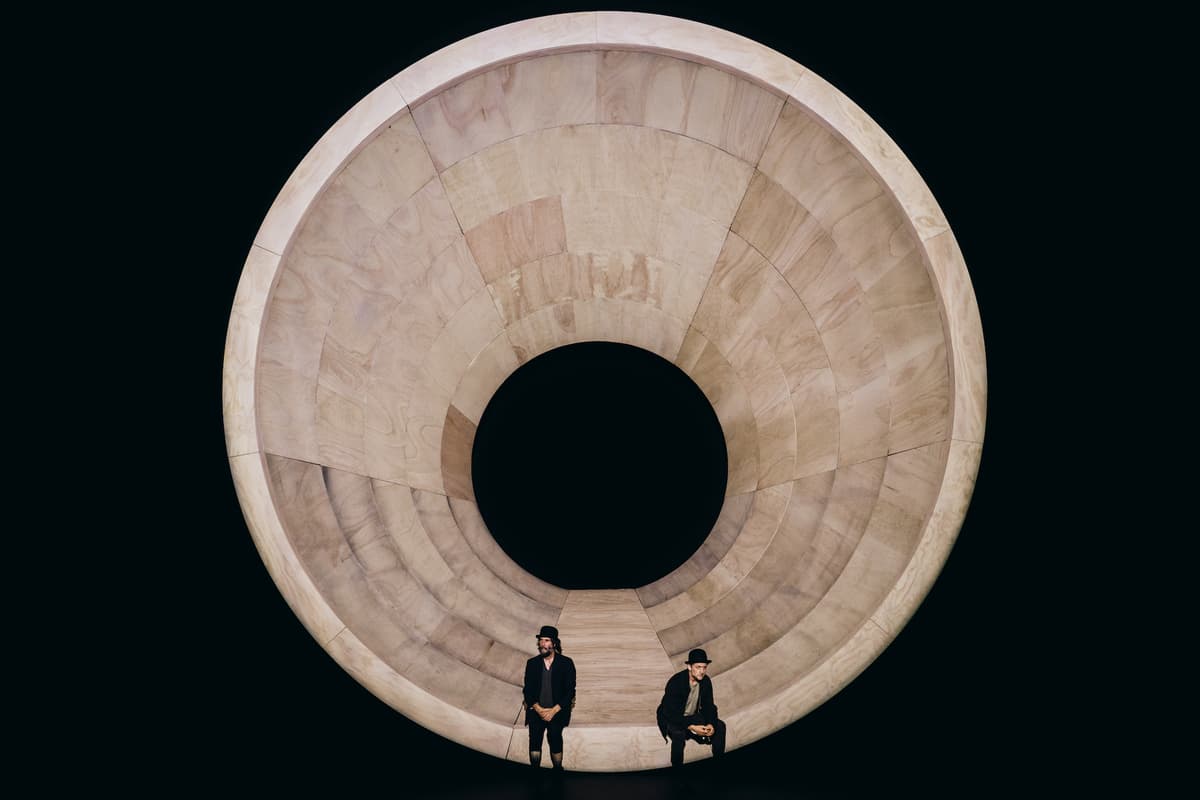
Keanu Reeves and Alex Winter in 'Waiting for Godot,' September 2025. Andy Henderson via 'Waiting for Godot'

Is it entirely coincidence that the peace plan for the Middle East proposed today by President Trump is being unveiled the same week in which Broadway gives us a new staging of what has been called the 20th century’s most significant play, “Waiting for Godot”? “Godot,” after all, our A.R. Hoffman reports, is a play “where nothing happens and every gesture is a swipe in the void.” And where no one knows who Godot is or whether he’ll show up.

It’s not our intention to make light of Mr. Trump’s peace plan. On the contrary, it is breath-taking in scale and ambition. The president is speaking of at least the possibility of it resulting in a regional peace in the Middle East. Yet, as our Benny Avni notes, the first step in the deal Mr. Trump is proposing requires Hamas to show up and release all the hostages, alive or dead. Who is Hamas, at this point, and why are we all waiting for him?

“Waiting for Godot,” of course, has nothing directly to do with the Middle East or Hamas. It was published in 1952, and is a classic of absurdist theater. Mr. Trump’s 20-point plan is, in one sense, a refutation of one of the play’s refrains, that there is “nothing to be done.” The president envisions the release of all hostages in 72 hours, to be followed by phased and what Prime Minister Benjamin Netanyahu calls “modest” Israeli withdrawals.

Mr. Netanyahu stresses that Mr. Trump’s plan does not envision the creation of a state for the Palestinian Arabs, nor does it assign to the Palestinian Authority a role in the governance of Gaza. The Israeli premier vowed that Hamas would be toppled the “easy way or it can be done the hard way. But it will be done.” A temporary board, chaired by Mr. Trump, would be committed to running Gaza. 

Godot perpetually tarries in Beckett’s play. Mr. Trump, in contrast, appears to have secured support of not only the Jewish state but also of ​Qatar, Jordan, the United Arab Emirates, Indonesia, Pakistan, Turkey, Saudi Arabia, and Egypt, all of whom issued a statement in support of the plan. Even the French president, Emmanuel Macron, himself something of an absurdist, took to X to declare that Hamas has “no choice” but to “follow this plan.”

Mr. Trump evinced a moral clarity that Israel’s foes would be wise to heed: “History has shown us that those who have relations with Israel have thrived, while those who have devoted resources and attention toward the destruction and even annihilation of Israel have languished. They haven’t done well 
  Israel is not going anywhere. They’re going to coexist with other people and countries in the region.”

One of Beckett’s characters declares, “Either I forget right away or I never forget.” Messrs. Trump and Netanyahu both urged the world to never forget the atrocities Hamas committed on October 7, though many appear to have forgotten the numerous offers of statehood to the Palestinian Arabs. It was Einstein, not Beckett, who ruminated on the insanity of doing the same thing and expecting different results.

“Godot” is not really about the plot, so it is no spoiler to share that the character who gives the play its title never appears. Messrs. Netanyahu and Trump, though, are cut from more impatient stuff than Beckett’s comic sad-sacks. If Hamas does not accept the plan, Mr. Trump declared, “Israel would have my full backing to finish the job of destroying the threat of Hamas.” The terrorists give up, or for them it’s curtains.


The New York Sun

© 2025 The New York Sun Company, LLC. All rights reserved.

Use of this site constitutes acceptance of our Terms of Use and Privacy Policy. The material on this site is protected by copyright law and may not be reproduced, distributed, transmitted, cached or otherwise used.

The New York Sun

Sign in or  create a free account

or
By continuing you agree to our Privacy Policy and Terms of Use