
Welcome to Washington: Are Republicans Overplaying Their Hand on Redistricting?

The Supreme Court could soon deliver a blow to the GOP’s effort to pad its margin for next year’s midterms elections.
AP/Eric Gay
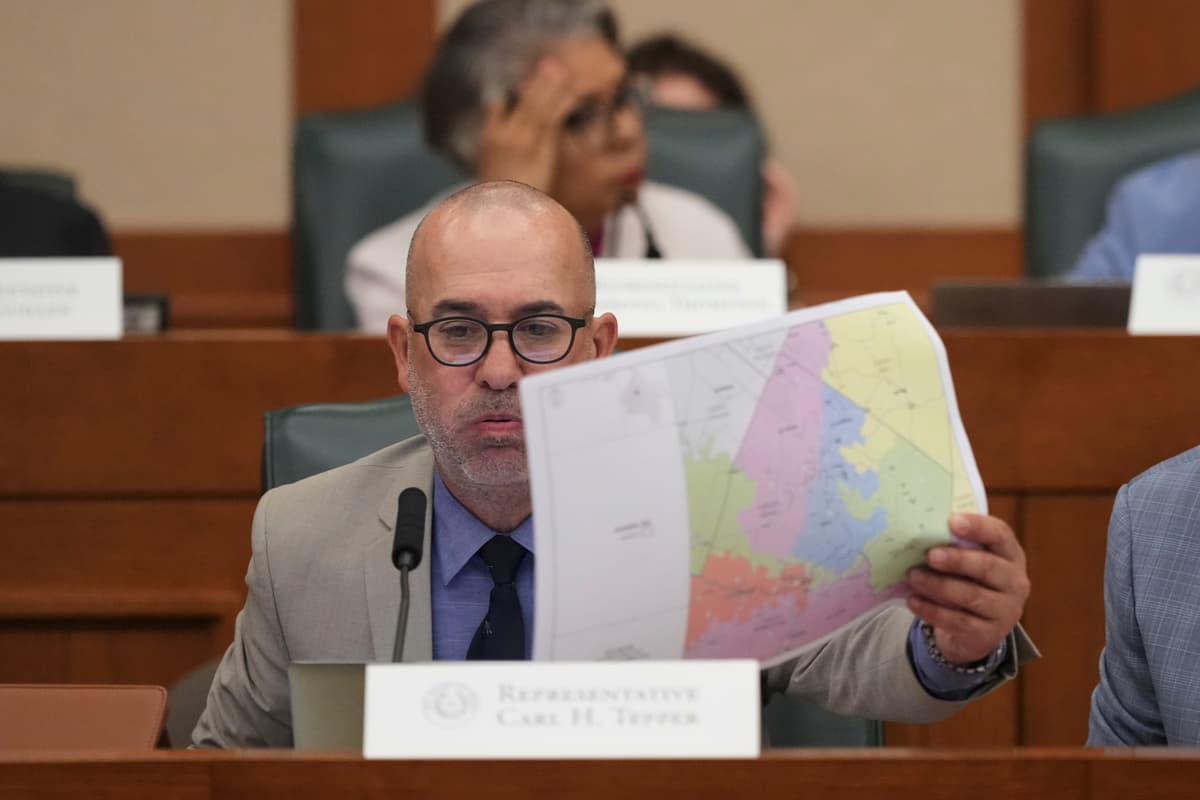
A Texas state representative, Carl Tepper, during a redistricting hearing at the Texas Capitol, July 24, 2025, at Austin. AP/Eric Gay

Republicans are waiting on edge on what could be a historic decision from the United States Supreme Court on redistricting. The justices could well strike down a new Texas congressional map aimed at eliminating Democratic seats. If that happens, the GOP will have dramatically overplayed their hand on redistricting, and made it much easier for Democrats to retake the House. 

Welcome to Washington, where news that a panel of federal judges was placing a hold on the new Texas maps was met with nothing short of jubilation. The ruling came down just as House members were walking into votes on the floor back on November 18, before the Thanksgiving break. 

The former Speaker, Nancy Pelosi, was seen on the House floor smiling and holding hands with Congressman Lloyd Doggett, a longtime lawmaker from Austin whose district had gone after redistricting from being deep-blue to being a double-digit Trump seat after redistricting. Other lawmakers, including Congressman Henry Cuellar of south Texas and Congresswoman Lizzie Fletcher from the suburbs of Houston, hugged and high-fived colleagues. 

The Supreme Court put a hold on the lower court order striking down the maps, though the filing deadline for congressional races in the Lone Star State is rapidly approaching on December 8, meaning the justices will almost certainly hand down their ruling within the next week. 

That same deadline — next Monday — also begins another pivotal day for the GOP. Members of the Indiana state senate will return to their chamber for a special session to consider whether they should redraw their own state’s congressional map to eliminate two Democratic seats. 

The state senate’s president pro tempore, Rodric Bray, will be the man to watch. Just last week, he reversed his previous position that his chamber ought not return to session to consider redistricting. He cited a lack of an appetite to do so among his Republican colleagues. Now, Mr. Bray says — citing political “strife” in his state — that there should be an up-or-down vote on the proposal. 

While Mr. Bray himself has opposed redrawing congressional maps, the chorus of Republican opposition to the plan is growing louder. State senator Jean Leising is the most recent lawmaker to say she will vote no.

“I will not cave,” she said in a statement Sunday evening. Ms. Leising says that over the weekend her home was targeted by a false pipe bomb threat, which she said was a result of “political pundits” pushing her and her colleagues to redraw her state’s maps. 

Other notable dissenters include state senator Michael Bohacek, who was disturbed by President Trump’s use of the word “retarded,” as well as other senators who have been targeted by “swatting” threats, meaning false police calls to one’s home. By one whip count, Republicans in favor of redrawing the congressional map are still 12 votes away from passing a redistricting measure. 

It is not just Indiana Republicans who are likely staying on the sidelines this year. The Kansas legislature, which is dominated by the GOP, will also not redraw their maps to eliminate the state’s one Democratic district. 

The North Carolina General Assembly, which also has ultimate authority over its congressional map, chose to move just one Democratic seat from lean Democrat to lean Republican, without shoring up a light-red district in the western part of the state — a district which could, in Democrats’ best-case scenario, flip blue next year. 

New Hampshire’s Republican governor, Kelly Ayotte, has said that she will not try to redistrict her state to eliminate a Democratic seat ahead of next year’s elections, despite a threat from Mr. Trump’s allies to back a primary challenger against her. 

Ohio Republicans made a deal with Democrats to turn only two of the current blue districts only slightly more red, for fear that the GOP could lose additional seats if it gerrymandered the state to make a number of seats only slightly red. 

Virginia and Maryland, meanwhile, may enter the fray with a vengeance. Democrats in the Virginia legislature have threatened to eliminate as many as four Republican-held seats, while Maryland’s governor, Wes Moore, is pushing his legislature to axe his state’s lone Republican district. 

Governor Gavin Newsom, too, has successfully won the right to draw his state’s congressional map in order to eliminate as many as five GOP-held seats. Governor JB Pritzker of Illinois says he may get rid of one or two Republican districts in his state, depending on what his neighboring Indiana does in the coming weeks. 

A Utah state court has also mandated that a new, deep-blue district be created, meaning that House Democrats have accidentally picked up an additional seat without even pressuring any state lawmakers. 

If the Texas map is struck down by the Supreme Court, it will spell disaster for the Republican Party. Had Governor Greg Abbott and Mr. Trump not kicked off this redistricting war, Democratic governors — many of whom are 2028 hopefuls — never would have tried to retaliate. 

The death of the new Texas map means the GOP likely flips just four seats, while the Democrats’ retaliation results in as many as 11 districts for themselves — a net loss for the Republicans of an astonishing seven seats in a year in which they are already poised to fare poorly.


The New York Sun

© 2025 The New York Sun Company, LLC. All rights reserved.

Use of this site constitutes acceptance of our Terms of Use and Privacy Policy. The material on this site is protected by copyright law and may not be reproduced, distributed, transmitted, cached or otherwise used.

The New York Sun

Sign in or  create a free account

or
By continuing you agree to our Privacy Policy and Terms of Use