Welcome to Washington: Democrats Face a Difficult Fork in the Road to Keeping the Government Open

Democratic voters say they want their leaders to be throwing up roadblocks as often as possible with President Trump in the White House.

AP/Ben Curtis
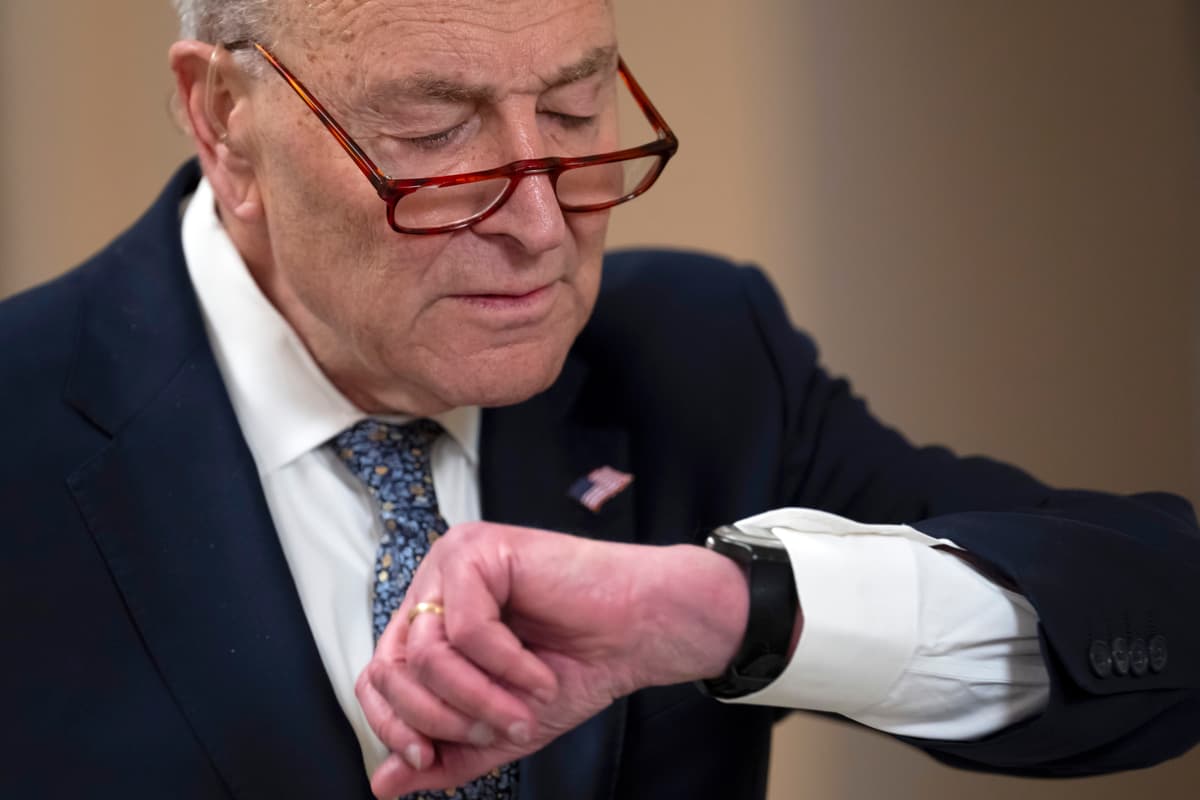
The Senate minority leader, Chuck Schumer. AP/Ben Curtis

President Trump this past week signed a piece of legislation aimed at rescinding $9 billion for foreign aid, public broadcasting, and other programs. Thanks to the rules of the process, the GOP was allowed to avoid the filibuster entirely. Their tactics have already sharply increased the possibility of a government shutdown. 

Welcome to Washington, where from now until the beginning of August, the House and Senate will continue their work on the government funding process. The legislative branch is required to pass 12 separate funding bills annually, though that has not happened in decades, leading congressional leadership to simply put out either continuing resolutions to keep the lights on, or to use omnibus mega-bills negotiated behind closed doors. 

The deadline to pass the 12 bills and have President Trump sign them is the first day of October. The timeline is especially complicated because both the House and Senate are taking off the entire month of August for their annual summer recesses. To get the individual pieces of legislation through the Senate, it takes 60 votes to avoid a filibuster, meaning Senator Thune will need at least seven Democrats to sign on to his funding agreement.

The $9 billion rescissions package may be complicating that, however. The way rescinding funds works in the federal government is the White House sends Congress a list of funds it would like to see withdrawn. The list this time was criticized for being vague, with short explanations for why certain money needed to remain in the Treasury. 

Three Republicans voted against the rescissions bill in the Senate. Two of them — Senators Collins and McConnell — said they were not happy signing off on the White House’s demand for a cut to funds without more specificity. 

Democrats, too, made clear that this would have an impact on how they legislate going forward. As Mr. Thune was speaking on the floor about the bill at just after 2 a.m. one day this week, Senator Kaine got up and yelled: “$9 billion this week, $3 trillion last week.”

Mr. Kaine was referring to the irony of Republicans heralding $9 billion worth of savings when in comparison an additional $3 trillion in deficit spending will be instituted as part of the One Big Beautiful Bill Act. 

Democrats have faced the dilemma of government spending before, and they walked away from that fight feeling significantly burned. In March, the government was set to shut down if a funding agreement was not reached. At the time — with Elon Musk rifling through the executive branch — Democrats wanted some kind of assurance that the funds they were sending to the White House would actually be spent. The House passed the bill on a nearly party-line vote, with only one Democrat voting yes, which then put pressure on Senate Democrats to keep up the fight. 

Ultimately, Senator Schumer announced that he would be one of the requisite 60 votes in order to avoid a filibuster. Democrats raged at him, and his popularity within his own party plummeted to 39 percent. One Republican senator joked at the time that Mr. Schumer was “as popular as chlamydia.”

Mr. Schumer is once again in the spotlight, as Democrats in the Senate are growing visibly more frustrated by the day about how the institution is functioning. If they choose to at least advance the bill to break the 60-vote threshold, then Republicans could always come back with another rescissions package that they can pass through the chamber with a simple majority. 

The chairman of the House Appropriations Committee, Congressman Tom Cole, tells the Sun that he was especially dismayed at the Democrats’ anger at Mr. Schumer when “he did the right thing and the smart thing” in voting to keep the government open. During an interview just off the House floor this past week, Mr. Cole said that it’s obvious to everyone involved that lawmakers will have to reach a similar kind of deal again. 

“Democrats had a hard time coming to a deal last time. I think they have a hard time dealing with Donald Trump,” Mr. Cole said. “If he signs something, they have to be against it. I mean, they’re getting that kind of pressure from their base.”

“Sooner or later, you have to govern the country,” the chairman told the Sun. “We can’t pass this with Republicans only, and they can’t enact legislation without the president signing it.”


The New York Sun

© 2025 The New York Sun Company, LLC. All rights reserved.

Use of this site constitutes acceptance of our Terms of Use and Privacy Policy. The material on this site is protected by copyright law and may not be reproduced, distributed, transmitted, cached or otherwise used.

The New York Sun

Sign in or  create a free account

or
By continuing you agree to our Privacy Policy and Terms of Use