
What’s in a Name? Middlebury College’s Performative Purification Amounts to a Small Act of Thievery

Like Aesop’s accounts of loquacious animals, today’s incidents on campus often have a pungent moral.
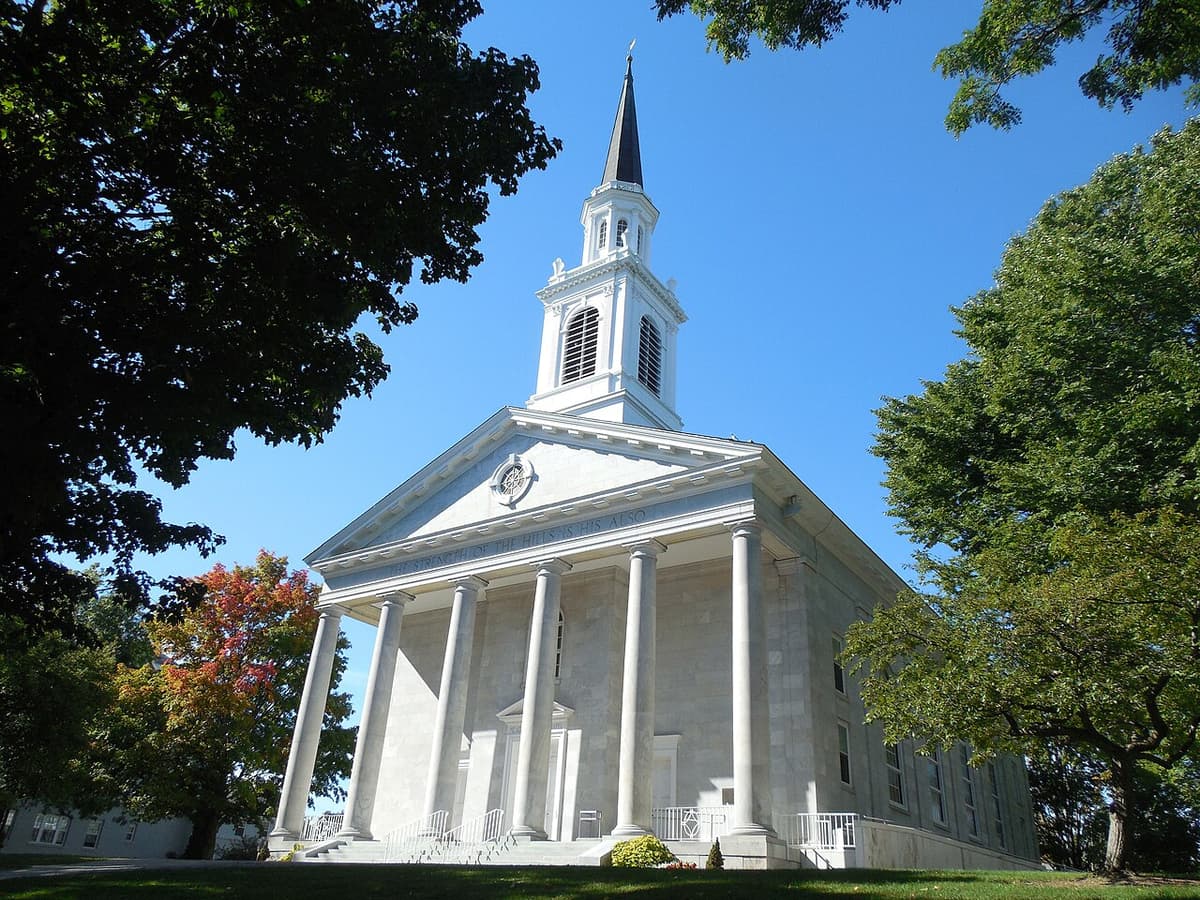
Niranjan Arminius via Wikimedia Commons CC4.0
The former Mead Chapel on the campus of Middlebury College. Niranjan Arminius via Wikimedia Commons CC4.0

Higher education provides more stories that deserve public attention than Aesop had fables. Like Aesop’s accounts of loquacious animals, though, the incidents on campus often have a pungent moral. 

I have written from time to time about a small act of thievery at a rural college in Vermont. The college is Middlebury, and the peculiar theft was the name of a building. 

In recent years, colleges and universities around the country have been busy renaming buildings, scholarships, and sometimes whole schools that had been burdened with references to individuals the institutions no longer wished to honor.  

In 2017, Yale University renamed Calhoun College (which honored the vice president of the United States. between 1825 and 1832, John Calhoun).  Henceforth, it would be “Grace Hopper College” (a pioneer of computer programming).  

Calhoun
Vice President Calhoun in 1849. Via Wikimedia Commons

In 2020, Princeton University renamed its Woodrow Wilson School of Public and International Affairs. Henceforth, it became the Princeton School of Public and International Affairs.  

Calhoun had defended slavery, and President Wilson defended (and promoted) segregation.  Whatever positive contributions these men had made during their lifetimes were deemed by their institutions as outweighed by their racial iniquity. 

Cancelling long-dead people, tearing down statues to Confederate generals or ordinary soldiers, and purging the present of reminders of chapters of American history that discomfort today’s citizens — or at least their leaders — has become a well-worn path of virtue-signaling. 

It is not limited to campuses, to be sure. In January 2022, the American Museum of Natural History removed the equestrian statue of President Theodore Roosevelt from the front entrance, where he kept watch on Central Park. Among his faults was that while he sat on his horse, he was accompanied on either side by a Native American and an African American on foot. This was deemed an act of subordination. 

People enter the American Museum of Natural History in 2021 past a statue of Theodore Roosevelt on horseback with a Native American man on one side and an African man on the other at New York City.
A statue, since removed, of Theodore Roosevelt on horseback in front of the American Museum of Natural History in 2021. AP/Ted Shaffrey

Instances of erasure and de-plinthing can be multiplied, but I am not right now arguing that Calhoun, Wilson, or Roosevelt were unfairly treated — though I think the matter deserves consideration. I just want to make clear that there are precedents for what Middlebury College did.  

An institution calling foul on one of its esteemed alumni (Calhoun) or former presidents (Princeton) may err in its judgment, but it acts within its rights.  And whether that action is wise, at least it is grounded in actual history.  

No one doubts that Calhoun was an ardent defender of slavery or that Wilson was a segregationist. And in both cases, there was substantial support within the university community for the cancellations.

Middlebury, though, presents a different story. The chapel at Middlebury, the college’s most prominent building, a colonnaded white marble structure that sits on the brow of a hill with a sweeping lawn in front of it, was built with donations from a physician, John Abner Mead, who directed that it be named for his “ancestors.” 

Governor Mead
Governor John Abner Mead of Vermont. Via Wikimedia Commons

As it happened, the College officials misrepresented this in justifying the renaming.  They announced that the chapel was named in honor of ‘him [John Mead] and his wife.”  Details, details.

Mead Memorial Chapel was dedicated in 1916. A Middlebury alumnus, John Mead, had been a governor of the state (1910-1912). During his life, John Mead occasioned no particular controversy. He volunteered in the Union Army during the Civil War, leaving his studies at Middlebury to do so. He saw active duty at the Battle of Gettysburg. Unlike most Union Army soldiers, he was an explicit opponent of slavery. 

He had no known connection to segregation. His social views were those typical of his time and place. He had been a delegate to the Republican National Convention in 1912, and was promoted as a possible running mate for William Howard Taft, though that nomination ultimately went to Nicholas Murray Butler. Ironically, the nomination went to Butler because Mead was considered too “progressive” for the ticket. His progressive positions included support for hydroelectric power, women’s suffrage, campaign finance reform, higher taxation, and vocational schools.

So perhaps Mead can be counted among those who tried to prevent the racialist Wilson’s election.  In his later years, he helped to create Vermont’s State School of Agriculture, and he helped to elevate the profession of nursing by enacting registration requirements.

mead
The spire of Mead Chapel towers over the Middlebury College campus, depicted in an old postcard. Via Wikimedia Commons

So how did it happen that in September 2021, with no public discussion or deliberation, the president of Middlebury had the wooden plaque inscribed “Mead Memorial Chapel” stripped off the entrance? That day, President Laurie Patton announced to her college community that the building would now be called just “The Middlebury Chapel.”

As it turned out, the rationale for this excision was that in his farewell address as governor, Mead had endorsed Vermont’s existing policies aimed at restricting the marriages of “degenerates” and separating “defectives” onto poor farms. This bit of information passed into historical obscurity until a freelance journalist, Mercedes de Guardiola, surfaced it in an article in Vermont History magazine. 

Her article caught Ms. Patton’s attention, who appears to have seen it as an opportunity.  Middlebury may not have had anything to do with slavery or other topics ripe for grievance-mongering, but dig deep enough, and you can find that the man who funded and named Mead Memorial Chapel was a proponent of “eugenics.” 

Vermont these days is primed for such bouts of performative purification. The legislature had gotten in on the act earlier in 2021 by issuing a public apology for the forced sterilization of some 250 citizens back in the day.  Blaming those sterilizations (justified or not) on Mead was Ms. Patton’s little addition to revisionist history.

Had there been an interval for public discussion, it might have emerged that, while Mead had died in 1920, Middlebury College, for decades after that, had taught eugenics as a positive contribution to public health, and that curriculum owed nothing to the influence of Mead. Middlebury College played a key part in passing Vermont’s 1931 sterilization legislation. Yet the rush by Ms. Patton to get out in front of a social justice cause left no time for historical investigation.

Yet my phrasing attributes to Ms. Patton an initiative that she modestly declined at the time.  She wrote, “After a careful and deliberative process, Middlebury’s Board of Trustees has made the decision to remove the Mead name from the chapel, for the reasons we will describe below.” Deferring to the authority of the board and feigning reluctance for the act might reflect what truly happened.  Somehow it doesn’t ring true. I’ve worked with college presidents and boards of trustees for some forty years, and I can’t think of any other instance of a board imposing on a college president in this fashion.

Ms. Patton might well have expected to be congratulated for her initiative, but the heirs of John Abner Mead thought otherwise.  In their view, Mead’s gift to Middlebury College was a binding agreement, and by renaming the building, Middlebury had broken it. A lawsuit commenced and, despite some setbacks along the way, it continues. 

Mead Chapel
The building formerly known as Mead Chapel on the Middlebury Campus. Kenneth James Burchfiel III via Wikimedia Commons

The latest in that suit is an amicus brief filed by Amherst College, Bennington College, Champlain College, Franklin & Marshall College, Ithaca College, Landmark College, Saint Michael’s College, Sarah Lawrence College, Smith College, Sterling College, Swarthmore College, Trinity College, Tufts University, Vermont College Of Fine Arts, Vermont State Colleges, Wellesley College, and Williams College. To get 17 colleges to weigh in on a matter this parochial is eye-catching. Is there a belated boom in opposition to country doctors who once spoke unkind words about degenerates? 

No. The issue here is the power of colleges to ignore the wishes of donors whenever that becomes convenient. You can read some thirty pages of legal posturing to the effect that Mead’s original gift didn’t really obligate the college to abide by his terms. Presumably, if Mead’s heirs were to prevail in their suit, all these colleges might be vulnerable to suits by other heirs who have seen their family gifts wash away in the caprices of college presidents like Ms. Patton. 

Should a college be bound by its promises? Or should it be free to set aside promises that interfere with current interests? There are legal procedures for doing that under what is called the cyprès doctrine, in which a court recognizes that the original terms of an agreement can no longer be upheld and a “close enough” substitute will have to suffice.  Yet there was no legal procedure pursued by Middlebury before it changed the name of Mead Memorial Chapel, and indeed, there was no reason at all to break the agreement. The name of John Mead’s parents on the white marble chapel harmed no one and could have stayed there for as long as the college endures. 

If Aesop came looking for a larger moral in this story, he might find it in the insouciance with which a college president (supported by her board) disregarded both tradition and institutional commitment in order to stand on the steps of the chapel and proclaim her own superior virtue. There are all too many such overweening college presidents these days. Yet Aesop might have dug deeper. Seeing one of their own stung by a hornet, the other donkeys charged the hive.

I have only a faint connection to Middlebury College. I know several faculty members there, and I have visited the campus from time to time. My main interest came from the affair, during Ms. Patton’s term as president, when the college permitted — actually fostered — the 2017 protest against Charles Murray, during which a faculty member was injured. Some activist faculty members helped rile up the students, and Ms. Patton, who was present, was content to let the protest play out and silence Mr. Murray.  

That memory of that protest surely lay behind Ms. Patton’s 2021 decision to erase Mead’s name from the chapel. The attack on Mr. Murray featured the accusation that he was (is) an advocate of eugenics. That happens to be as false as the accusations against Mead, but no matter, it elevated “eugenics” as a scary word for a pernicious policy, and gave Ms. Patton the rhetorical bludgeon she needed to show her fierce determination to be on “the right side of history.” 

What Middlebury College does or doesn’t do is fairly far down the scale of significance in our year of epochal controversies at Harvard, Columbia, and other institutions — most recently Northwestern.   What strings all those stories together is the persistent mendacity of college and university leaders. 

The Mead controversy at Middlebury is a microcosm of institutional dissembling on behalf of what the leaders believe will be seen as a righteous cause. Aesop teaches us to look closely at such microcosms to understand the bigger picture. All those donkeys charging the hornets’ nest may well learn some painful lessons.

This article was originally published by RealClearEducation and made available via RealClearWire.


The New York Sun

© 2025 The New York Sun Company, LLC. All rights reserved.

Use of this site constitutes acceptance of our Terms of Use and Privacy Policy. The material on this site is protected by copyright law and may not be reproduced, distributed, transmitted, cached or otherwise used.

The New York Sun

Sign in or  create a free account

or
By continuing you agree to our Privacy Policy and Terms of Use