President Johnson Felt JFK Was Much Too Promiscuous — With His Use of Autopen

Lost in today’s partisan volleys over Biden and pardons, though, is that a president doesn’t need to sign anything to dole out clemency.
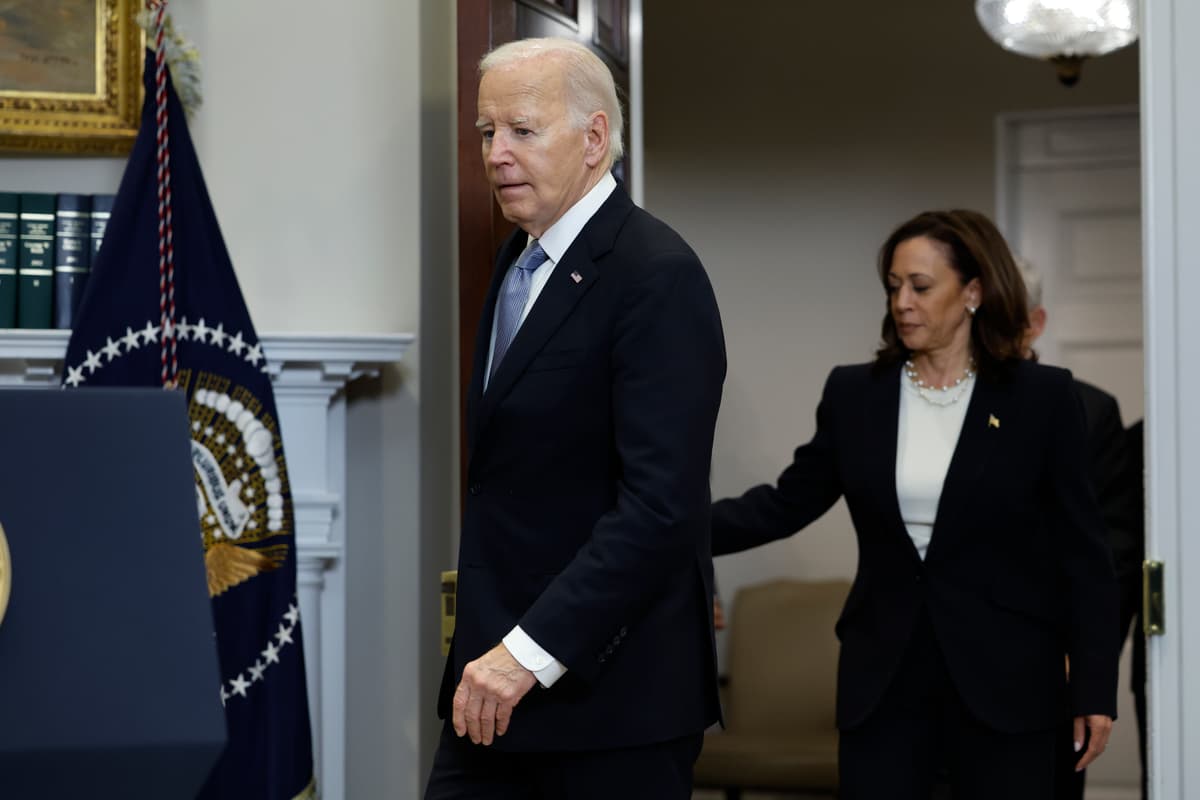

Kevin Dietsch/Getty Images
President Biden at the White House on July 14, 2024, with Vice President Harris behind him. Kevin Dietsch/Getty Images

With allegations about President Biden’s diminished capacity trickling out, he is pushing back on the question of subordinates using an autopen to forge his signature on documents. Regardless of the political fallout, it’s good for Americans to get an accounting of how presidents use a tool that, like any technology, can be abused.

In the sunset of his term, Mr. Biden pardoned political allies and family members while reducing the sentences of almost 4,000 federal prisoners. “I made every decision,” he told Sunday’s New York Times, calling Republicans “liars” for arguing otherwise.

Mr. Biden said that he relied on the autopen — sometimes called a robot pen — to ease his burden because there were “a lot of people” on his list. For the same reason, President Jefferson patented a version of the device in 1803, making it easier to duplicate his writings in the days before copy paper, Xerox, and PDFs.

In 1968, the National Enquirer reported that “one of the best-kept secrets in Washington” was “the robot that sits in for the president.” President Lyndon Johnson was photographed with the device that year but, as David Halberstam writes in “The Best and the Brightest,” he disliked it.

Johnson, Halberstam wrote, felt that President Kennedy “had used” the autopen “too frequently and promiscuously, and that there were too many Kennedy letters which were not true Kennedy letters.” LBJ began signing everything by hand. 

LBJ
President Lyndon Johnson hands President Truman a pen at the signing of the Medicare Bill, July 30, 1965. Via Wikimedia Commons

As seen with smartphones, technology expands its role in our lives until we become dependent on it. President Truman, the first to use an autopen in office, limited it to checks and letters. Today, when citizens request presidential greetings for special occasions, the robotic arm acts as the White House pinch hitter.

In 2005, the justice department examined the limits of the autopen, advising President George W. Bush that he “need not personally perform the physical act of affixing his signature to a bill” for it to become law. A deputy assistant attorney general, Howard Nielson, made the distinction in a 30-page opinion. 

Presidents, Mr. Nielson wrote, could command that an autopen be employed to perform official duties. But the DOJ was “not suggesting” that the chief executive could “delegate the decision” of whether to sign, only the technique of marking the dotted line. 

Autopen
A Kennedy-era Autopen Model 50, used to reproduce the president’s signature on documents. Benjamin Olding, International Autopen Company via Wikimedia Commons CC3.0

President Obama was the first to employ an autopen for legislation, using it to sign an extension of the Patriot Act, an appropriations bill, and a tax bill while far from Washington. After Republicans won Congress in 2010, Mr. Obama said, “I have a pen and a phone,” but they were his alone to wield.

President Trump told reporters in March that he leans on the autopen “only for very unimportant papers.” Using it “to sign pardons and all of the other things,” he said, is “disgraceful.” 

After President Wilson was crippled by a stroke in 1919, his wife, Edith, signed official documents — doing by hand what it’s alleged was done with Mr. Biden’s autopen. The first lady called the period her “stewardship,” though the Constitution creates no such role just as it doesn’t invest executive authority in the autopen itself. 

President Wilson in June 1920 at the White House after his stroke, with his wife at his side.
President Wilson in June 1920 at the White House after his stroke, with his wife at his side. Via Wikimedia Commons

Lost in the partisan volleys is that a president doesn’t need to sign anything to dole out pardons. In 1929, the acting solicitor general, Alfred Wheat, wrote that “neither the Constitution nor any statute” sets “the method” for granting clemency. “It is wholly a matter for the president to decide” and the “method” is a “mere detail.” 

Wheat, however, stressed that “nobody but the president can exercise the power” of clemency, which is what the DOJ is investigating. It would have been within Mr. Biden’s purview to direct that an autopen be used to execute his commands. But if others did so without his knowledge, that’s illegal. 

Political wrangling over Mr. Biden’s autopen will fade, but concerns like those Johnson expressed will linger as AI and other technologies advance. The American people will chart a wise course forward by hewing to the Constitution, and by making clear that they elect a human being, not a robot, to fill the Oval Office.


The New York Sun

© 2025 The New York Sun Company, LLC. All rights reserved.

Use of this site constitutes acceptance of our Terms of Use and Privacy Policy. The material on this site is protected by copyright law and may not be reproduced, distributed, transmitted, cached or otherwise used.

The New York Sun

Sign in or  create a free account

or
By continuing you agree to our Privacy Policy and Terms of Use