
Why Europe Is Flummoxed by Trump’s New National Security Strategy
Team Trump’s new document repudiates the charge that the president is an isolationist trying to hide from reality.
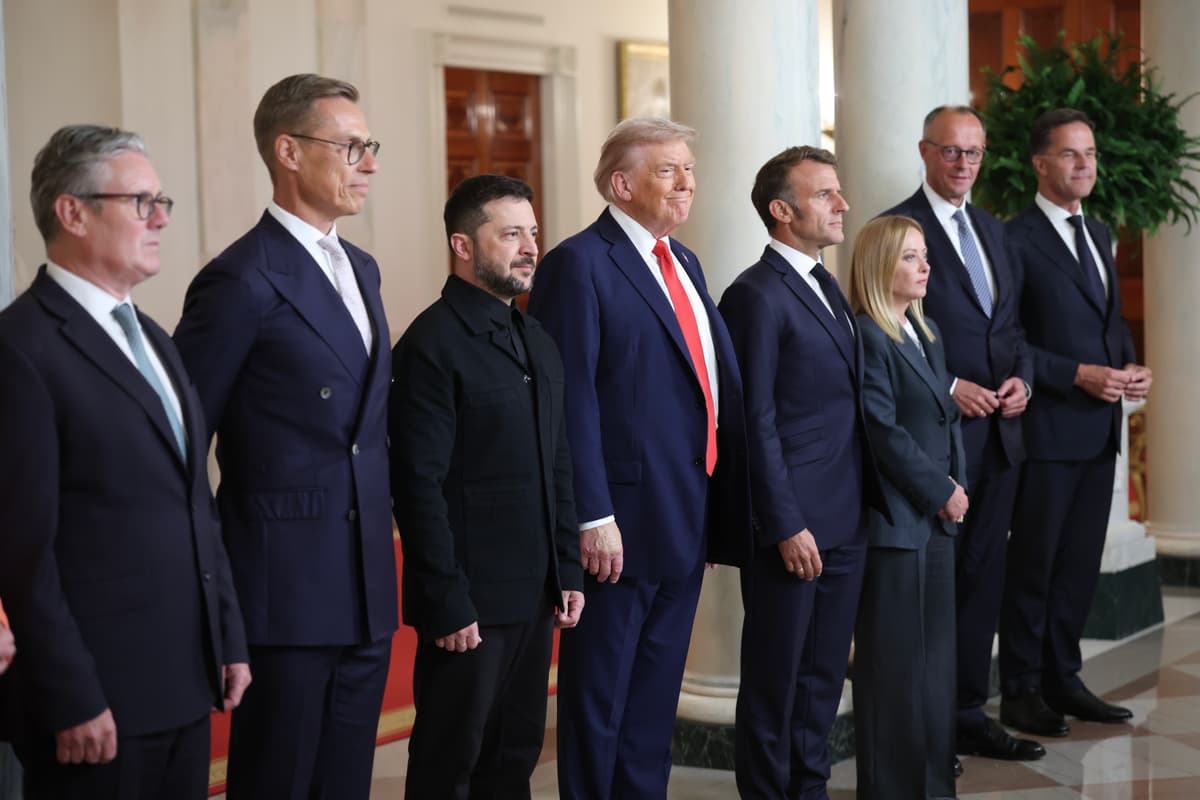
Many Europeans, American Europhiles, and Never Trumpers are all certain President Trump’s new National Security Strategy must be wrong. Indeed, they write and talk about it as though no rational person could undertake the kind of rethinking Mr. Trump has put into motion.
This is in part because it defies their mental narrative. The new strategy document is a perfect repudiation of their charge that Mr. Trump is an isolationist trying to hide from reality. After many years of living in Europe, getting a Ph.D in European history, and teaching about the art of war since 1983, it seems to me that Mr. Trump’s critics are the ones out of touch with reality.
Yes, Europe was once briefly the center of the world. Those days are gone. Now, the current European elites are doing all they can to prop up a system which cannot compete in a modern technologically advanced world economy. It cannot cope with waves of migration from cultures which repudiate European values. It cannot organize itself to defend itself without American help.
The war in Ukraine illustrates the current weakness of the European experiment. A weakened, sanctioned, partially isolated Russia can generate more combat power than all Western Europe combined. It is an absurdity that indicts European elites for their determined pursuit of fictional passions and unworkable ideologies at the expense of solving real problems.
The scale of change needed for European civilization to survive as a dynamic, safe, and prosperous system is enormous. It is clearly beyond the capacity of Europe’s current political leaders and bureaucracies. Even if Europe were stronger, it still would be a declining part of a rapidly changing world.
By the end of the century, Nigeria alone may have more people than all of Western Europe. The rest of Africa will be extraordinary in population and natural resources. India and Communist China are behemoths with huge industrial bases and powerful militaries that dwarf the European countries. Japanese and South Korean industrial and technological capabilities are world-class.
Brazil is on the verge of becoming a major player — and the rest of Latin America has enormous potential (nearly all of them have strong relationships with China — not America). In raw materials, there are many parts of the planet which have more resources, energy, and growth potential than Europe.
This analysis is not designed to denigrate or diminish Europe’s many achievements. The quality of science in Switzerland equals anything found in the rest of the world. The European space program still makes a significant contribution to the human journey beyond the planet. In pharmaceuticals, there are world-class institutions based in Europe. Airbus remains a major manufacturer of commercial aircraft on a scale that makes it a worldwide company.
Look at the globe from the American perspective. In 1917, President Woodrow Wilson led us into World War I. Then came World War II, and a half-century Cold War, which ended with the disappearance of the Soviet Union in 1991. Over this time, America had to prioritize the security of Europe. Even during the Korean War, two-out-of-three new defense dollars went to defending Germany rather than winning in Korea.
Now, the centrality of Europe can no longer dominate and define American strategic planning. The new realities require a global vision that starts with dominance in space — and the ability to provide intelligence, communications, defensive systems, and offensive systems from space. Space will be to the next century what air power was to the last. By investing in space dominance, America seizes the high ground everywhere in the world.
America must develop a combination of big-country strategies and regional strategies. Where possible, these should be synergistic and mutually reinforcing. In this new emerging world, Europe is still important, but it is important as one of a number of centers of economic, cultural, financial, and military capabilities.
To the degree that European elites can learn from the failures of the last 30 years, they may be able to launch Europe on a better, more important future. However, one of the key takeaways of Mr. Trump’s strategic plan is: Saving Europe is Europe’s job. America must rethink its allocation of resources and capabilities within the larger emerging global framework.