Will Automatic Birthright Citizenship Go the Way of ‘Separate but Equal’?

The high court appears to be open to reconsidering a venerable legal precedent.
Rebecca Noble/Getty Images
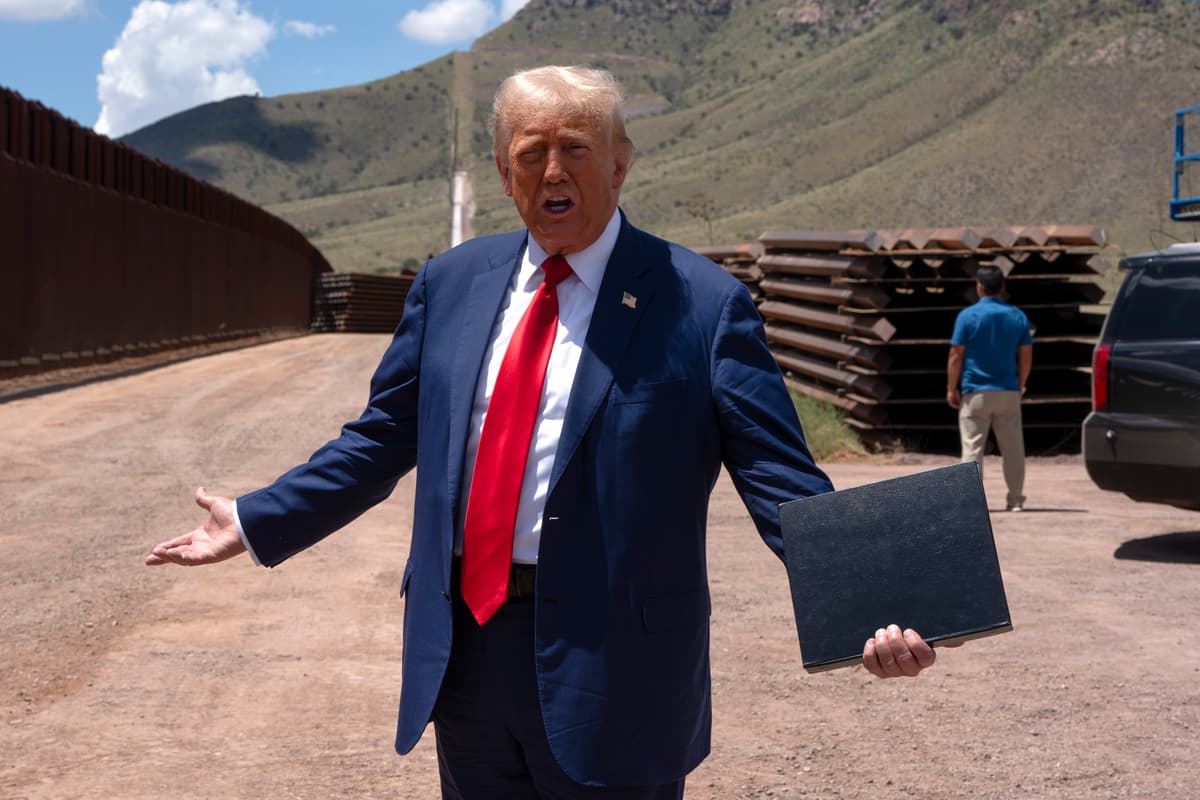
President Trump speaks at the Mexican border on August 22, 2024 south of Sierra Vista, Arizona. Rebecca Noble/Getty Images

Is American citizenship automatically bestowed on children born within the territory of the United States, regardless of the nationality of the child’s parents? For more than 125 years, the answer has, by and large, been yes. Yet the Supreme Court, by agreeing today to hear the president’s appeal in the case of Trump v. Barbara, appears to be open to at least reconsidering this venerable legal precedent. 

The high court’s decision follows a number of lower court rulings opposing President Trump’s effort to prospectively deny automatic birthright citizenship to, say, children of illegal immigrants. Yet these columns, as these cases have made their way through the federal courts, have marked how a review of this question could prove illuminating for both opponents and proponents of the longstanding legal standard for citizenship.

After all, America has been relying for guidance on the question of birthright citizenship on a precedent set in 1898. That year, the Nine found in the case of United States v. Wong Kim Ark that a child born on American soil, even to parents of a different nationality, was in effect guaranteed American citizenship. Longevity, though, is not in itself a reason to uphold a legal precedent.

Feature the high court’s move in 2022, in Dobbs v. Jackson Women’s Health Organization to overturn the nearly 50-year-old Roe v. Wade precedent that discerned in the Constitution a federal right to an abortion. Plus, too, in 1954 the high court in Brown v. Board of Education saw fit to strike down the segregationist doctrine, known by the shorthand of “separate but equal,” set in 1896 in the case of Plessy v. Ferguson

“It’s rare for the Supreme Court to reverse long-held precedents,” these columns contended, “but when it does it can signal a seismic change in American political and cultural life.” Mr. Trump’s call to reform American law surrounding citizenship would amount to a legal transformation that could prove to be on a par with the reappraisals in Dobbs and Brown. The realities of immigration in the 21st century help bolster the case for revisiting the Wong precedent.

The legal challenges to Mr. Trump’s birthright policy — which he put forward in January — “raise questions about the United States’ ability to define its citizenry and protect its borders,” he averred in November to the Nine. The high court’s determination in Wong reflected the realities of an age of international travel by steam and sail. Today, the phenomenon of “birth tourism” has been facilitated by air travel reducing to hours the distance between continents.

In Mr. Trump’s analysis, the Citizenship Clause of the 14th Amendment — the constitutional crux of the legal dispute — “was adopted to grant citizenship to newly freed slaves and their children.” That contrasts, Mr. Trump reckons, with the argument of backers of automatic birthright citizenship that the privilege applies to “the children of aliens illegally or temporarily in the United States.” 

Mr. Trump’s reading of the 14th Amendment — a Reconstruction-Era landmark — finds that the clause in question “confers birthright citizenship only upon those who are both born in the United States,” he says, and “subject to the jurisdiction thereof.” Mr. Trump’s solicitor general, John Sauer, earlier argued to the high court that the president’s executive order on this head “restores the original meaning of the Citizenship Clause.” 

Lower courts — including riders of the federal appeals circuit — have disagreed with Mr. Trump. Judges of the First Circuit groused that it was “more than a century since a branch of our government has made as concerted an effort as the Executive Branch now makes to deny Americans their birthright.” Yet the high court’s review of Wong offers a chance to weigh anew a question posed in the 1890s in light of the circumstances prevailing in 2025.


The New York Sun

© 2025 The New York Sun Company, LLC. All rights reserved.

Use of this site constitutes acceptance of our Terms of Use and Privacy Policy. The material on this site is protected by copyright law and may not be reproduced, distributed, transmitted, cached or otherwise used.

The New York Sun

Sign in or  create a free account

or
By continuing you agree to our Privacy Policy and Terms of Use