

2025 Cabaret Convention Gets Off to a Vampy Start at Rose Hall
The first concert marks an example of the two hosts, Andrea Marcovicci and Jeff Harnar, stealing their own show.
36th Annual Cabaret Convention
Presented by the Mabel Mercer Foundation
Rose Hall, Jazz at Lincoln Center
Through October 23
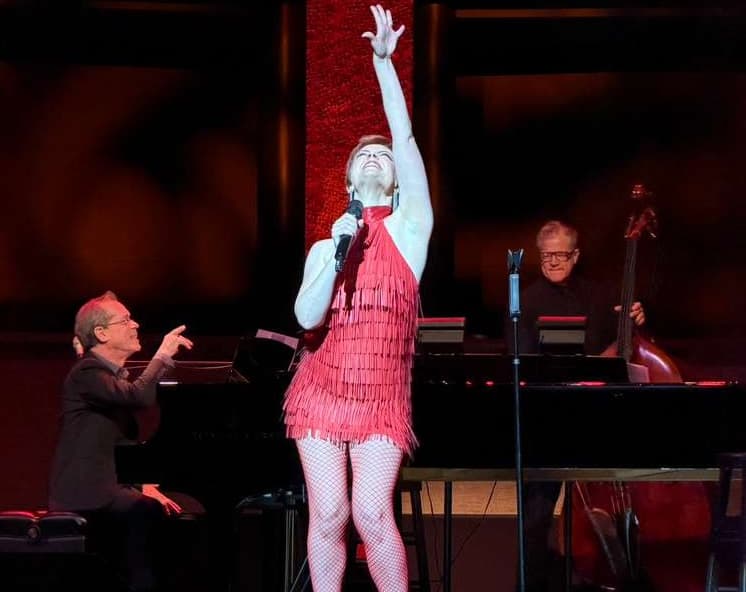
The first of three nights of the 2025 Cabaret Convention, titled âThe Best is Yet to Come â A Celebration of Cy Coleman,â opened in a way that was taking no chances. The house lights went down and out onto the stage slinked Carole J. Bufford, looking the very picture of a sloe-eyed vamp in a short, tight, shiny sequined red dress plus matching fishnets and heels, singing an even more incendiary number, âHey Big Spender,â from âSweet Charity.â
Everyone in Rose Hall likely was well aware this classic 1966 musical was based on a Fellini movie about a sex worker. When Neil Simon adapted âLe Notti Di Cabiriaâ into a musical, he made the heroine a taxi dancer instead, though it was also widely known at the time that this was code for a streetwalker. In âHey Big Spender,â Ms. Bufford spells all of that out.
In the show itself, the ladies of the evening are depicted as being highly blasĂ© regarding the ho-hum tedium of sex work â which somehow makes them even more enticing in a Bob Fosse kind of way. Ms. Bufford, however, incarnated the song as pure erotic excitement. She flashed her eyes, she curled her upper lip, and she took a defiant stance that announced to the whole of Jazz at Lincoln Center that she wants it all: the sex, the money, and the Big Spender himself.
Ms. Bufford, one of the younger performers on the bill, sang what was easily the most adult song of the night. Conversely, she was followed by the two of the more senior, the eveningâs hosts, Andrea Marcovicci and Jeff Harnar, who together sang Cy Colemanâs most innocent, playful, and childlike work, âA Doodlinâ Song.â
This nursery rhyme of a melody boasts a lyric (by Carolyn Leigh) that sounds like a toddler humming an ear worm and improvising words that are a combination of nonsense syllables interspersed with self-descriptive Italian musical terminology (âObbligato, pizzicatoâ) and familiar Italo-American names (âPerry Como ⊠Guy Lombardoâ) as well as other infantile vocabulary â like âparty poop.â
When Mr. Harnar and Ms. Marcovicci addressed the crowd, they stated that their ambition was to demonstrate the versatility and diversity of Seymour Kaufman, better known as Cy Coleman (1929-2004). And between âBig Spenderâ and âDoodlinâ Song,â they had already achieved precisely that.
Cy â who was a personal friend â started as a virtuoso jazz pianist before he started writing popular songs in the Brill Building era. Then he graduated to Broadway, and quickly became, alongside such peers as Jerry Herman and Stephen Sondheim, one of the towering giants of musical theater in the late 20th century.
Opening night was a long one â about three hours including intermission â and played out like a baseball doubleheader that opened with a string of home runs. After Mr. Harnar and Ms. Marcovicci, Bryce Edwards, armed with banjo, songophone (essentially a kazoo on steroids), and a few modulations, retrofitted âHey There Good Timesâ as a vigorous, two-beat Dixieland bouncer.

Then, Eric Comstock and Barbaro Fasano, the most famously long-married couple in cabaret, delivered a characteristically ingenious mashup of Colemania that pivoted around âWhen in Rome,â a suitably saucy ode to infidelity, and âLittle What If.â
Next, apple-cheeked Richard Skipper belted âItâs Not Where You Startâ â one of Colemanâs rah-rah cheer-up marches â with letter-perfect Broadway bravado.
Then pianist-singer Nicole Zuraitis did precisely the opposite, giving us an introspective, moody âI Walk a Little Fasterâ inspired by the angular interpretations of Coleman by postmodern piano masters like Bill Evans and Keith Jarrett. Craig Rubano likewise made âOn the Other Side of the Tracksâ more inwardly facing and melancholy.
At this point weâre barely halfway through the first act. The second act pivoted around two classic Tony-winning hit shows via original cast members. For âSweet Charity,â Lee Roy Reams reminisced about the showâs creation process, and for âCity of Angels,â we were treated to a reunion of the original background vocal group, the Angel City Four, led by Amy London.
âCharityâ was also highlighted by âPink Taffeta Sample Size 10,â which was understandably cut but which Tovah Feldsuh reminded us is a swell song nonetheless, and another vocal quartet, Those Girls, whose name is generic but whose performance of âRhythm of Lifeâ was inspirational in multiple senses of the word.

Two more high-glam gals in sexy, sparkly drag turned on the torch with âAngelsâ tunes, in modes first light and then very dark: Leanne Borghesi with âYou Can Always Count On Me,â followed by Ann Kittredge and âWith Every Breath I Take.â
The Tuesday concert also marked an example of the two hosts stealing their own show. Andrea Marcovicci talked and charmed her way through âIsnât He Adorable,â a song associated with convention namesake Mabel Mercer. And Jeff Harnar gave us a big payoff on âWitchcraftâ â subtly sounding like the Sinatra of 1947 rather than ten years later.
The hosts then cleared the stage for headliner Ann Hampton Callaway to fire the climactic closing shot, with Colemanâs blockbuster standard âThe Best is Yet to Come,â a song introduced by Tony Bennett and then immortalized by Sinatra and Count Basie. The hosts pointed out that it was so significant for Sinatra that the title became his epitaph â which both is and isnât true.
âThe Best is Yet to Comeâ was indeed on Sinatraâs headstone when he was first laid to his earthly rest in 1998, but somewhere along the line some cretinous goon essentially vandalized the grave and substituted a far less copasetic inscription.
Fortunately, we still have the song âThe Best is Yet to Comeâ and Cy Colemanâs amazing songbook to listen to, not to mention another night of the Cabaret Convention.