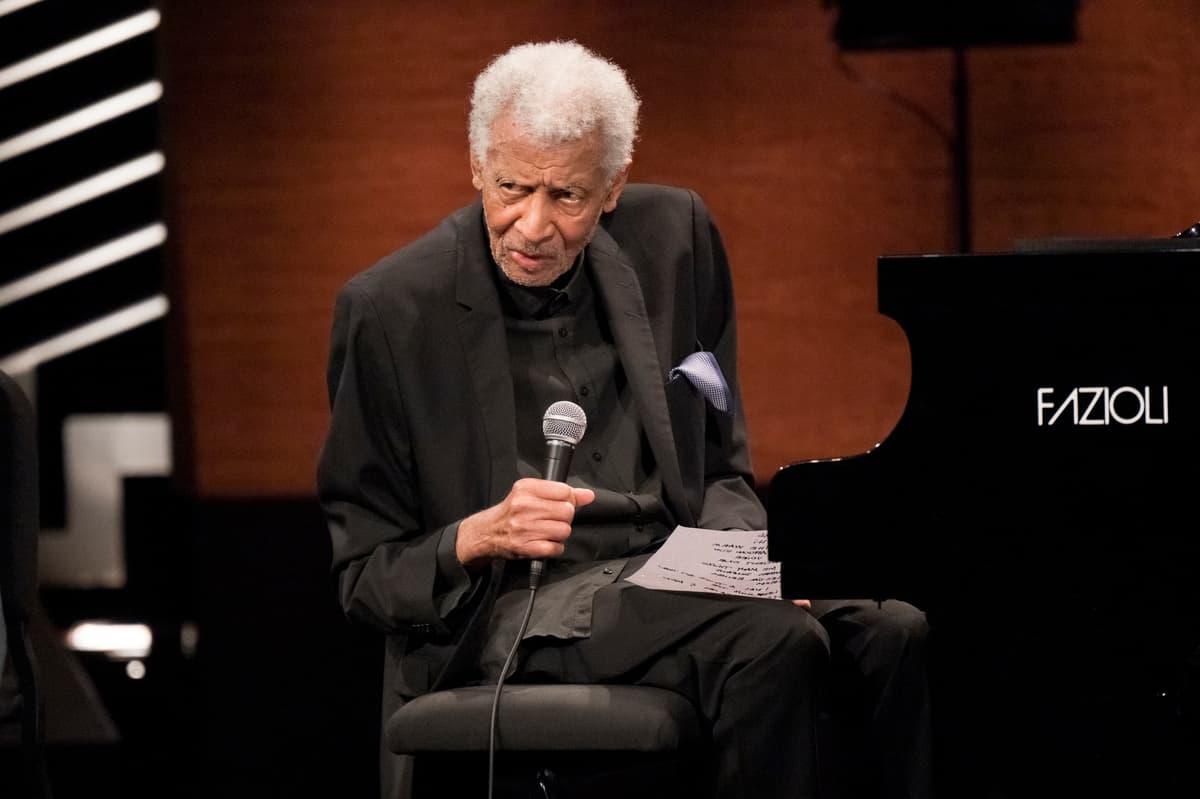
A Jazz Maestro, Abdullah Ibrahim, Brings His Unique Sounds to Jazz at Lincoln Center
At 91, the pianist-composer-bandleader formerly known as Dollar Brand is one of the most imposing figures in all of world culture today.
Abdullah Ibrahim
āLife of a Legendā
Jazz at Lincoln Center
Streaming Through October 10
Thereās nobody who knows better how to mix disparate, even seemingly inapposite, musical moods and feelings better than Abdullah Ibrahim. In a concert at Jazz at Lincoln Center on Friday and Saturday, he played a succession of extended compositions that were happy and sad, intimate and extroverted, classical and yet funky, which were on the long side but also somehow seemed far too short.
Itās not as if the music was continually shifting moods or grooves, but rather, it was all of these things at the same time.
When Jazz at Lincoln Center announced that the 2025-26 season would be devoted to the theme of āMother Africa,ā it was a foregone conclusion that Abdullah Ibrahim would be invited to be at the center of it. At 91, the pianist-composer-bandleader formerly known as Dollar Brand is one of the most imposing figures in all of world culture today.
As JALCās Swing University director, Seton Hawkins, delineated in a pre-concert talk, Mr. Ibrahim has been developing and perfecting his unique music for more than 70 years, even before his earliest recording, in the rhythm section of a local Johannesburg dance band, the Tuxedo Slickers Orchestra, in 1954.
Mr. Ibrahim is not only by far the single most celebrated jazz figure from the African continent, but heās a major player who helped to prove that it was possible to create pure jazz with an international flavor ā music that didnāt sound like it was coming from New York, New Orleans, or Los Angeles. His music has little in common with the African-inspired jazz even of well-meaning Americans, like Randy Weston or even JALCās Wynton Marsalis; itās a sound unto itself.

Nathalie Schueller/Jazz at Lincoln Center.
The highly pervasive influence of both Duke Ellington and Thelonious Monk isnāt hard to detect in his piano work. The former was the first Westerner to encounter the remarkable Mr. Ibrahim after the pianist and his future wife, the inspired jazz singer Sathima Bea Benjamin, escaped from Apartheid to Switzerland in 1962. At one point on Saturday, the pianist quoted Monkās āCrepuscule With Nellie,ā and other of his solo keyboard statements recall Ellingtonās āSingle Petal of a Rose,ā but thereās no doubting that Mr. Ibrahim is fundamentally his own man.
The two-night JALC stand helped illuminate many aspects of Mr. Ibrahimās canon; in nearly all of his commercially released albums of the last 10 years or more, the maestro has performed solo. Likewise, every time Iāve had the great fortune to hear Mr. Ibrahim in concert, it has also always been in a solo setting. JALC presented a rare evening with the latest edition of his signature ensemble, Ekaya, which, I am told, is a word in the South African languages isiZulu and isiXhosa meaning āhome.ā
In addition to the leader, his core group ā with whom he recorded two years ago at London as the Abdullah Ibrahim Trio ā co-stars the multi-reed player Cleave Guyton Jr. and Noah Jackson, who doubles on bass and cello. The rest of the current Ekaya lineup consists of three more horns, trombonist Michael Pallas, tenor saxophonist Lance Bryant and baritone saxophonist Joshua Lee, plus drummer Will Terrill. Also, there were three more guest players, trumpeter Terence Blanchard, saxophonist Kenny Garrett, and a second bassist, the 90-year-old veteran Cecil McBee.
Unusually for JALC, the printed program carried no song titles but rather informed us that they would be announced from the stage; however, Mr. Ibrahim didnāt speak until near the end, and then it was to offer a recitation rather than an announcement. The music was beyond any verbal demarcation, however, and while there were occasional pauses ā and moments of copious applause ā it seemed irrelevant to try to ascertain where one piece ended and the next began.
Indeed, the evening was framed by a lovely, tranquil passage played by Mr. Guyton on flute and Mr. Jackson on bass. This progressed into a significantly faster ensemble section that featured solos both by Mr. Blanchard and then Mr. Garrett on alto. Iāve heard both of these outstanding soloists many times in many different contexts, yet they sounded completely different playing the music of Abdullah Ibrahim. They played back and forth in sections of roughly 16 bars each ā it wasnāt so much like they were trading phrases, but rather they seemed more like West African griots, two storytellers, swapping anecdotes.
The tempos didnāt vary that much ā from medium slow to moderately fast ā but time in general seems to stand still during Mr. Ibrahimās music, especially in several extended, unaccompanied piano intervals. For much of the show, he didnāt play at all, but rather let the nine-piece ensemble play his music all around him; with no piano, having two basses came in handy.
Also, there were long ā or possibly short ā unaccompanied solo keyboard passages. These have a compellingly hypnotic quality; he starts with a tantalizing, Middle Eastern- or Mediterranean-style arpeggio that suggests a harp or an oud, and then draws you and surrounds you. Itās only if and when you think to look at your watch that you realize heās been playing solo for 15 minutes and it still feels like he just started.
The whole evening was like that, both beginning and ending with the flute-cello intro and a tremendous standing ovation for the legendary maestro. He ended with what is quite possibly his most famous work, āWater from an Ancient Well,ā which he introduced with the only words he had spoken from the stage all night, a recitation that started: āOne day in the warm African sun, I heard the voice of the ancient one. / He told me many things, of flowers, dolphins, and celestial beings. / Welcome home. Welcome home. Welcome home.ā